How Can Bilingualism Boost Your Child's Confidence?
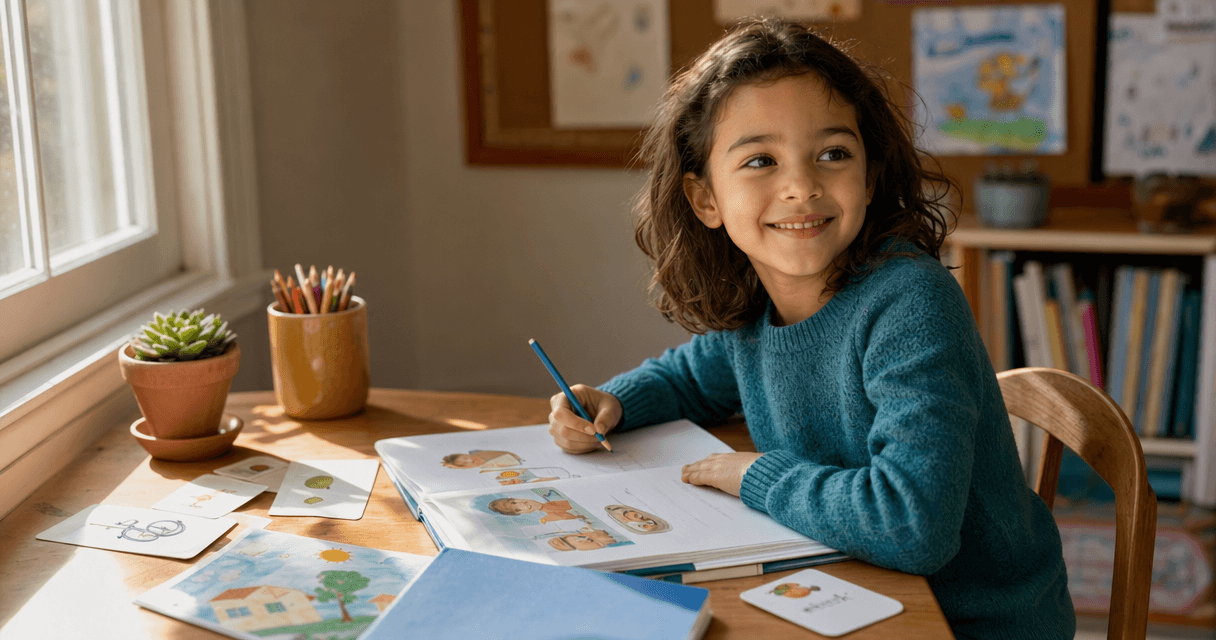
Bilingualism and confidence are deeply connected. When your child learns Spanish alongside English, they develop stronger executive function skills, perform better academically, and build a sense of achievement that fuels confidence across every area of their life. Research shows bilingual children outperform monolingual peers on cognitive tasks and demonstrate greater self-esteem in social settings.
Key takeaways
- Bilingual children develop enhanced executive function skills that improve problem-solving and self-control.
- Learning a second language builds confidence through visible progress and a sense of accomplishment.
- Bilingual kids show stronger social-emotional skills, including better perspective-taking and empathy.
- Academic success in bilingual children reinforces confidence that extends beyond the classroom.
- The earlier your child starts learning Spanish, the more pronounced the cognitive and confidence benefits.
The cognitive foundation of confidence
Your child's confidence starts in their brain. Every time they switch between English and Spanish, they're exercising executive function — the mental skills that control attention, manage emotions, and solve problems. Studies confirm that bilingual children outperform monolingual children on executive function tasks far more often than chance would predict.
This cognitive advantage translates directly to confidence. When your child can focus better, switch between tasks smoothly, and solve problems independently, they feel capable. That feeling of "I can do this" becomes part of how they see themselves.
What executive function looks like in daily life
Executive function isn't abstract. It's your child remembering multi-step instructions without asking twice. It's them calming themselves down after a frustration instead of melting down. It's choosing to finish homework before screen time without a battle.
Research on bilingual toddlers as young as 24 months shows they already outperform monolingual peers on conflict tasks that require selective attention. By school age, these advantages compound. Bilingual children demonstrate better cognitive flexibility, stronger working memory, and improved inhibitory control — all skills that make everyday challenges feel manageable rather than overwhelming.
The achievement loop: progress you can see
Confidence grows when your child sees their own progress. Unlike vague promises of "future benefits," language learning offers immediate, tangible wins. Last month your daughter knew ten Spanish words. This month she's using full sentences. That visible growth builds what researchers call self-efficacy — the belief that effort leads to results.
Fluently bilingual children show high self-esteem and academic success, and the link between the two is reciprocal. Academic success boosts confidence, and confidence fuels the motivation to keep learning. Your child enters a positive feedback loop where each small win makes the next challenge feel achievable.
This is especially powerful for kids who struggle in other areas. A child who finds math hard or feels clumsy in sports can excel at Spanish. That success becomes an anchor — proof that they're capable, that practice works, that they can be good at something.
Social confidence: connecting across worlds
Language is inherently social. When your child learns Spanish, they're not just memorizing vocabulary — they're learning to navigate different cultural contexts, read social cues in two languages, and communicate with a wider circle of people. Bilingual children develop greater empathy and emotional intelligence because they learn to differentiate and express emotions across languages and cultural frameworks.
Building bridges, not walls
Bilingual kids become bridge builders. They can talk to the Spanish-speaking classmate who just moved from Mexico. They can order for the family at a restaurant. They can help a neighbor who's struggling with English. Each of these moments reinforces a powerful identity: "I'm someone who helps. I'm someone who connects."
Research on dual language learners shows they have equal or better social-emotional outcomes compared to native English speakers. They're more collaborative during group projects, show stronger conflict-resolution skills, and demonstrate leadership in peer mediation. These aren't soft skills — they're the foundation of confidence in every social setting your child will navigate.
Academic confidence: the real-world payoff
Bilingual children don't just feel more confident — they perform better. Studies show bilingual students score higher on standardized tests in reading, math, and science. The cognitive flexibility and problem-solving skills they develop through managing two languages transfer directly to academic tasks.
When your child brings home a strong report card, when they're placed in the advanced reading group, when they solve a math problem their peers find hard — that's confidence being built in real time. And because executive function predicts academic success, and academic success predicts long-term well-being, the confidence bilingualism builds compounds over years.
The identity advantage
Confidence isn't just about skills — it's about identity. Bilingual children develop a richer, more complex sense of who they are. They're not just "a kid who speaks Spanish." They're someone who can move between worlds, who carries multiple cultures, who has access to stories and songs and conversations that monolingual peers don't.
Self-confidence with bilingual proficiency has a great effect on children's global, academic, and social self-esteem. When your child feels proud of their bilingualism, that pride becomes part of their core identity. They see themselves as capable, connected, and competent.
Starting early: the confidence window
The earlier your child starts learning Spanish, the more natural the confidence-building process becomes. Young children don't carry the self-consciousness older learners do. They're willing to make mistakes, to sound silly, to try words they're not sure of. That fearlessness accelerates learning, which accelerates visible progress, which accelerates confidence.
Children who participate in multilingual education programs from a young age show improved academic performance in later years, particularly in areas requiring complex cognitive skills. Starting at age five or six means your child builds bilingual confidence during the same developmental window when their core identity is forming. Spanish becomes part of who they are, not something they're struggling to add later.
What this means for your family
You're not choosing between confidence-building activities. You're choosing one that does multiple jobs at once. Spanish classes that your child enjoys become the vehicle for cognitive development, academic success, social connection, and identity formation — all of which feed confidence.
The key is finding an approach your child actually loves. Confidence doesn't come from forced learning or stressful classes. It comes from a teacher who knows your child's name, celebrates their progress, and makes every session feel like a win. When your child looks forward to Spanish class, when they practice at home without being asked, when they proudly show off a new phrase to grandma — that's confidence in action.
If you're ready to give your child the cognitive, social, and emotional advantages that bilingualism offers, Spanish For Us matches your child with a dedicated native-speaking teacher for 1-on-1 classes they'll genuinely enjoy. The confidence starts with the first conversation.
Sources
- Bilingual children outperform monolingual children on executive function tasks far more often than chance: An updated quantitative analysis — ScienceDirect, 2023
- The effects of bilingualism on toddlers' executive functioning — PMC, National Institutes of Health
- Raising Bilingual Children: A Qualitative Study of Parental Attitudes, Beliefs, and Intended Behaviors — PMC, National Institutes of Health
- Social-Emotional Learning in the Context of Language Learning — Language Kids World, 2025
- The social–emotional development of dual language learners — ScienceDirect, 2014
- The Effect of Ethnic Identity and Bilingual Confidence on Chinese Youth's Self-Esteem — ResearchGate, Alberta Journal of Educational Research
- The impact of multilingualism and socio-economic status on academic performance — Taylor & Francis Online, 2024
- Benefits and advantages of early childhood bilingual education — Hiba Academy Bay Area, 2024
- Bilingual education for young children: review of the effects and consequences — PMC, National Institutes of Health
Frequently Asked Questions
What if my child is shy and struggles with confidence already?
1-on-1 classes are ideal for shy kids. Your child gets 100% of the teacher's attention, can't hide in a group, and builds a trusting relationship with the same teacher every week. Many parents tell us their shy children open up in Spanish class in ways they don't elsewhere because the environment feels safe and the progress is immediate.
How long before I see a confidence boost?
Most parents notice changes within the first month. Your child will start using Spanish words at home, showing pride in what they've learned, and looking forward to the next class. The cognitive benefits build over time, but the emotional confidence — the "I can do this" feeling — often appears within weeks.
Can bilingualism help my child who's struggling in other subjects?
Yes. The executive function skills bilingualism builds — focus, problem-solving, task-switching — transfer directly to other academic areas. A child who struggles with math or reading often finds success in Spanish, and that success becomes proof that effort works. The confidence from one area spills into others.
Is it too late to start if my child is already 10 or 11?
It's never too late. While younger children acquire language more naturally, older kids bring motivation and metacognitive awareness that accelerates learning. The confidence benefits are still real — your child will still develop stronger executive function, academic skills, and social-emotional competence. Starting now is better than waiting another year.
What if my child loses interest after a few weeks?
That's usually a sign the teaching method isn't working, not that your child can't learn Spanish. Kids stay engaged when the teacher matches their personality, celebrates small wins, and makes every class feel like play. If your child isn't looking forward to class, the fit isn't right — and that's fixable.
Ready to get your child speaking Spanish?
Book a free 1-on-1 class with a native-speaking teacher. No commitment, no credit card.
Try a Free Class