What Are Effective Techniques for Improving Spanish Vocabulary Retention?
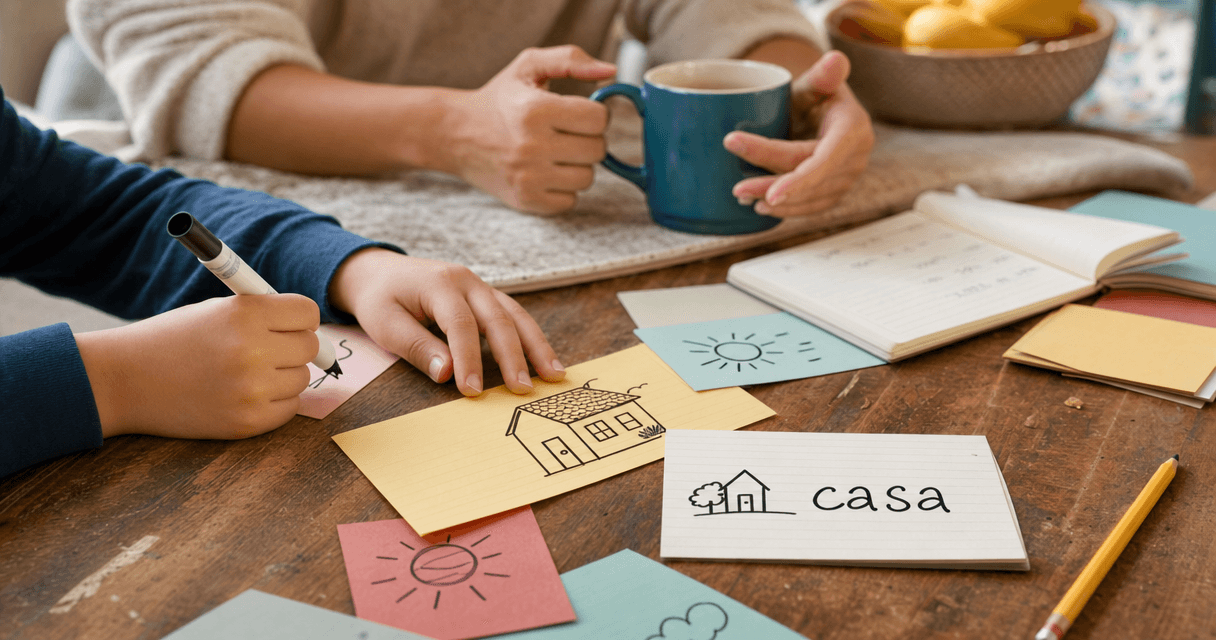
If your child is struggling to remember Spanish vocabulary from week to week, you're not alone. Many children learn words one day and forget them by the next class. The good news: Spanish vocabulary retention isn't about how smart your child is—it's about how they practice. Research-backed techniques can transform frustration into real, lasting progress.
Key takeaways
- Spaced repetition—reviewing words at increasing intervals—dramatically improves long-term retention compared to cramming.
- Active recall (testing yourself) builds stronger memory than passive review like re-reading flashcards.
- Multisensory practice—using sight, sound, touch, and movement together—helps children retain vocabulary more effectively.
- Learning words in meaningful context rather than isolation leads to better understanding and recall.
- Short, frequent practice sessions work better than long, infrequent study marathons.
Why children forget vocabulary (and why it's not their fault)
Your child sits down with a stack of flashcards, reviews them for 20 minutes, and seems to know every word. The next day, half of them are gone. By the following week, they're starting from scratch.
This isn't laziness or a bad memory. It's how human memory works. Research on children's vocabulary retention shows that continuing to retrieve a word across multiple sessions—even after it seems learned—supports long-term retention. The problem is that most study methods stop too soon.
When children review vocabulary by passively reading or re-reading word lists, they create a false sense of mastery. The words feel familiar in the moment, but that recognition doesn't translate to recall when your child needs the word in conversation or on a test.
Use spaced repetition instead of cramming
Spaced repetition is one of the most powerful tools for vocabulary retention, and it's backed by decades of research. Studies show that spacing out repeated encounters with material over time produces superior long-term learning compared with cramming everything together.
Here's how it works: instead of reviewing 20 vocabulary words five times in one sitting, your child reviews them once today, again in two days, then four days later, then a week later. Each successful retrieval strengthens the memory and extends the interval before the next review.
You don't need expensive software to use spaced repetition. A simple system works:
- Day 1: Introduce new words
- Day 2: Quick review (5 minutes)
- Day 4: Second review
- Day 7: Third review
- Day 14: Fourth review
By the fourth review, most words will stick. The ones that don't get cycled back to a shorter interval.
Make it practical at home
Keep a small notebook or use index cards. When your child learns a new Spanish word, write the date on the back. Check the dates each day and pull out the cards that are due for review. Five minutes of spaced practice beats an hour of cramming every time.
Practice active recall, not passive review
Passive review—reading flashcards, highlighting vocabulary lists, or watching your child's teacher explain words—feels productive. It's also nearly useless for long-term retention.
A 2011 study published in Science found that active recall improved retention of foreign language word pairs by 80%, compared to 34% for passive review. Active recall means your child has to produce the answer from memory, not just recognize it.
Here's the difference:
- Passive: Your child sees perro on a flashcard, flips it over, reads "dog," and moves on.
- Active: Your child sees perro, covers the answer, tries to remember "dog," then checks.
That moment of struggle—trying to pull the word from memory—is what builds the neural pathway. Even when your child gets it wrong, the act of trying strengthens future recall.
Three active recall techniques that work
- Blank-page recall: After a lesson, hand your child a blank sheet of paper and ask them to write down every Spanish word they remember. No peeking. Then check together and review only the ones they missed.
- Question-based practice: Instead of showing the Spanish word, give the English prompt: "How do you say 'house' in Spanish?" Your child has to retrieve casa from memory.
- Teach-back method: Ask your child to teach you five new words as if you've never heard them. Explaining forces deeper retrieval than recognition.
Use multisensory practice to engage the whole brain
Children—especially those who struggle in traditional classroom settings—often retain vocabulary better when they can see, hear, touch, and move while learning. Research demonstrates that when vocabulary is introduced through both verbal and visual formats, learners activate multiple memory channels, improving long-term retention.
Multisensory practice doesn't mean complicated activities. It means layering simple sensory experiences:
- Visual: Draw a picture of the word or use a photo
- Auditory: Say the word out loud (correctly pronounced)
- Kinesthetic: Act out the word with a gesture or movement
- Tactile: Write the word in sand, on a whiteboard, or with finger paint
For example, when learning saltar (to jump), your child says the word aloud, jumps three times, and writes it on a whiteboard. That's three memory channels activated at once.
One study found that students using multisensory vocabulary instruction recognized, understood, and used over five times as many words compared to students using traditional methods.
Multisensory ideas for home practice
- Gesture dictionary: Create a specific hand motion for each new word. When reviewing, do the gesture first, then say the word.
- Vocabulary scavenger hunt: Hide word cards around the house. When your child finds one, they have to say it aloud and use it in a sentence.
- Tactile writing: Let your child write new words in shaving cream, rice, or with their finger on your back.
Teach vocabulary in context, not isolation
Flashcards with a Spanish word on one side and an English translation on the other are a staple of language learning. They're also one of the least effective ways to build lasting vocabulary.
Research on meaning-first instruction shows that introducing vocabulary through rich, meaningful contexts leads to much better retention and more accurate use among young learners than isolated word drills. When children learn triste as "the word the character used when her dog ran away," they remember it. When they learn it as "sad = triste" on a flashcard, it evaporates.
Context gives the brain something to attach the word to. It answers the question every child's brain is asking: Why does this word matter?
How to add context at home
- Story-based practice: Read a short Spanish story together (or watch a Spanish video). Pause when you hit a target word and talk about what it means in that moment.
- Sentence creation: Instead of drilling gato = cat, ask your child to make up a sentence: "El gato es negro" (The cat is black).
- Real-life connections: When your child learns cocina (kitchen), practice using it while you're actually in the kitchen. Point and say, "Estamos en la cocina."
Context doesn't have to be elaborate. It just has to be meaningful.
Keep practice sessions short and frequent
Your child's brain isn't built for 45-minute vocabulary drills. Attention spans are short, and fatigue kills retention. The research is clear: short, frequent practice beats long, infrequent sessions.
Five minutes of focused vocabulary practice every day will outperform one 35-minute session per week. The daily repetition builds habit, keeps words fresh, and prevents the forgetting curve from erasing progress.
A simple daily routine
- Morning (2 minutes): Quick review of 5–10 words using active recall
- After school (3 minutes): Introduce 3–5 new words with context and multisensory practice
- Before bed (2 minutes): Blank-page recall—write down as many words as possible from memory
Seven minutes a day. That's it. Consistency matters more than duration.
When school Spanish isn't enough
If your child is falling behind in school Spanish, these techniques can help at home. But sometimes the gap is too wide, or the classroom pace is too fast, or your child needs someone who can meet them where they are and build confidence one word at a time.
That's where a dedicated teacher makes the difference. At Spanish For Us, every child gets 1-on-1 attention from a native-speaking teacher who knows how to make vocabulary stick—using the same research-backed techniques we've covered here, tailored to your child's learning style. No group class where shy kids disappear. No app that gets abandoned after a week. Just real progress, real confidence, and a teacher your child looks forward to seeing. Book a free class and see the difference personalized attention makes.
Sources
- Fostering effective vocabulary retention among primary school students: a case study — PMC, 2025
- Fostering retention of word learning: The number of training sessions children retrieve words positively relates to post-training retention — PMC, 2024
- Spaced Repetition Promotes Efficient and Effective Learning — Policy Implications for Instruction, Sean H. K. Kang, 2016
- How to use Active Recall in Language Learning — Thinking Italian, 2024
- IMPROVING VOCABULARY ACQUISITION WITH MULTISENSORY INSTRUCTION — ERIC, 2007
Frequently Asked Questions
How many times does my child need to review a word before it sticks?
Research shows that most children need 4–7 spaced encounters with a word to retain it long-term. The key is spacing those reviews over days and weeks, not cramming them into one session. Each successful retrieval strengthens the memory and extends how long your child will remember it.
What if my child hates flashcards?
Flashcards are just one tool, and they're not for everyone. Try multisensory alternatives: act out words with gestures, create a vocabulary scavenger hunt around the house, or use the blank-page recall method where your child writes down everything they remember. The goal is active recall—pulling words from memory—and there are many ways to do that without traditional flashcards.
Should I correct my child's mistakes immediately during practice?
Let your child struggle for a few seconds before stepping in. That moment of effort—even if they get it wrong—strengthens the memory pathway. After they've tried, give the correct answer and have them repeat it aloud. The combination of retrieval attempt plus correction is more powerful than immediate correction alone.
How do I know if my child is actually retaining vocabulary or just memorizing for the moment?
Test retention after a delay. If your child can recall a word correctly one day, then again three days later, and again a week later, it's moving into long-term memory. If they know it during practice but forget it by the next day, they're relying on short-term recognition, not true retention. Spaced repetition is the fix.
Ready to get your child speaking Spanish?
Book a free 1-on-1 class with a native-speaking teacher. No commitment, no credit card.
Try a Free Class