How to Help Your Child Overcome Language Anxiety in Spanish Class
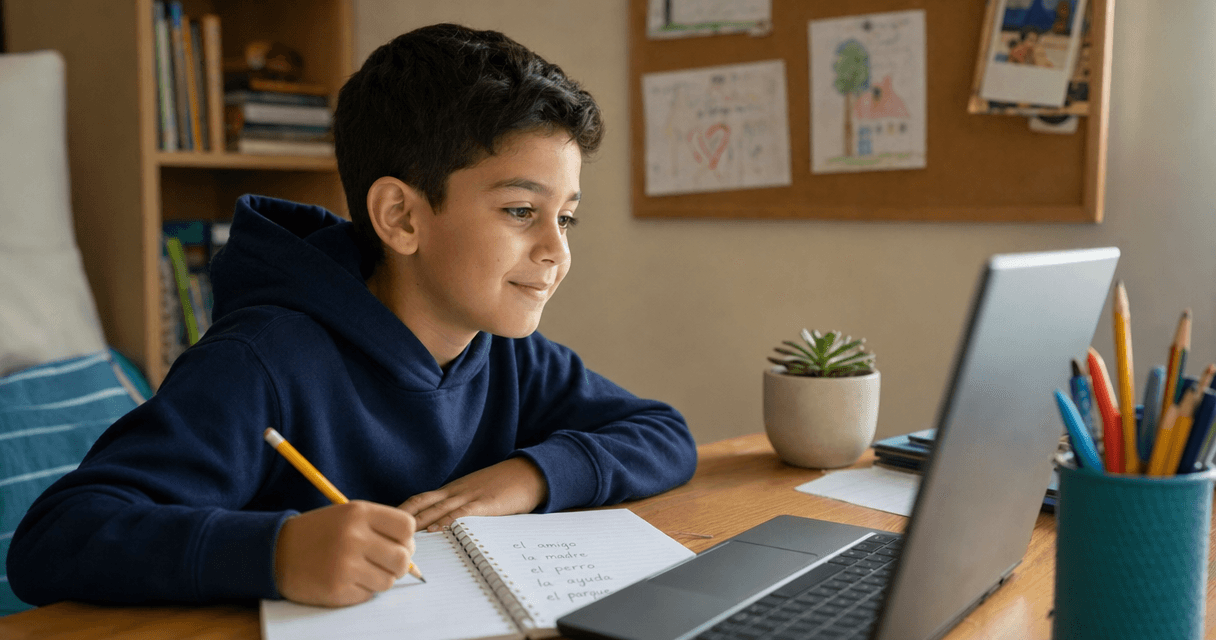
Language anxiety affects your child's ability to learn Spanish and can turn every class into a source of stress. Research shows at least a quarter of young language learners experience above-average anxiety, particularly when being called on to speak or feeling that other students perform better. When your child struggles with Spanish at school and starts shutting down, addressing that anxiety becomes the first step toward real progress.
Key takeaways
- Language anxiety is common and affects up to 40% of language learners, but it can be overcome with the right support.
- Children feel most anxious when comparing themselves to peers or being called on to speak in front of others.
- One-on-one instruction eliminates peer comparison and creates a safe space where your child can practice without judgment.
- Building confidence through small wins and patient teaching helps break the cycle of anxiety and avoidance.
- The right teacher relationship transforms Spanish from a source of stress into something your child looks forward to.
What language anxiety looks like in your child
Your child might not say "I have language anxiety." Instead, you hear "I don't want to go to Spanish class" or "I'm not good at Spanish." If language anxiety isn't recognized or addressed early, it can have detrimental effects not only on language acquisition but also on a child's overall psychosocial well-being.
Watch for these signs:
- Avoiding Spanish homework or making excuses not to practice
- Freezing up when asked to speak Spanish, even though they know the words
- Complaining of stomachaches or headaches before Spanish class
- Saying they're "bad" at Spanish despite putting in effort
- Refusing to participate in speaking activities at school
These behaviors aren't defiance or laziness. They're your child's way of protecting themselves from a situation that feels threatening.
Why Spanish class triggers anxiety
Students are most likely to feel anxious due to worry over inadequate language performance and fear of being evaluated negatively by others. In a typical classroom, your child sits with 20 or 30 other students. When the teacher calls on them, everyone is listening. One mistake feels public.
The comparison trap
Your child notices which classmates answer quickly and correctly. They notice who gets praised. When they stumble over a word or forget how to conjugate a verb, they assume everyone thinks they're slow or stupid.
That comparison happens even when other kids aren't judging them. The anxiety comes from inside.
The pressure to perform
Group classes move at one pace. If your child needs an extra moment to process a question or recall a word, the class has already moved on. They fall behind, which increases the anxiety, which makes it even harder to keep up.
Research indicates teachers often observe learners struggling with physical signs of anxiety such as tense muscles, trembling, and dry throat. Your child's body is reacting to the stress before they even open their mouth.
How one-on-one classes change everything
One-on-one settings provide a safe space for children who feel anxious about speaking up. When your child is the only student in the room, the entire dynamic shifts.
There's no one to compare themselves to. No one watching them struggle. No pressure to keep up with faster learners or worry about slowing down the class.
A teacher who waits
In a 1-on-1 class, the teacher can pause. They can give your child time to think, to search for the word, to try again without rushing. That patience alone reduces anxiety.
Your child learns they don't have to be perfect. They learn that making mistakes is part of the process, not a public failure.
Progress they can see
When your child has the same teacher every week, that teacher knows exactly where they started and how far they've come. They celebrate the small wins your child might not even notice themselves.
That recognition builds confidence. Confidence reduces anxiety. And reduced anxiety makes learning Spanish feel possible again.
Practical strategies you can use at home
You don't need to speak Spanish fluently to help your child manage language anxiety. What matters is how you talk about the struggle.
Normalize mistakes
Tell your child about a time you made a mistake learning something new. Make it specific and a little embarrassing. Show them that mistakes don't mean failure—they mean you're trying.
When your child makes a mistake in Spanish, respond with curiosity, not correction. "Oh, interesting! What were you trying to say?" feels different than "No, that's wrong."
Celebrate effort, not perfection
Notice when your child tries, even if the outcome isn't perfect. "You kept going even though that was hard" matters more than "You got it right."
Anxious children are often perfectionists. They need permission to be imperfect.
Ask what would help
It's important to ask your child why they're nervous—their answer will tell you the best way to prepare them. Sometimes they need more practice. Sometimes they need reassurance. Sometimes they just need you to listen.
Don't assume you know what's wrong. Ask.
Why the teacher relationship matters most
The right teacher doesn't just teach Spanish. They teach your child that they're capable of learning Spanish. That distinction is everything.
A teacher who is patient, who makes class feel like play instead of a test, who remembers what your child is interested in and weaves it into lessons—that teacher changes how your child feels about Spanish.
Your child stops dreading class. They start looking forward to it. And when they look forward to it, they practice more. They try harder. They make progress.
That's not magic. That's what happens when anxiety is removed from the equation.
Moving forward
Language anxiety doesn't disappear overnight. But it does fade when your child experiences success in a setting where they feel safe. Every class where they speak without freezing, every sentence they complete without panicking, every mistake they make and recover from—those moments retrain their brain.
Spanish stops being the thing they're bad at. It becomes the thing they're getting better at. And that shift changes everything.
If your child is struggling with language anxiety, the most important step is finding a learning environment that removes the triggers. At Spanish For Us, we match your child with a dedicated native-speaking teacher for 1-on-1 classes where they can practice, make mistakes, and build confidence without the pressure of a classroom audience.
Sources
- Learner Differences among Children Learning a Foreign Language — English Language Teaching, 2014
- Book Review: Young Children's Foreign Language Anxiety — Frontiers in Psychology, 2021
- Managing your child's foreign language anxiety for test-taking — Michigan State University Extension, 2023
- 5 Playful Strategies That Reduce Language Learning Anxiety — Edutopia, 2023
- Coaching Tips For Struggling Learners In One-on-One Vs Small Group Settings — K12 Tutoring, 2026
Frequently Asked Questions
What if my child refuses to speak Spanish at all during class?
Start by removing the pressure to speak. A skilled teacher will use games, songs, and activities that let your child respond non-verbally at first—pointing, drawing, or nodding. As your child feels safer, they'll naturally begin to use words. Forcing speech too early reinforces the anxiety.
How long does it take for language anxiety to improve?
Most children show noticeable improvement within 4-6 weeks of consistent, low-pressure practice. The key is regular exposure in a safe environment where mistakes are normalized. Progress isn't linear—some weeks will feel like breakthroughs, others like setbacks—but the overall trend moves toward confidence.
Should I tell my child's Spanish teacher about their anxiety?
Yes. A good teacher will adjust their approach when they know a child is anxious—giving more wait time, reducing public speaking demands, and offering private encouragement. If the school teacher can't accommodate these needs, that's a sign your child may benefit from supplemental 1-on-1 instruction outside of school.
Can language anxiety affect other subjects too?
Absolutely. When a child experiences repeated stress and failure in one subject, they can develop a broader fear of academic challenges. Addressing language anxiety early protects their overall confidence and willingness to take risks in learning. Success in Spanish can actually boost their mindset in other areas.
Is it better to push through the anxiety or take a break from Spanish?
Neither extreme works well. Pushing through in a high-anxiety environment reinforces the fear. But taking a complete break means losing momentum and falling further behind. The solution is changing the environment—move to a setting where your child can practice Spanish without the triggers that caused the anxiety in the first place.
Ready to get your child speaking Spanish?
Book a free 1-on-1 class with a native-speaking teacher. No commitment, no credit card.
Try a Free Class