How Can Parents Encourage Their Kids to Speak Spanish at Home?
Your child can speak Spanish at home—and it starts with making Spanish feel like a natural, joyful part of daily life rather than a chore. Research shows that heritage language maintenance strengthens family bonds and helps children stay connected to their cultural roots. The key is consistency, patience, and finding what works for your family.
Key takeaways
- Create specific times or places for Spanish to give your child clear, predictable language routines.
- Code-switching between Spanish and English is completely normal and a sign of bilingual competence, not confusion.
- Celebrate small wins—every new word or phrase your child uses in Spanish is progress worth acknowledging.
- Involve extended family, especially grandparents, who provide authentic motivation for your child to practice.
- Make Spanish feel rewarding by connecting it to things your child already loves: favorite foods, games, bedtime stories.
Start with a family language strategy
The first step is deciding when and where Spanish happens in your home. Popular family language strategies include One Parent One Language (OPOL), Minority Language at Home, and Time and Place approaches, and each works differently depending on your family's dynamics.
If you're bilingual and your partner isn't, you might speak only Spanish with your child while your partner uses English. If both of you speak Spanish, you can designate Spanish as the home language and let your child hear English at school and in the community. If neither of you is fluent, you can still create Spanish moments—during dinner, at bedtime, or on weekend mornings—and stick to them.
The strategy matters less than the consistency. Your child needs to know when Spanish is expected so it becomes part of the rhythm of the day.
Make it time-and-place specific
The Time and Place strategy designates specific contexts for speaking the target language, like using Spanish during meals, bedtime routines, or weekend mornings. This gives your child a clear framework: "We speak Spanish at the dinner table" or "Saturday mornings are Spanish mornings."
Start small. Pick one daily routine—breakfast, the car ride to school, or the bedtime wind-down—and commit to making it a Spanish-only zone. Once that feels natural, add another.
Embrace code-switching (yes, really)
If your child mixes Spanish and English mid-sentence, don't panic. Code-switching is completely normal and a natural part of bilingual development. It doesn't mean your child is confused or failing to learn. It means your child recognizes your home as a bilingual space and is drawing on both languages to communicate.
Research confirms that code-switching is a systematic and complex linguistic skill, not a sign of language deficiency. Your child will code-switch less in environments where only Spanish is spoken—like with abuela or during a Spanish class—but at home, where both languages coexist, mixing is expected.
You can gently encourage more Spanish by responding in Spanish when your child uses English. If your child says, "Mamá, I want agua," you can reply, "¿Quieres agua? Aquí está." You're modeling the full sentence without correcting or shaming.
Connect Spanish to people your child loves
Grandparents play a central role in heritage language maintenance, and children are far more motivated to speak Spanish when they know it helps them talk to abuela, tía, or cousins who live far away.
Schedule regular video calls with Spanish-speaking relatives. Let your child show off a new toy, tell a story, or sing a song. The goal is for your child to experience Spanish as a bridge to the people they care about—not as a school subject.
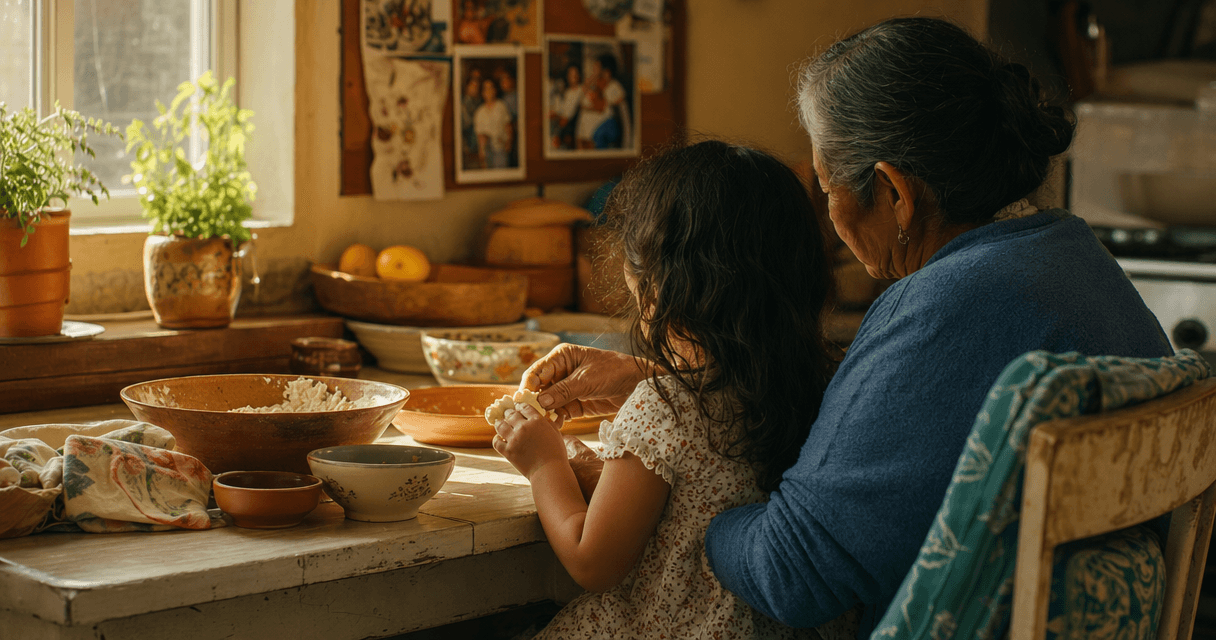
If your extended family lives nearby, create opportunities for your child to spend time with them in Spanish-only settings. A Saturday morning with abuela in the kitchen, helping make empanadas, is worth hours of flashcards.
Make Spanish feel like a reward, not a rule
Your child will resist Spanish if it feels like homework. But if Spanish is connected to things your child already loves—favorite snacks, special games, silly songs—it becomes something to look forward to.
Let your child pick the Spanish cartoon. Play their favorite song in Spanish on repeat. Read a bedtime story in Spanish and let them choose the book. When Spanish is tied to comfort, fun, and closeness with you, your child will want more of it.
Celebrate the small wins. When your child uses a new word or answers a question in Spanish, make a big deal out of it. "¡Lo hiciste! You said that all in Spanish!" That pride—and your reaction—will stick.
Be patient with the silent period
Some children go through a phase where they understand Spanish but refuse to speak it. This is normal, especially if English feels easier or more dominant in their world. Research on bilingual children shows that comprehension develops before production, and pushing too hard can backfire.
Keep speaking Spanish. Keep reading, singing, playing. Your child is absorbing more than you realize. One day, often when you least expect it, the words will come.
Get help when you need it
If you're doing everything right and your child still isn't speaking Spanish, it might be time to bring in a teacher. A weekly 1-on-1 class with a native-speaking teacher who knows how to make Spanish fun can be the missing piece. Your child gets dedicated practice, you get support, and Spanish stops feeling like a battle at home.
Your child doesn't need perfection. Your child needs consistency, encouragement, and the belief that speaking Spanish matters—because it connects them to you, to their family, and to a part of who they are. Start small, stay patient, and celebrate every step. If you're ready to add structured support, Spanish For Us offers 1-on-1 classes with teachers kids actually love.
Sources
- Heritage language maintenance and family relationship dynamics — McGill eScholarship
- How do parents think about multilingual upbringing? Comparing OPOL parents and parents who mix languages — Taylor & Francis Online
- How to Raise a Bilingual Child with the Time and Place Method — Language Learning At Home, 2021
- Code-switching in bilingual children — Bilingual Babies, 2019
- Code-switching in parents' everyday speech to bilingual infants — PMC
- Resilient heritage language maintenance: the interplay of family, culture, and pragmatic choices — PMC
- To Speak or Not To Speak My Language: Supporting Families' Home Language Practices — NAEYC
Frequently Asked Questions
What if my child only answers me in English even when I speak Spanish?
This is one of the most common challenges in bilingual homes. Keep speaking Spanish to your child—they're still absorbing it even if they respond in English. Gently recast their English responses into Spanish without making it feel like a correction. Over time, as their confidence grows and they see Spanish as useful (especially with relatives or in a class they enjoy), they'll start using it more.
How much Spanish exposure does my child need each day?
Quality matters more than quantity. Even 30 minutes of focused, engaging Spanish time each day—through conversation, play, reading, or a class—can make a real difference. The key is consistency. Daily exposure, even in small doses, builds momentum far better than occasional long sessions.
Should I correct my child's Spanish mistakes?
Avoid direct corrections, which can make your child self-conscious and less willing to try. Instead, model the correct form naturally in your response. If your child says "Yo quiero el rojo uno," you can reply, "Ah, ¿quieres el rojo? Aquí está." Your child hears the right way without feeling criticized.
What if I'm not fluent in Spanish myself?
You don't need to be fluent to support your child's Spanish learning. Use the Spanish you do know during specific routines, lean on Spanish-speaking relatives, and bring in a teacher for structured practice. Many successful bilingual families include a non-fluent parent—what matters most is creating opportunities for your child to hear and use Spanish regularly.
My child used to speak Spanish but has stopped—what happened?
Language regression is common when children start school or spend more time in English-dominant environments. It doesn't mean the Spanish is lost—it's still there. Ramp up Spanish exposure at home, reconnect your child with Spanish-speaking relatives, and consider adding a weekly class to rebuild confidence and momentum.
Ready to get your child speaking Spanish?
Book a free 1-on-1 class with a native-speaking teacher. No commitment, no credit card.
Try a Free Class