How to Measure Progress in Spanish Learning: Milestones for Ages 5-12
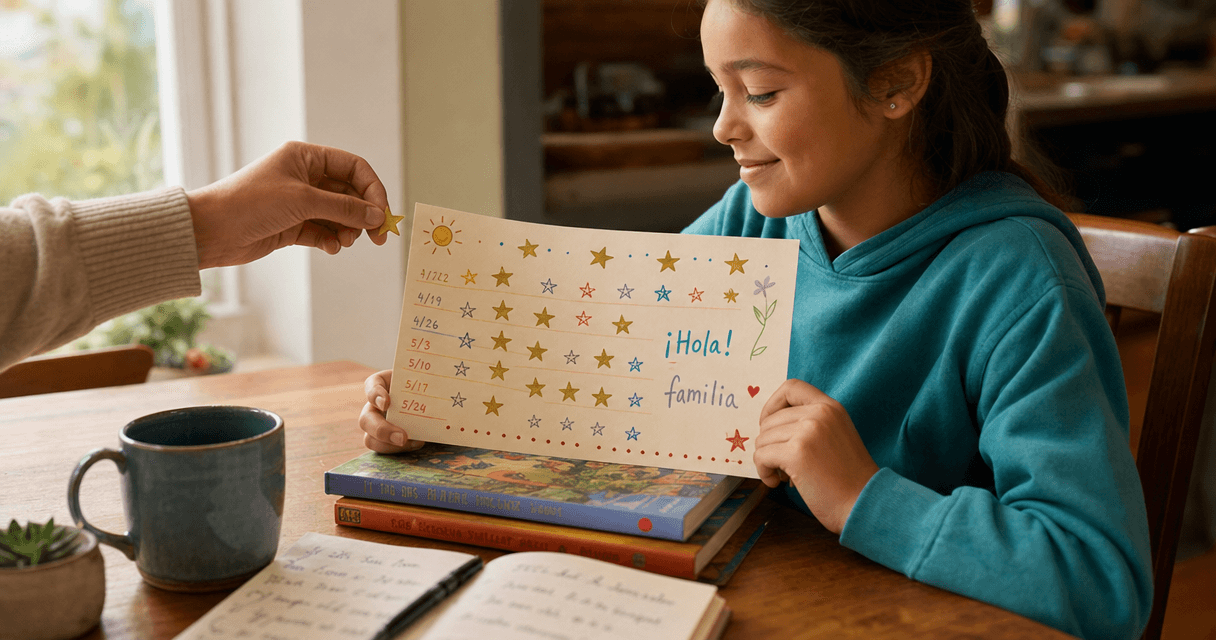
Your child can measure progress in Spanish learning through clear, observable milestones in Spanish learning that go far beyond test scores. The first 3 years of life are critical for language acquisition, but children ages 5-12 remain in an optimal window where they can develop native-like pronunciation and conversational fluency. Tracking the right indicators helps you celebrate real growth and know when your child is truly advancing.
Key takeaways
- Receptive skills develop before expressive skills in second language learning.
- Vocabulary size matters less than how your child uses words in context.
- Conversational confidence is the clearest sign of meaningful progress.
- Bilingual children may lag 6 months in single-language measures but develop normally overall.
- Weekly 1-on-1 instruction produces visible gains within 8-12 weeks.
Understanding the two types of language skills
Your child develops two distinct skill sets when learning Spanish: receptive and expressive language.
Receptive language is what your child understands. This includes following directions in Spanish, recognizing vocabulary when they hear it, and comprehending stories or conversations. Receptive language skills develop before expressive abilities in both first and second language acquisition.
Expressive language is what your child can produce. This covers speaking, forming sentences, asking questions, and using Spanish independently. In second language learning, children typically understand far more than they can say, especially in the first 6-12 months.
The gap between these two skills is normal and expected. Your child might understand 200 Spanish words but actively use only 50. That gap narrows over time with consistent practice.
Why receptive skills come first
Your child's brain needs to hear and process a word dozens of times before it becomes available for active use. Think of receptive vocabulary as the foundation. Once your child can reliably understand a word in multiple contexts, their brain begins to recruit it for speaking.
This is why a child in their first few months of Spanish class may seem quiet during lessons but suddenly starts using phrases at home. The input was building silently.
Milestones for ages 5-7
Children in this age range are just beginning formal language instruction. Progress looks different than it will at age 10.
Months 1-3:
- Responds to simple Spanish commands ("siéntate," "levántate")
- Recognizes 20-30 high-frequency words by sound
- Uses single words or short phrases ("sí," "no," "más")
- Shows excitement or engagement during Spanish activities
Months 4-8:
- Follows two-step directions in Spanish without translation
- Uses 2-3 word combinations ("quiero agua," "mi libro")
- Asks simple questions ("¿Qué es esto?")
- Begins to self-correct pronunciation when modeling is provided
Months 9-12:
- Holds brief conversations with teacher using memorized phrases and some original sentences
- Vocabulary of 100-150 words across multiple categories (food, family, colors, animals)
- Uses present tense verbs with some accuracy
- Initiates Spanish use at home in specific contexts (counting, naming objects)
Younger children in this range may progress more slowly in expressive output but often develop better accent and intonation than older learners.
Milestones for ages 8-10
Children in this range can handle more complex grammar and longer conversational exchanges.
Months 1-3:
- Understands short stories or instructions without visual support
- Produces 3-5 word sentences consistently
- Vocabulary of 50-75 words
- Asks clarifying questions in Spanish ("¿Cómo se dice...?")
Months 4-8:
- Describes past events using simple past tense
- Vocabulary of 200-300 words
- Engages in back-and-forth conversation for 3-4 exchanges
- Uses Spanish to express preferences, opinions, and emotions
Months 9-12:
- Tells a story or recounts an event with a clear beginning, middle, and end
- Uses multiple verb tenses with increasing accuracy
- Vocabulary of 400-500 words
- Reads simple texts and understands main ideas
- Writes short sentences or paragraphs
At this age, research on bilingual Spanish-English children shows they may lag 6 months to 1 year behind monolingual children in single-language vocabulary measures, but this does not indicate delay when total language ability across both languages is considered.
Milestones for ages 11-12
Pre-teens can achieve conversational fluency and begin using Spanish for academic or creative tasks.
Months 1-3:
- Understands teacher instruction delivered entirely in Spanish
- Produces complex sentences with subordinate clauses
- Vocabulary of 100-150 words
- Discusses abstract topics (feelings, hypotheticals, plans)
Months 4-8:
- Engages in spontaneous conversation without relying on memorized scripts
- Uses subjunctive mood in common expressions
- Vocabulary of 500-700 words
- Reads age-appropriate chapter books or articles
Months 9-12:
- Holds 10+ minute conversations on familiar and unfamiliar topics
- Writes multi-paragraph essays or creative stories
- Vocabulary of 800-1,000+ words
- Self-corrects errors without prompting
- Uses Spanish outside of class (texting, watching shows, talking to family)
Children at this age benefit from exposure to native speakers and authentic materials (music, videos, books) to continue progressing beyond classroom vocabulary.
What progress actually looks like at home
Grades and test scores measure only a narrow slice of language ability. Real progress shows up in daily life.
Your child starts using Spanish words without being prompted. They count in Spanish while playing. They ask you how to say something in Spanish. They laugh at a joke their teacher made in Spanish.
You overhear them talking to themselves in Spanish during pretend play. They correct your pronunciation. They want to watch a show in Spanish or pick a Spanish book at the library.
These moments matter more than a vocabulary quiz. They signal that Spanish is becoming part of how your child thinks and interacts with the world.
Conversational confidence is the goal
A child who can recite 500 vocabulary words but freezes when asked a question in Spanish has not made meaningful progress. A child who can hold a 3-minute conversation with 200 words and some grammatical errors has.
Longitudinal studies of Spanish-English bilingual children show that expressive language skills (speaking and using language actively) are the strongest predictor of continued growth. Input alone is not enough. Your child needs regular opportunities to produce language with a responsive partner.
This is why 1-on-1 classes with a dedicated teacher produce faster gains than group classes or apps. Your child speaks more, receives immediate feedback, and builds confidence through successful communication.
How to track progress week to week
You don't need formal assessments to know if your child is advancing. Simple observation tells you everything.
Keep a milestone journal. Documenting achievements, even small ones, helps you notice patterns. Write down new phrases your child uses, topics they can discuss, or moments they chose Spanish over English.
Record short videos monthly. Ask your child the same 3-4 questions in Spanish every month ("¿Cómo estás?" "¿Qué hiciste hoy?" "¿Cuál es tu comida favorita?"). Watching these back over 6 months makes progress undeniable.
Ask the teacher specific questions. Instead of "How is my child doing?" ask "What can my child do now that they couldn't do a month ago?" or "What's one skill we're working toward next?" Teachers who know your child well can name concrete gains.
Notice when Spanish becomes automatic. The shift from effortful recall to automatic use is a major milestone. Your child stops translating in their head and starts thinking in Spanish, even briefly.
When progress stalls
Every child hits plateaus. Progress is not linear.
A plateau often means your child is consolidating skills before the next leap. They may seem stuck at the same level for 4-6 weeks, then suddenly produce longer sentences or use a new verb tense.
If progress has genuinely stalled for 2-3 months, three factors are usually at play: inconsistent attendance, lack of speaking opportunities, or a mismatch between instruction level and your child's readiness.
Weekly classes produce better results than twice-monthly. Your child's brain needs regular, repeated exposure to retain new language. Missing classes disrupts the rhythm.
If your child is shy or anxious, they may understand far more than they demonstrate. A patient teacher who creates low-pressure opportunities to speak will draw them out over time.
Why the right teacher changes everything
Language learning is relational. Your child's progress depends as much on the teacher as the curriculum.
A teacher who knows your child's interests can tailor lessons to topics that motivate them. A teacher who tracks exactly where your child is in their learning can scaffold the next skill at the right moment. A teacher your child trusts will take risks, make mistakes, and keep trying.
Studies on bilingual phonological acquisition show that children learning Spanish and English simultaneously develop at rates similar to monolingual peers when instruction is consistent and responsive. The quality of interaction matters more than the quantity of input.
This is the foundation of how Spanish For Us works. Your child gets the same native-speaking teacher every week, someone who knows their name, their progress, and exactly what they're ready to learn next. That relationship is what turns milestones from abstract benchmarks into real, celebrated moments.
Sources
- Speech and Language Developmental Milestones — National Institute on Deafness and Other Communication Disorders
- The 6 Most Productive Receptive Language Activities — Bilinguistics, 2025
- Language Growth in English Monolingual and Spanish-English Bilingual Children from 2.5 to 5 Years — NIH, 2017
- Phonological acquisition in bilingual Spanish-English speaking children — PubMed, 2010
- Tracking and Celebrating Developmental Milestones: A Guide to Nurturing Growth — LBU Community Clinic, 2025
Frequently Asked Questions
How long does it take to see progress in a child learning Spanish?
Most children show visible progress within 8-12 weeks of consistent weekly instruction. Early gains include responding to simple commands and using memorized phrases. Conversational fluency typically develops over 12-24 months with regular practice.
Is it normal for my child to understand Spanish but not speak it yet?
Yes, this is completely normal and expected. Receptive language (understanding) always develops before expressive language (speaking) in second language learners. The gap can last several months, especially in younger children or those who are shy.
What if my child is progressing slower than other kids their age?
Every child learns at their own pace. Age is less important than consistency and engagement. A 7-year-old with weekly classes for 6 months will often outpace a 10-year-old with sporadic instruction. Focus on your child's growth compared to their own starting point, not other children.
How can I support my child's Spanish progress if I don't speak the language?
You don't need to speak Spanish to support your child. Celebrate when they use new words, ask them to teach you phrases, play Spanish music or shows at home, and maintain a consistent class schedule. Your enthusiasm matters more than your fluency.
Should I worry if my child makes grammatical mistakes in Spanish?
No. Mistakes are a sign of learning, not failure. Children overgeneralize rules as they internalize grammar patterns—saying "yo sabo" instead of "yo sé" shows they understand how regular verbs work. Gentle modeling (repeating the correct form without criticism) is the best response.
Ready to get your child speaking Spanish?
Book a free 1-on-1 class with a native-speaking teacher. No commitment, no credit card.
Try a Free Class