How Can Music Enhance Your Child's Spanish Learning Experience?
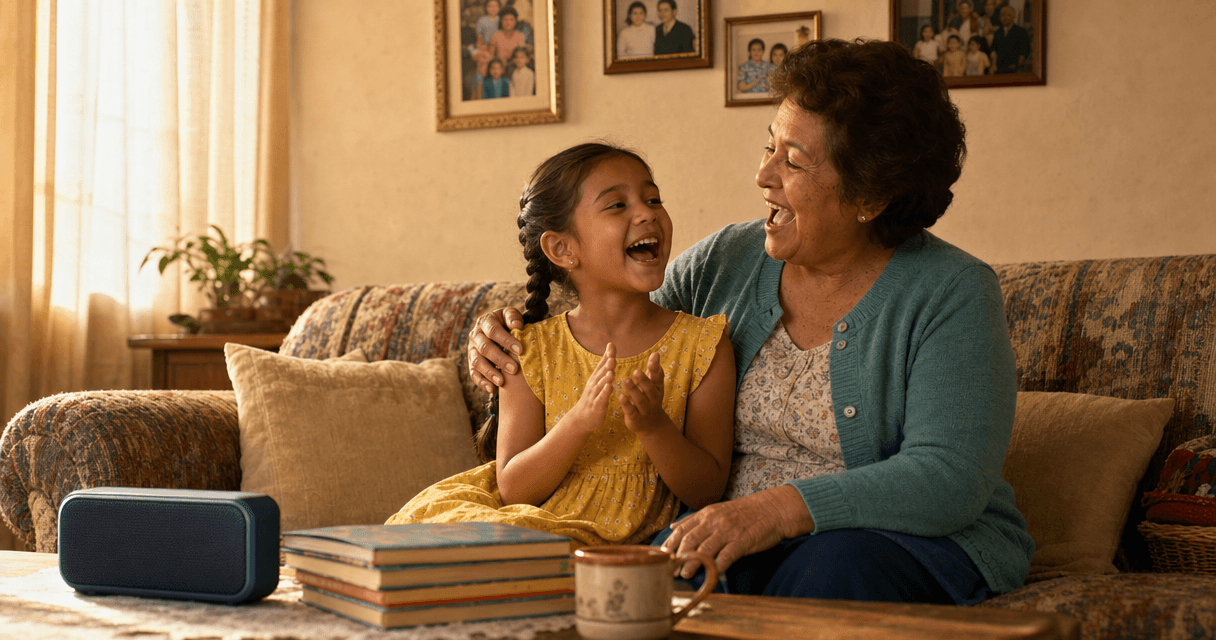
Music makes Spanish stick. Research shows that children who engage with music develop stronger memory, attention, and language skills, and when music is paired with language learning, those benefits multiply. Songs give your child repetition, rhythm, and emotion — three ingredients that turn fleeting words into lasting vocabulary and cultural connection.
Key takeaways
- Songs help children remember Spanish vocabulary longer because rhythm and melody strengthen memory pathways in the brain.
- Music lowers anxiety around speaking a new language, making your child more willing to practice out loud.
- Traditional Spanish songs connect your child to their heritage and give them a shared experience with Spanish-speaking family.
- Repetition in songs reinforces pronunciation and sentence patterns without feeling like drill work.
- Singing together at home turns language learning into a joyful family ritual your child will look forward to.
Why music works where other methods don't
Your child can sing the alphabet before they can recite it. They remember commercial jingles from years ago. That's not luck — that's how the brain processes music. A 2018 MIT study found that piano lessons improved kindergartners' ability to distinguish different pitches, which translated into better word discrimination, particularly for consonants. The same neural pathways that process melody also handle the rhythmic and tonal patterns of language.
When your child hears a Spanish song, their brain is doing double duty. They're tracking the beat, anticipating the rhyme, and absorbing new words — all at once. A 2023 National Institutes of Health review concluded that musical properties such as rhythm and melody affect language acquisition, including grammar and phonological awareness. Songs package language in a way that feels effortless, even when the learning happening underneath is profound.
For parents teaching their kids Spanish, this matters in a specific way. Your child hears English all day at school. Spanish can feel like work if it's only worksheets or forced conversation. But a song? A song is something they want to repeat.
Songs build vocabulary that sticks
Repetition is the engine of language learning, but most children resist it. Ask your child to say "buenos días" ten times and you'll get eye rolls. Play "Buenos Días" by José-Luis Orozco and they'll sing it without being asked.
Musical rhythm and repetition help children solidify new vocabulary and promote comprehension as they connect meaning through context. Each time your child sings "los colores" or "uno, dos, tres," they're not just memorizing — they're building the neural scaffolding that makes retrieval automatic. The melody acts as a retrieval cue, so when your child needs the word for "blue" later, the tune brings it back.
Songs also introduce vocabulary in clusters. A single song about family might teach "abuela," "tío," "hermana," and "papá" all in one go, embedded in a story or scene your child can picture. That's more efficient and more memorable than isolated flashcards.
Songs you can start with today
You don't need to hunt for obscure recordings. Start with songs you or your own parents sang. Here are a few classics that work across age ranges:
- "De Colores" — teaches colors and nature words, beloved across Latin America
- "Los Pollitos Dicen" — animal sounds, family care, simple present tense
- "Cabeza, Hombros, Rodillas y Pies" — body parts with movement, great for toddlers and early elementary
- "La Araña Pequeñita" — repetition, weather vocabulary, and a tune most kids already know in English
Play them during breakfast, in the car, or while your child is drawing. The goal is exposure, not performance.
Music lowers the fear of speaking
Research on language acquisition shows that music lowers the affective filter, the invisible barrier of anxiety that stops children from trying new words out loud. Singing feels safer than speaking. Your child isn't worried about making a mistake when they're singing along to a song — they're just following the melody.
That safety matters. Many heritage kids understand Spanish but won't speak it because they're afraid of sounding wrong or being corrected. Songs give them a low-stakes entry point. They can mumble the first few times, then sing louder as they gain confidence. No one is grading them. No one is waiting for them to answer. They're just part of the music.
Over time, that confidence transfers. A child who sings "¿Cómo estás?" a hundred times in a song will eventually say it to abuela without thinking twice.
Songs are culture, not just curriculum
When your child learns "Cielito Lindo" or "La Bamba," they're not just learning words. They're learning what it feels like to be part of a tradition that stretches back generations. Music serves as a tool for education, allowing younger generations to learn about their cultural heritage and traditions, and for immigrant families, songs often carry the emotional and historical weight of home.
Your child may not be able to name the region a song comes from or explain its history yet — but they'll recognize it when abuela hums it in the kitchen. They'll feel the pull of familiarity when they hear it at a family party. Research across immigrant communities shows that children who maintain heritage language skills feel more connected to their cultural identity and community, and music is one of the most accessible ways to sustain that connection.
Songs also give your child something to share. When they sing a Spanish song they learned at home, they're not just showing off vocabulary — they're claiming a piece of their identity out loud.
How to make music part of your routine
You don't need to be musical. You don't need perfect pitch or a playlist curated by a linguist. You just need consistency and a willingness to let music become part of the background hum of your home.
Make a family playlist
Pick 10–15 songs your child enjoys and put them on repeat. Spotify, YouTube, and Apple Music all have ready-made playlists for Spanish kids' music. Start there, then swap in songs that feel personal to your family — the ones your mom sang, the ones that played at every birthday, the ones tied to a specific memory.
Sing during transitions
Car rides, getting dressed, cleaning up toys — these are all moments when a song can turn a mundane task into a language lesson. Your child doesn't need to sit still and focus. They just need to hear the words over and over until they start singing along.
Let them lead
If your child latches onto one song and wants to hear it twenty times in a row, let them. Repetition is the point. Their brain is working even when it looks like they're just goofing around.
Pair songs with movement
Songs with gestures — clapping, jumping, pointing to body parts — help cement vocabulary through physical memory. "Cabeza, Hombros, Rodillas y Pies" isn't just a song. It's a full-body Spanish lesson.
Music and teachers work best together
Songs at home are powerful, but they work even better when paired with a teacher who can build on what your child is absorbing. A native-speaking teacher will hear when your child starts using phrases from songs in conversation, and they'll know how to expand that into full sentences, correct pronunciation gently, and celebrate progress.
At Spanish For Us, every teacher understands that music is part of the cultural fabric of Spanish. They weave songs into lessons naturally — not as a gimmick, but as a bridge between what your child hears at home and what they're learning to say out loud. When your child sings "buenos días" in class and the teacher sings it back, that's not just vocabulary practice. That's belonging.
If you've been playing Spanish music at home and wondering whether your child is ready for real conversation practice, try a free 1-on-1 class. You'll see how quickly a teacher can turn those memorized lyrics into confident speech.
Sources
- How musical training affects cognitive development: rhythm, reward and other modulating variables — Frontiers in Neuroscience, 2014
- How music lessons can improve language skills — MIT News, 2018
- The Impact of Music on Language Acquisition — Northern Illinois University, literature review
- How Music Improves Your Child's Vocabulary — Milestones Learning Center, 2025
- How Music Helps Preserve Cultural Heritage — InterContinental Music Awards, 2023
- Raising Bicultural Kids: How Heritage Language Shapes Identity — Chicago Persian School, 2026
Frequently Asked Questions
What if my child doesn't like the traditional songs I remember?
Start with what they already enjoy in English and find Spanish versions or similar rhythms. Many classic kids' songs exist in both languages, and contemporary Latin artists like Lucky Diaz, 123 Andrés, and Mister G make music that feels modern and fun. Let your child pick a few favorites from a playlist and rotate them in. The goal is engagement, not preserving every song from your childhood.
How much music exposure is enough to make a difference?
Even 10–15 minutes a day adds up. Consistency matters more than duration. Play Spanish music during breakfast, in the car, or while your child plays. Over a month, that's hours of passive and active exposure, and research shows that repeated listening helps children internalize vocabulary and pronunciation patterns without formal study.
Can music replace structured Spanish lessons?
Music is a powerful supplement, but it works best alongside conversation practice with a fluent speaker. Songs teach vocabulary, rhythm, and cultural context, but they don't provide the back-and-forth dialogue your child needs to build conversational fluency. Pairing songs at home with weekly classes gives your child both the input and the output they need to truly speak Spanish.
What if I don't know the words to Spanish songs myself?
You don't need to. Play recordings by native speakers and let your child learn directly from the source. Many YouTube videos and streaming playlists include lyrics on-screen, so you can both follow along. Your role is to create the environment and celebrate when your child starts singing — not to be the expert.
Ready to get your child speaking Spanish?
Book a free 1-on-1 class with a native-speaking teacher. No commitment, no credit card.
Try a Free Class