How Can Reading Aloud in Spanish Boost Your Child's Skills?
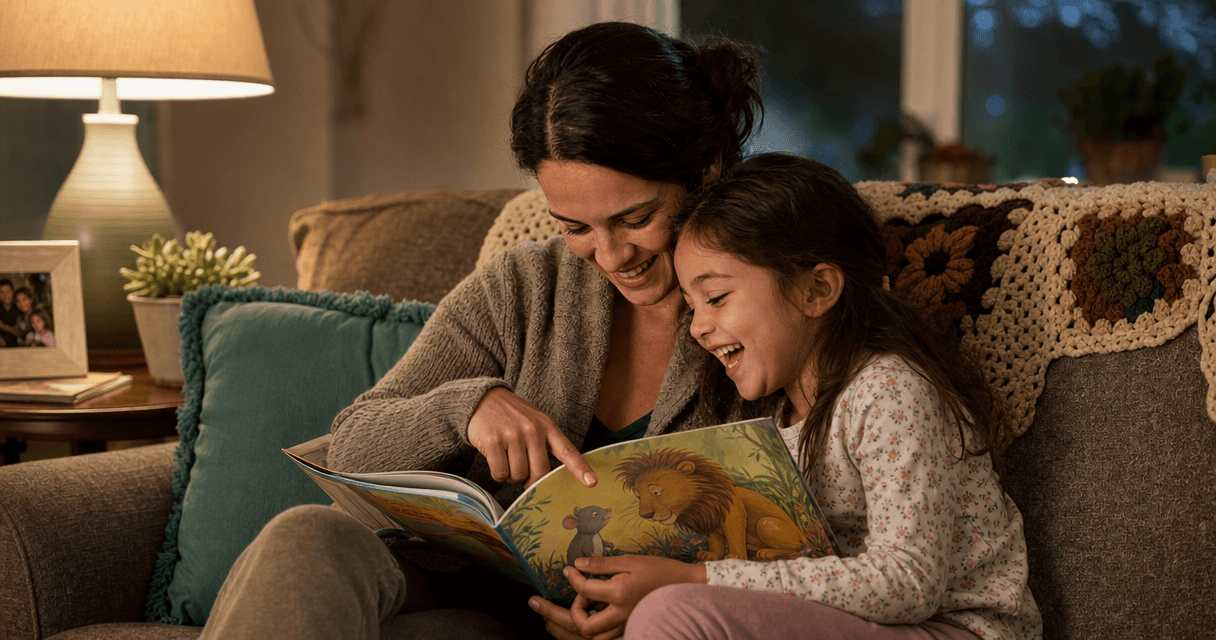
Reading aloud in Spanish is one of the most powerful ways to strengthen your child's language skills while keeping them connected to their cultural roots. Research shows that reading aloud promotes emergent literacy, language development, and phonemic awareness, and when you do it in Spanish, you're giving your child access to the vocabulary, stories, and worldview that make up their heritage.
Key takeaways
- Reading aloud in Spanish builds vocabulary faster than conversation alone and exposes children to rich, uncommon words.
- Shared reading strengthens the parent-child bond and helps children feel emotionally connected to their heritage language.
- Bilingual children require more support in heritage language reading since it's often their weaker language, making read-aloud time essential.
- Just 15 minutes a day of reading together can boost your child's confidence and language development.
- Stories in Spanish carry cultural values and humor that don't always translate, giving your child access to their full identity.
Why reading aloud in Spanish matters for heritage families
You want your child to talk to abuela. You want them to understand the jokes at family gatherings and feel like they belong when relatives visit. But if your child is growing up in an English-dominant environment, Spanish can start to feel like the language they hear but don't fully own.
That's where reading aloud in Spanish changes everything. Reading in the home language helps children stay connected to their cultural roots, traditions, and heritage, and it opens doors to a world that might otherwise remain out of reach. The stories you read together carry values, humor, and perspectives that are uniquely part of your family's culture. Your child doesn't just learn words—they learn what those words mean in the context of who they are.
Reading builds vocabulary faster than talking
You talk to your child in Spanish every day. But conversation has limits. Research shows that picture books are more likely than speech to include uncommon words, the kind of vocabulary that expands your child's ability to express complex ideas. When you read "El león y el ratón," your child hears words like "compasión" and "gratitud"—words that rarely come up when you're asking them to brush their teeth.
Books give your child access to language they wouldn't encounter otherwise. And hearing those words read aloud, in context, with your voice giving them meaning, is how vocabulary sticks.
The emotional power of shared reading time
Reading together is more than a language lesson. Research suggests that when two people engage in a shared activity like reading a book together, their brain activity synchronizes, deepening emotional connection. That's why those 15 minutes curled up with a book feel different from other parts of the day. Your child feels seen, heard, and safe.
And when that reading happens in Spanish, it sends a powerful message: this language is ours. It's not just the language of school or chores or correction. It's the language of stories, laughter, and closeness.
Creating space for Spanish as children grow
Here's the hard truth: read-aloud time in heritage languages decreases as children grow older, often because of pressure from English-dominant schooling. Your child starts bringing home English chapter books. Their friends only speak English. Spanish starts to feel like the language of the past, not the present.
But older children still love being read to. Teachers use read-aloud strategies in middle school because students respond to them. Your ten-year-old might roll their eyes, but if you pick the right book—something funny, something with adventure, something that feels like it was written for them—they'll listen. And they'll absorb Spanish in a way that feels effortless.
How to make reading aloud in Spanish a habit
You don't need a perfect plan. You need 15 minutes and a book your child actually wants to hear.
Pick books that match your child's interests
If your child loves dinosaurs, find a Spanish book about dinosaurs. If they're obsessed with soccer, read about their favorite players. The content matters more than the vocabulary level. A child who's engaged will tolerate words they don't know yet. A child who's bored will tune out even if every word is familiar.
Read with expression and ask questions
Children's engagement during a read-aloud increases when you create anticipation, make predictions, and connect with characters. Pause and ask, "¿Qué crees que va a pasar?" Let your child guess. Let them be wrong. Let them laugh when the story surprises them.
You're not testing comprehension. You're making the story come alive.
Let your child see you value Spanish books
Keep Spanish books on the shelf year-round, not tucked away in a closet. Let your child see you reading in Spanish, too. When they see that Spanish is part of daily life—not something you only pull out for special occasions—they internalize that it matters.
What if your child resists?
Some kids push back. They say, "I don't understand." Or, "Can we read it in English?"
Here's what works: start small. Read one page in Spanish, then talk about it in whatever language your child wants to use. Let them ask questions. Let them code-switch. The goal is not perfection. The goal is connection.
And if they truly resist, try audiobooks. Hearing a native speaker read a story with music and sound effects can hook a reluctant listener. Once they're invested in the story, they'll want more.
Reading aloud works, but it's not the only answer
Reading together in Spanish is powerful. But if your child still struggles to speak confidently, or if you want them to have regular conversation practice with someone who can gently correct and encourage them, that's where a dedicated teacher makes the difference.
At Spanish For Us, we pair children with native-speaking teachers who make Spanish feel like play, not work. Your child gets 1-on-1 attention every week, and you get to see them go from hesitant to confident. Book a free class and watch what happens when your child has a teacher who makes them feel proud to speak Spanish.
Sources
- Reading aloud to children: The evidence — ResearchGate, 2008
- Reading Aloud: Engaging Young Children during a Read Aloud Experience — ERIC, 2019
- Study says reading aloud to children, more than talking, builds literacy — EdSource, 2015
- Beyond words: How reading aloud strengthens language and family connections in bilingual homes — Growing Up Multilingual, 2025
- Shared Reading in Children's Heritage Language Development — Journal of Education and Social Policy, 2015
Frequently Asked Questions
What if I'm not fluent enough to read aloud in Spanish?
You don't need perfect Spanish to read to your child. Start with simple picture books and read slowly. Your child benefits from hearing the rhythm and sounds of Spanish, even if you stumble over a word. You can also use audiobooks narrated by native speakers to supplement your reading time.
How do I find good Spanish books for my child's age?
Look for books that match your child's interests first, reading level second. Check your local library's Spanish section, browse online retailers like Amazon or Book Depository, or ask for recommendations in bilingual parenting groups on social media. Publishers like Lil' Libros, Scholastic en Español, and Santillana have excellent age-appropriate options.
Should I translate as I read or let my child figure it out?
Let your child experience the story in Spanish first. If they ask what a word means, explain it briefly and keep reading. Constant translation interrupts the flow and makes reading feel like a lesson instead of a story. Context clues and pictures help children understand more than you think.
My child only wants to read in English now. How do I bring Spanish back?
Start by reading books that connect to something they already love in English—a Spanish version of a favorite story, or a new book about their current obsession. Make it low-pressure: read one Spanish book for every two English ones. Let them respond in English if they want. The goal is exposure, not forcing fluency overnight.
Ready to get your child speaking Spanish?
Book a free 1-on-1 class with a native-speaking teacher. No commitment, no credit card.
Try a Free Class