How Role-Playing Can Boost Your Child's Spanish Skills
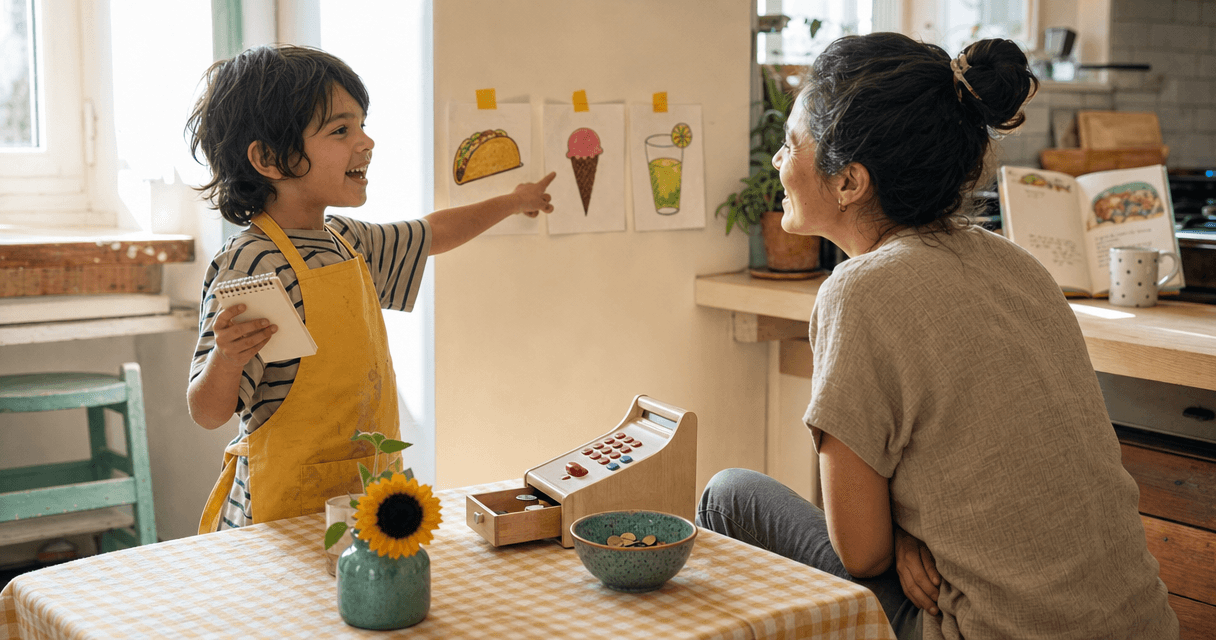
Role-playing can boost your child's Spanish skills by creating a low-pressure environment where they practice real conversations without fear of failure. Research shows that role-playing activities significantly reduce language anxiety while building speaking confidence, making it especially powerful for children who have struggled with traditional language learning methods. When your child pretends to order food at a restaurant or play teacher with their stuffed animals, they're rehearsing Spanish in ways that feel like play, not homework.
Key takeaways
- Role-playing lowers language anxiety by letting kids practice Spanish through pretend scenarios that feel safe and fun.
- Children use more complex language during pretend play than in regular conversations, accelerating their learning.
- Acting out real-life situations helps kids apply Spanish vocabulary in context, making words stick better than memorization.
- Role-playing builds confidence in struggling learners by removing the fear of making mistakes in front of others.
- Simple scenarios like playing restaurant, doctor, or grocery store can be done at home with no special materials.
Why role-playing works when other methods don't
Your child sits through Spanish class at school. They've tried the apps. They know the vocabulary words on paper. But when it's time to actually speak, they freeze.
This is the reality for so many kids who are falling behind in Spanish. The problem isn't that they can't learn. The problem is that traditional methods ask them to perform before they feel ready.
Role-playing addresses this by creating what researchers call a "low-stakes environment" where mistakes are part of the game. When your child is pretending to be a chef taking orders in Spanish, a mistake isn't a failure. It's just part of the story.
The science behind pretend play and language
Psychologist Jerome Bruner discovered that "the most complicated grammatical and pragmatic forms of language appear first in play activity." Your child naturally reaches for more advanced language when they're playing a role because the pretend situation pushes them to communicate in new ways.
This isn't just true for younger children. Studies across age groups show that role-playing reduces speaking anxiety and improves oral proficiency, even in students who have struggled for years.
How to use role-playing at home
You don't need to be fluent in Spanish to help your child practice through role-play. You just need to set up scenarios where Spanish becomes the natural way to communicate.
Start with familiar situations
Pick scenarios your child already knows:
- Ordering at a restaurant ("¿Qué quieres comer?")
- Shopping at a store ("¿Cuánto cuesta?")
- Visiting the doctor ("¿Cómo te sientes?")
- Playing school with stuffed animals as students
- Setting up a pretend panadería (bakery) or mercado (market)
The key is choosing situations where your child understands the flow of the conversation even if they don't know every Spanish word yet. Authentic, relatable scenarios help children stay engaged and reduce anxiety because they're not starting from zero.
Let your child lead
You don't need to script everything. In fact, the less you control the play, the better. When children create their own stories and scenarios during role-play, they take ownership of their learning.
If your child wants to turn the living room into a pet hospital where all the patients only speak Spanish, go with it. If they want to be a superhero who saves the day by teaching Spanish to their toys, even better. The goal is for Spanish to feel like a tool for creativity, not a chore.
Use props and labels
Simple props make role-playing more concrete. You don't need anything fancy. A few items from around the house work perfectly:
- Play food or empty food containers for a restaurant or grocery store
- A toy cash register or play money
- Stuffed animals as customers, students, or patients
- Index cards labeled in Spanish ("abierto/cerrado," "menú," "medicina")
Labels in Spanish help children organize their thinking and provide vocabulary support right when they need it, without you having to interrupt the play to correct or teach.
What role-playing does for kids who struggle
If your child has been frustrated by Spanish, role-playing offers something traditional methods don't: a way to rebuild confidence from the ground up.
It removes the spotlight
In a classroom, your child might feel like everyone is watching and waiting for them to mess up. At home during role-play, there's no audience. It's just you, your child, and the pretend world you've created together.
Research consistently shows that role-playing in small groups or pairs significantly reduces the anxiety that blocks language production. Your child can try, fail, laugh, and try again without the weight of judgment.
It builds fluency through repetition that doesn't feel repetitive
Your child might play restaurant five days in a row, and each time they'll practice the same phrases. But because the context shifts slightly each time (today they're the customer, tomorrow the waiter; today they're ordering tacos, tomorrow helado), the repetition doesn't feel like drill work.
That repeated practice in varied contexts is exactly what builds fluency. Your child internalizes sentence patterns and vocabulary without realizing they're studying.
It gives them control
Kids who struggle with Spanish often feel powerless. They're behind. They don't understand. They can't keep up.
Role-playing flips that dynamic. Your child gets to decide who they are, what happens next, and how the story unfolds. That sense of control translates into confidence. When they realize they can navigate a pretend Spanish conversation successfully, they start to believe they can handle a real one.
When to bring in a teacher
Role-playing at home is powerful, but it works best when paired with structured guidance from someone who knows how to build on what your child is practicing.
A teacher who understands how to use role-playing as a teaching tool can introduce new vocabulary in context, gently correct errors in the moment, and design scenarios that target exactly what your child needs to work on next. They can also model natural Spanish conversation in ways that feel like play, not instruction.
That combination — your child practicing through play at home and getting expert guidance during class — creates the kind of progress you can actually see. If your child has been stuck, a teacher who meets them where they are and makes Spanish feel achievable again can be the turning point. Spanish For Us matches kids with native-speaking teachers who specialize in building confidence through fun, personalized 1-on-1 classes where role-playing and conversation take center stage.
Sources
- Facilitating pragmatic skills through role-play in learners with language learning disability — PMC, National Center for Biotechnology Information
- The Effectiveness of Role Play Strategy in Teaching Vocabulary — Theory and Practice in Language Studies, 2016
- Benefits of Pretend Play - Language & Literacy Learning for kids — The Genius of Play
- Role play to alleviate speaking anxiety: Action research in ESP class of Batam Tourism Polytechnic — Cahaya Pendidikan, 2025
- Role-play and Speaking Anxiety: A Case Study in an Online English Speaking Class — JLA (Jurnal Lingua Applicata), 2022
- Supporting Language: Culturally Rich Dramatic Play — NAEYC (National Association for the Education of Young Children), 2017
- The power of role play activities in language teaching — Sanako, 2024
Frequently Asked Questions
What if my child is too shy to role-play, even at home?
Start with their stuffed animals or toys as the main characters instead of your child. Let them be the director who tells the toys what to say in Spanish, or let them voice one toy while you voice another. This removes the pressure of being "on stage" and lets them ease into using Spanish through play they already feel comfortable with.
How much Spanish do I need to know to help my child role-play?
You don't need to be fluent. Learn a handful of phrases for each scenario alongside your child—"¿Qué quieres?" (What do you want?), "Me gusta" (I like), "¿Cuánto cuesta?" (How much does it cost?). You can even keep a cheat sheet nearby. Your child will feel proud teaching you new words, and that role reversal builds their confidence.
Should I correct my child's Spanish mistakes during role-play?
Not in the moment. Correcting mid-play breaks the flow and can make your child self-conscious. Instead, model the correct phrase naturally in your next response. If your child says "Yo quiero dos taco," you can reply "Ah, ¿quieres dos tacos? Perfecto." They'll hear the right form without feeling corrected.
How often should we do role-playing activities?
Short and frequent beats long and rare. Five to ten minutes of role-play three or four times a week will build momentum better than a single hour-long session. The key is making it feel like play, not a scheduled lesson, so your child stays excited and asks to do it again.
Ready to get your child speaking Spanish?
Book a free 1-on-1 class with a native-speaking teacher. No commitment, no credit card.
Try a Free Class