Why Your Child's School Spanish Program Isn't Enough
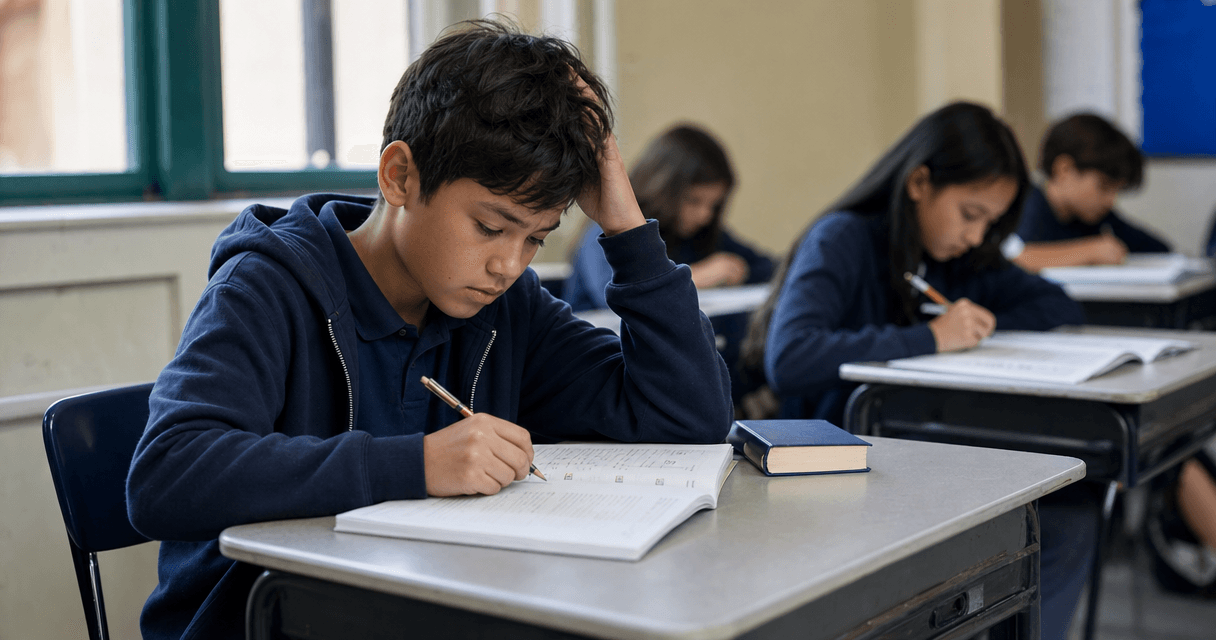
Your child's school Spanish program has limitations that prevent real fluency. Research shows that most U.S. students remain at novice or low-intermediate levels even after several years of classroom instruction. The problem isn't your child — it's that group classes can't provide the individualized attention and speaking practice necessary for language acquisition.
Key takeaways
- Most school Spanish programs focus on grammar and tests rather than real conversation skills.
- In a typical classroom, each child gets only a few minutes of actual speaking time per week.
- Research indicates that teachers should talk 20-30% of class time, but most classrooms fall short of the ideal 70-80% student talk time.
- One-on-one instruction allows children to practice speaking for the entire lesson with immediate feedback.
- School programs provide a foundation, but children need additional conversational practice to achieve fluency.
The speaking time problem
In a classroom of 20-30 students, the math is simple and discouraging. If your child has Spanish class three times a week for 45 minutes, that's 135 minutes of total class time. But how much of that is your child actually speaking?
Language education research shows that in large classroom settings, it's difficult for every student to get solid speaking time. When one teacher manages an entire class, most time goes to instruction, transitions, and managing the group. Your child might raise their hand twice, answer in a few words, and sit back down.
The reality is stark. While teachers do their best, a study of Spanish-speaking students in English-only classrooms found that oral language skills began below expectations and didn't grow fast enough to reach grade-appropriate levels by fifth grade. The same dynamic works in reverse — English-speaking children learning Spanish in traditional classrooms simply don't get enough practice to develop conversational ability.
What happens in those 45 minutes
A typical school Spanish class breaks down like this:
- 5-10 minutes: Taking attendance, settling in, reviewing homework
- 15-20 minutes: Teacher instruction (new vocabulary, grammar rules, cultural notes)
- 10-15 minutes: Worksheet or textbook exercises
- 5-10 minutes: Wrap-up, assigning homework
Your child might speak Spanish for two minutes. Maybe three if they're called on multiple times. That's it.
School programs teach about Spanish, not how to speak it
Most school curricula are built around passing tests. Your child learns to conjugate verbs, fill in blanks, and match vocabulary words to pictures. These are useful skills, but they don't translate to conversation.
Traditional programs focus on grammar and passing the next test, leaving students able to earn A's in the classroom but struggling to understand or participate in basic conversations. The system rewards memorization over communication.
Your child can recite "yo tengo, tú tienes, él tiene" perfectly on a quiz and still freeze when asked "¿Cuántos hermanos tienes?" by a native speaker. That gap — between knowing the rules and using the language — is where school programs fall short.
The shy child disappears
If your child is quiet, hesitant, or still building confidence, a group class makes it easy to hide. The teacher calls on the kids with their hands up. Your child sits in the middle, hopes not to be called on, and learns to stay invisible.
This isn't the teacher's fault. With 25 students and 45 minutes, there's no time to draw out every child. But the result is the same: your child falls further behind while the extroverted kids get all the practice.
One-on-one instruction changes this dynamic entirely. Research shows that individualized instruction allows teachers to respond directly to a student's needs, adapt explanations in real time, and focus practice on the skills that matter most. Your child can't hide, can't tune out, and can't avoid speaking — but in a one-on-one setting, that pressure becomes support.
Mixed levels slow everyone down
Spanish teachers face the challenge of meeting diverse needs and wide skill levels in a single classroom. One child grew up hearing Spanish at home. Another started from zero last year. A third moved from a different school with a completely different curriculum.
The teacher has to find a middle ground, which means:
- The advanced kids are bored
- The struggling kids are lost
- The middle kids are... fine, but not progressing quickly
Your child gets a one-size-fits-all lesson that wasn't designed for them.
What your child actually needs
Language acquisition requires three things that school programs struggle to provide:
Consistent speaking practice. Your child needs to talk — in full sentences, making mistakes, getting corrected, and trying again. Not twice a week for two minutes. Every single lesson, for the entire lesson.
Immediate feedback. When your child says "yo es" instead of "yo soy," they need to hear the correction right away, understand why, and practice the correct form before the mistake becomes a habit. In a group class, most errors go unnoticed.
Personalized pacing. If your child struggles with verb conjugations, they need extra time there — not a quick review before the class moves on to the next unit. If they've mastered greetings, they need to skip ahead, not repeat the same phrases for a third week.
These three needs are nearly impossible to meet in a traditional classroom. They're the default in a 1-on-1 setting.
School Spanish is a starting point, not the finish line
None of this means school programs are useless. Your child is learning vocabulary, getting exposure to the language, and building a foundation. That matters.
But if your goal is for your child to actually speak Spanish — to have a conversation with a relative, to travel confidently, to use the language in the real world — the school program won't get them there alone.
You've probably noticed this already. Your child comes home with good grades on vocab quizzes, but when you ask them to tell you about their day in Spanish, they freeze. Or they default to English. Or they say a few memorized phrases and stop.
That's not your child's fault. That's the system working exactly as it's designed — to teach the mechanics of the language, not the skill of using it.
What comes next
The gap between classroom instruction and real fluency doesn't close on its own. Your child needs speaking practice with a teacher who can focus entirely on them, correct mistakes in real time, and move at their pace.
At Spanish For Us, every class is 1-on-1 with a native-speaking teacher who knows your child by name, remembers what they struggled with last week, and designs each lesson around their progress. Your child spends the full 30 minutes speaking, listening, and building confidence — not waiting for a turn that might not come.
School Spanish gives your child a start. We help them finish the journey.
Sources
- Fluency can't be forced: why mandatory world language courses don't work — The Southerner, 2026
- How to increase Students' Talking Time (STT) in language classes? — Sanako, 2024
- Student's Perspective: Benefits of One-on-One Language Learning — DLS, 2024
- Moving Forward by Looking Back: Understanding Why Some Spanish-Speaking English Learners Fall Behind — PMC, 2020
- Fluency or failure: The flaws in foreign language education — Cedar BluePrints Magazine, 2022
- Why One-on-One Language Lessons Accelerate Learning According to Science — Language Trainers USA, 2026
- Strategies for Differentiated Instruction in the Spanish Classroom — Savvas, 2024
Frequently Asked Questions
How much speaking time does my child actually get in a school Spanish class?
In a typical 45-minute class with 20-30 students, your child might speak for only 2-3 minutes total. The rest of the time is spent on instruction, transitions, and other students' turns. Language experts recommend students speak 70-80% of class time for effective learning, but traditional classrooms rarely achieve this.
Will adding more school Spanish classes be enough for my child to become fluent?
More classroom hours help build vocabulary and grammar knowledge, but they don't solve the core problem: lack of individualized speaking practice. Your child needs consistent one-on-one conversation time with immediate feedback to develop real fluency, which group classes can't provide regardless of frequency.
My child gets good grades in Spanish class — does that mean they're learning to speak it?
Good grades usually measure vocabulary memorization and grammar accuracy on tests, not conversational ability. Many students can conjugate verbs perfectly on paper but freeze when asked to speak spontaneously. Grades show academic progress, but speaking fluency requires different practice.
Should I pull my child out of school Spanish if it's not working?
No — school Spanish provides valuable exposure and builds a foundation. The solution isn't to remove classroom instruction but to supplement it with personalized speaking practice. Think of school Spanish as the textbook learning and one-on-one classes as the real-world application.
At what age should I add extra Spanish instruction outside of school?
The earlier, the better. If your child is already in a school program and you're noticing they can't hold a simple conversation despite good grades, that's your signal. Ages 5-12 are the ideal window for language acquisition, so adding personalized instruction now maximizes their natural learning ability.
Ready to get your child speaking Spanish?
Book a free 1-on-1 class with a native-speaking teacher. No commitment, no credit card.
Try a Free Class