How Can Storytelling Improve Your Child's Spanish Skills?
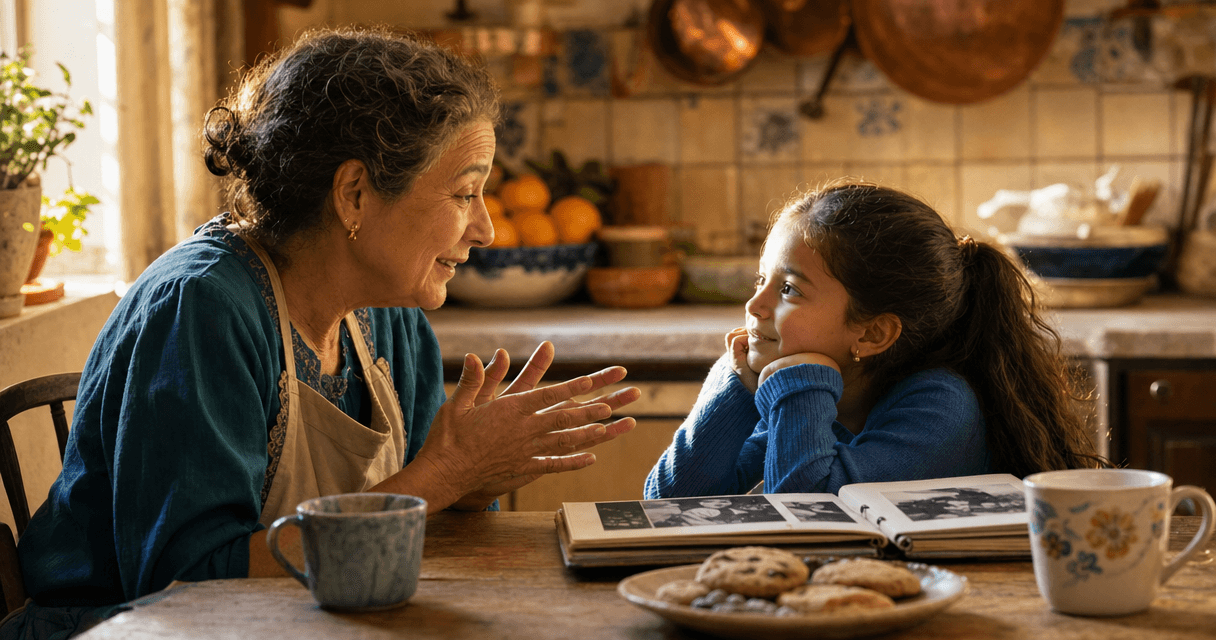
Storytelling is one of the most powerful tools for improving your child's Spanish skills. Research confirms that children who are frequently exposed to stories develop more advanced vocabulary and syntactic complexity than children who aren't. For heritage families, storytelling does something even more profound—it weaves language learning into identity, memory, and connection with the people your child loves.
Key takeaways
- Storytelling develops vocabulary, grammar, and narrative skills simultaneously in Spanish learners.
- Children exposed to oral storytelling build comprehension and conversation abilities faster than through apps or worksheets.
- Heritage stories connect your child to family culture and make Spanish personally meaningful.
- Interactive storytelling—asking questions, retelling, acting out—multiplies the language learning benefit.
- You don't need to be fluent to use storytelling; simple family stories work beautifully.
Why storytelling works where other methods fall short
Apps teach words. Flashcards drill vocabulary. But storytelling teaches your child how Spanish actually works—how sentences flow, how emotions are expressed, how a conversation builds. Studies show that storytelling creates ideal language learning conditions because it provides comprehensible input within a meaningful context, which is exactly what young brains need to acquire a second language naturally.
When your child hears a story in Spanish, they're not just memorizing isolated words. They're absorbing sentence structure, verb tenses, and the rhythm of the language all at once. A 2022 Duke study found that children demonstrated higher language and literacy skills throughout elementary school when their mothers used engaging and complex language during storytelling in early childhood. The same principle applies to Spanish—rich, engaging stories build a foundation that worksheets never will.
The vocabulary advantage
Storytelling introduces new words in context, which is how children learn vocabulary most effectively. Instead of drilling "abuela means grandma," your child hears "La abuela preparó tamales para toda la familia" and understands the word through the scene, the emotion, the sensory details. That's the difference between memorization and true acquisition.
Children retain words they encounter in stories because those words are attached to images, feelings, and narrative momentum. The word isn't floating in isolation—it's part of a world your child can picture.
Heritage stories build identity alongside language
For heritage families, storytelling is about more than vocabulary. When you tell your child stories about your childhood, about their grandparents' lives, about the town where your family comes from, you're doing two things at once: teaching Spanish and teaching belonging.
Research on bilingual narrative development shows that heritage language skills are essential for children's identity formation and connection to their cultural roots. A child who hears family stories in Spanish learns that Spanish isn't just a school subject—it's the language of memory, of laughter, of the people who matter most.
Those stories answer the question every heritage kid eventually asks: "Why do I need to speak Spanish?" Because that's how abuela told the story. Because that's the language your family's history lives in. Because when you retell that story to your own children someday, you'll want to tell it the way you heard it.
Stories your child will remember
You don't need elaborate fairy tales. The stories that stick are often the simplest:
- The time you got in trouble as a kid
- How your parents met
- What your grandmother cooked on Sundays
- The first time you came to the United States
- A funny thing that happened at a family gathering
These stories are emotionally rich, culturally specific, and completely unique to your family. No app can replicate that.
How to use storytelling at home—even if you're not fluent
You don't need to be a perfect Spanish speaker to use storytelling with your child. You just need to start.
Tell stories in the Spanish you have
If you speak some Spanish but not fluently, tell the story in a mix. Start in Spanish, switch to English when you need to, then return to Spanish. Your child's brain is wired to handle code-switching—it's a natural part of bilingual life. What matters is that they hear Spanish used in a meaningful, connected way.
If you don't speak Spanish at all, you can still use storytelling by playing audio stories in Spanish, watching Spanish-language storytelling videos together, or asking a Spanish-speaking family member to record stories for your child.
Make it interactive
The magic of storytelling multiplies when your child participates. Pause and ask questions in Spanish: "¿Qué crees que pasó después?" (What do you think happened next?) or "¿Cómo se sintió la abuela?" (How did grandma feel?). Let your child retell parts of the story back to you. Act out scenes together.
Interactive storytelling has been shown to strengthen comprehension, vocabulary, and confidence in young language learners because it transforms passive listening into active language use.
Use picture books and retelling
Read a Spanish picture book together, then close the book and ask your child to retell the story in their own words. They'll use the vocabulary they just heard, practice sentence construction, and build narrative skills—all at once. If they mix in English, that's fine. The goal is for them to feel confident putting sentences together in Spanish.
Record family members telling stories
Ask grandparents, aunts, uncles, or older cousins to record short stories in Spanish—funny memories, family legends, anything with a beginning, middle, and end. Your child can listen to these over and over. Repetition is one of the most effective language learning strategies, and hearing the same story multiple times lets your child catch new words and phrases each time.
What storytelling teaches that apps can't
Apps are great for vocabulary drills, but they can't teach your child how to have a conversation. Storytelling does. When your child listens to a story, they learn how people actually talk—how they build suspense, how they express surprise, how they connect one idea to the next.
Narrative skills are strong predictors of reading comprehension and academic success, which means storytelling isn't just a fun activity—it's foundational literacy work. A child who can tell a story in Spanish can eventually write one, read one, and hold a real conversation.
Storytelling also teaches your child that Spanish is a language for connection, not just for school. When they hear you tell a story in Spanish, they see that Spanish is alive, warm, and worth speaking.
Pair storytelling with a teacher who knows how to use it
Storytelling at home is powerful. Storytelling with a skilled teacher is even better. At Spanish For Us, our native-speaking teachers use stories, games, and conversation to make Spanish feel natural and fun. Your child gets the same teacher every week—someone who knows their interests, their progress, and exactly how to keep them engaged.
If your child lights up when they hear a good story, imagine what happens when that story is told by a teacher who's great with kids, who speaks Spanish fluently, and who knows how to turn listening into speaking. That's what a 1-on-1 class with Spanish For Us looks like. Book a free trial class and see how storytelling can transform your child's Spanish.
Sources
- Storytelling: Enhancing Language Acquisition in Young Children — Speaker, Taylor, & Kamen, Education, 2004
- The role of storytelling in language learning: A literature review — University of Victoria, Working Papers in Linguistics
- The Power of Storytelling: How Parents and Caregivers Can Give Children a Strong Foundation for Language and Literacy Development — Duke Center for Child & Family Policy, 2022
- The effect of storytelling on the development of language and social skills in French as a foreign language classrooms — PMC, 2024
- Why Storytelling Helps Children's Language Development — Kids First, 2025
- When children's storytelling says so much more — Research Outreach, 2023
Frequently Asked Questions
What if I don't speak Spanish fluently—can I still use storytelling?
Absolutely. Tell stories in the Spanish you know and switch to English when you need to—your child's brain handles code-switching naturally. You can also play audio stories in Spanish, use picture books, or ask a Spanish-speaking family member to record stories your child can listen to repeatedly. What matters most is that your child hears Spanish used in a meaningful, connected way.
How often should we do storytelling to see progress?
Consistency matters more than duration. Even 10–15 minutes of storytelling three to four times a week will build vocabulary and comprehension over time. The key is making it a regular part of your routine—bedtime stories, weekend story sessions with grandparents, or retelling the day's events at dinner.
What kinds of stories work best for language learning?
Personal family stories are incredibly effective because they're emotionally meaningful and culturally specific. Stories about your childhood, your parents' lives, or funny family moments give your child vocabulary in context and a reason to care. Picture books with repetitive language, folktales, and stories your child can retell or act out also work beautifully.
My child listens but won't speak Spanish back—is storytelling still helping?
Yes. Listening comprehension develops before speaking, and storytelling builds the foundation your child needs to eventually speak. Keep the experience pressure-free—ask questions in Spanish but accept answers in English for now. As their confidence grows and they hear more stories, they'll start using Spanish words and phrases naturally.
Can storytelling replace formal Spanish lessons?
Storytelling is a powerful supplement but works best alongside structured learning. A skilled teacher can use storytelling techniques while also teaching grammar, pronunciation, and conversation skills your child needs to become fluent. Pairing storytelling at home with 1-on-1 classes gives your child the best of both worlds—cultural connection and systematic skill-building.
Ready to get your child speaking Spanish?
Book a free 1-on-1 class with a native-speaking teacher. No commitment, no credit card.
Try a Free Class