How to Support Your Child's Spanish Learning Without Speaking It Fluently
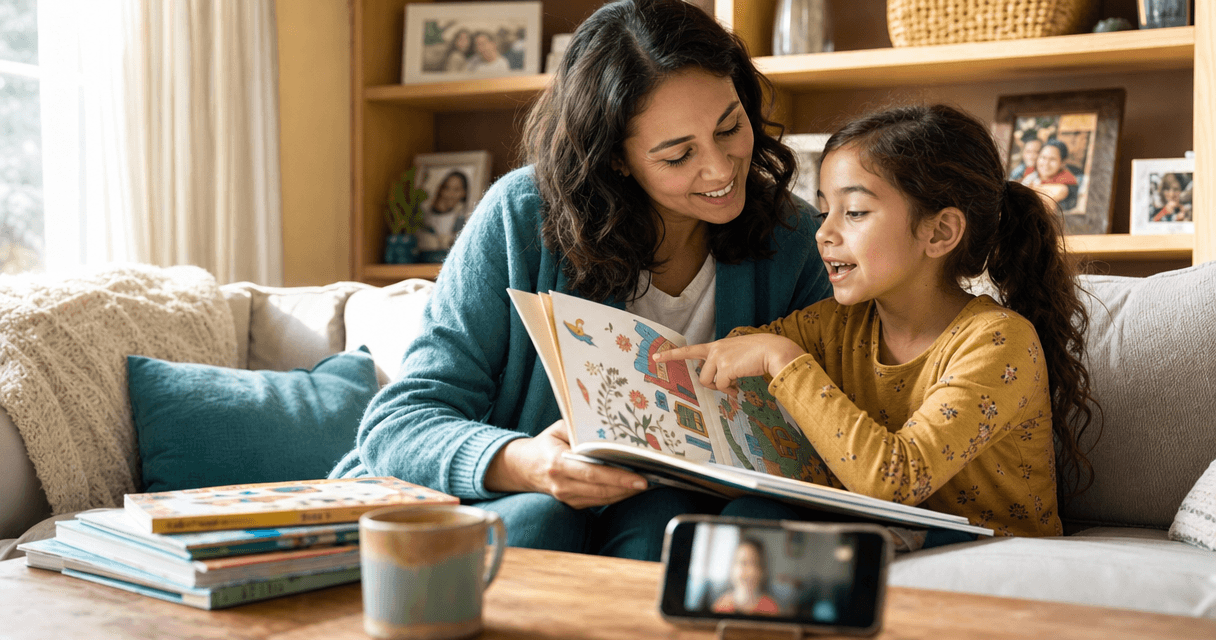
You can support your child's Spanish learning journey even if you're not fluent yourself. Research confirms that children can thrive in bilingual environments with simple parental support strategies, and your role as a facilitator matters far more than perfect pronunciation. The key is creating consistent opportunities for your child to hear, practice, and connect emotionally with Spanish through native speakers and high-quality resources.
Key takeaways
- Parents don't need fluency to successfully support their child's Spanish learning journey.
- Creating consistent exposure through native-speaking teachers and quality resources drives real progress.
- Your enthusiasm and encouragement matter more than perfect Spanish grammar.
- Maintaining children's cultural and linguistic heritages leads to stronger identity development and long-term academic success.
- Strategic use of books, music, and community connections reinforces what children learn in class.
Your role is facilitator, not teacher
You don't need to be your child's Spanish teacher. That's what native-speaking teachers are for. Your job is to create the right environment and opportunities. Think of yourself as a project manager for your child's language learning — you're organizing resources, scheduling practice time, celebrating wins, and keeping motivation high.
Studies show that parents and educators play a crucial role by providing consistent support, encouragement, and resources. Positive reinforcement and patience are essential. Your belief that your child can do this matters more than whether you can conjugate verbs.
Many Heritage Moms worry that their limited Spanish will somehow hold their child back. The opposite is true. When you demonstrate curiosity about the language — even asking your child to teach you new words they learned — you're modeling that learning is lifelong and valuable.
Prioritize consistent exposure to native speakers
The single most important thing you can do is ensure your child hears Spanish from fluent speakers regularly. Children's success in learning each of their languages is a direct consequence of the quantity and quality of their everyday language experience, including at home and in educational settings.
Weekly classes with the same teacher
Consistency builds relationships. When your child sees the same native-speaking teacher every week, they're not starting from scratch each time. The teacher learns your child's personality, interests, and exactly where they need support. That familiarity makes your child feel safe enough to take risks and make mistakes — which is where real learning happens.
Connecting with Spanish-speaking family
If you have Spanish-speaking relatives, schedule regular video calls. Even 15 minutes of conversation with abuela once a week gives your child a reason to use what they're learning. The emotional connection — wanting to talk to someone they love — is a powerful motivator that no app can replicate.
Use your home language strengths strategically
You might not speak Spanish fluently, but you can absolutely support the learning process in English. Research has shown that one of the key predictors of an emergent bilingual or multilingual learner's future academic success is the quality of their experiences with their home language.
Ask about what they learned
After each Spanish class, ask your child to teach you three new words. Let them be the expert. This reinforces what they just learned and gives them pride in their progress. You're also subtly communicating that Spanish is important enough to talk about at home.
Celebrate small wins out loud
When your child uses a Spanish word at dinner or sings a song they learned in class, make a big deal out of it. "You just said 'gracias' without even thinking about it!" That kind of recognition builds confidence and makes your child want to keep going.
Surround your child with Spanish outside of class time
Exposure doesn't stop when class ends. The more your child hears Spanish in daily life, the faster their brain will start recognizing patterns and building fluency.
Books in Spanish
You don't need to read them aloud perfectly. Many Spanish children's books come with audio recordings. Play the audio while your child follows along with the pictures. Repetition is your friend — young children love hearing the same story dozens of times, which is exactly how language sinks in.
Check your local library. Most urban libraries have Spanish-language children's sections, and librarians can help you find age-appropriate books even if you can't read the titles yourself.
Music and videos
Create a Spanish playlist for car rides or morning routines. Songs with repetitive lyrics help children internalize vocabulary and sentence structures without it feeling like work. YouTube has countless Spanish children's songs — pick a few your child enjoys and put them on repeat.
Screen time can work for you here. Choose Spanish-language cartoons or educational shows. Even 20 minutes a day of passive listening helps your child's brain stay tuned to Spanish sounds and rhythms.
Label objects around the house
You can do this even if you need Google Translate to write the words. Stick labels on everyday items — "la puerta" on the door, "la mesa" on the table, "el refrigerador" on the fridge. Your child will start associating the written Spanish word with the object, building literacy alongside spoken skills.
Find your community
You're not alone in this. Other families are navigating the same challenges, and connecting with them makes the journey easier and more fun.
Spanish-language storytimes and events
Many public libraries offer bilingual storytimes. Community centers and cultural organizations host family events — Día de los Muertos celebrations, Latin dance classes, cooking workshops. These experiences show your child that Spanish isn't just something they do in class; it's a living, joyful part of a bigger community.
Playdates with Spanish-speaking families
If your child has classmates or neighbors who speak Spanish at home, arrange playdates. Peer interaction is one of the most effective ways children practice language. They're motivated to communicate to play together, and they learn from each other in ways that feel natural and pressure-free.
Let go of perfection
Your child will make mistakes. They'll mix English and Spanish in the same sentence. They'll mispronounce words. All of that is normal and healthy. Language mix-ups are a normal part of learning two languages, according to speech-language experts.
Don't correct every error. If your child says something wrong, just repeat it back correctly in a natural way. If they say "I want agua," you can respond, "Oh, you want water? Here's some water." They'll hear the correct form without feeling criticized.
The goal is communication and connection, not perfection. A child who feels confident trying to speak Spanish — even imperfectly — will progress faster than a child who's afraid of making mistakes.
Model curiosity, not fluency
Your attitude toward Spanish shapes your child's attitude. If you approach the language with curiosity and respect, your child will too. If you're anxious about your own limitations, they'll pick up on that.
Learn alongside your child. When they bring home a new song, ask them to teach it to you. When they tell you a word they learned, repeat it and use it later that day. You're showing them that learning a language is valuable at any age and that it's okay to be a beginner.
Some parents worry their child will surpass them and feel embarrassed. Flip that script. Celebrate it. "Wow, you know more Spanish than I do now! Can you help me say this?" That's a win, not a loss.
Trust the process and the teacher
You don't need to quiz your child or assign extra homework unless their teacher recommends it. Pressure can backfire, especially with young children. What they need from you is encouragement, consistency, and the message that Spanish is part of your family's life.
Parents' knowledge about language development influences their interactions with their children, ultimately affecting their child's language development. But that doesn't mean you need to be an expert. It means you need to trust the experts you've chosen — the native-speaking teacher who knows how to make Spanish come alive for kids.
Your child's teacher sees this every day. They know how to meet your child where they are and move them forward. Your job is to reinforce that relationship by showing up consistently, communicating openly with the teacher, and celebrating progress at home.
You're already doing more than you think. By prioritizing Spanish, finding the right teacher, and creating space for the language in your home, you're giving your child a gift that will connect them to their heritage, their family, and their future. That's what supporting Spanish learning looks like — and you don't need fluency to do it powerfully.
Ready to connect your child with a native-speaking teacher who makes Spanish fun? Start with a free class at Spanish For Us and see the difference a dedicated teacher makes.
Sources
- Can My Children Learn a New Language If We Don't Speak It at Home? — The French American Academy, 2025
- To Speak or Not To Speak My Language: Supporting Families' Home Language Practices — NAEYC, 2023
- Teaching Second Language Acquisition for Children — Language Joy Kids, 2025
- Bilingual Language Development in Infancy: What Can We Do to Support Bilingual Families? — PMC, 2022
- Raising Bilingual Children: A Qualitative Study of Parental Attitudes, Beliefs, and Intended Behaviors — PMC, 2016
Frequently Asked Questions
What if I can't help my child with their Spanish homework?
You don't need to. If you can't help directly, that's actually beneficial — it gives the teacher an authentic picture of what your child truly understands. Focus on encouragement and celebrating effort rather than correcting answers.
How much Spanish exposure does my child need each week?
Even one dedicated session per week, combined with other activities like music and books, can make a significant difference. Consistency matters more than total hours. Regular weekly classes plus daily passive exposure through songs or videos builds momentum over time.
Will my accent or mistakes confuse my child?
No. Children are remarkably good at distinguishing between speakers and learning from native-speaking teachers even when parents use imperfect Spanish at home. Your enthusiasm and willingness to try matter far more than perfect pronunciation.
Should I force my child to respond in Spanish at home?
Forcing can backfire and create negative associations with the language. Instead, celebrate any Spanish your child uses naturally, ask them to teach you words, and model curiosity. Understanding always comes before speaking, so even if your child responds in English, they're still learning.
What if we don't have Spanish-speaking family nearby?
You can still create rich exposure. Prioritize weekly classes with a consistent native-speaking teacher, use Spanish-language books and music at home, attend community cultural events, and consider virtual playdates or pen-pal programs with Spanish-speaking families.
Ready to get your child speaking Spanish?
Book a free 1-on-1 class with a native-speaking teacher. No commitment, no credit card.
Try a Free Class