What Spanish Words and Phrases Should Kids Learn First?
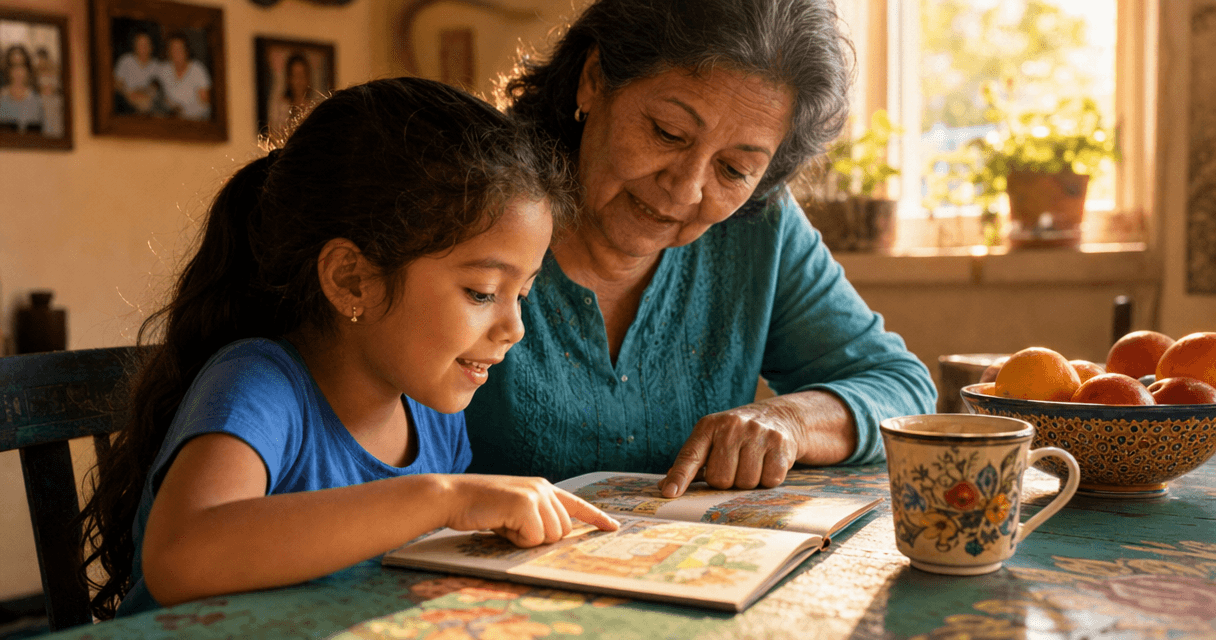
The most effective beginner Spanish words for kids are the ones they'll use every single day — family words like mamá and abuela, greetings like hola and buenos días, and high-frequency words like quiero and más. Research shows children's first words are predictable from input frequency — meaning the words your child hears most often are the ones they'll learn fastest and remember longest.
Key takeaways
- Family words, greetings, and daily-life verbs are the most effective beginner Spanish words because kids use them constantly.
- High-frequency words like el, de, and y form the foundation of everyday communication and reading fluency.
- Starting with concrete, emotionally meaningful words helps children connect Spanish to real relationships and experiences.
- Repetition in natural contexts beats memorization — the words your child hears at breakfast, bedtime, and playtime stick.
Start with the people your child loves
The single most powerful place to begin is with family words. Your child already knows these people. They see them, love them, talk about them. All they need now are the Spanish names.
- Mamá, papá
- Abuela, abuelo
- Hermana, hermano
- Tía, tío
- Prima, primo
Family factors and language input quantity are critical for heritage language vocabulary growth, especially when your child can use these words to talk to the actual people in their lives. When your daughter can say "¡Hola, abuela!" on a video call, Spanish stops being abstract. It becomes the language of belonging.
Why family words work
These aren't just nouns to memorize. They're the bridge between your child and the people who matter most. Every time your child uses abuela instead of grandma, they're practicing Spanish and strengthening a relationship at the same time.
Greetings and polite phrases kids use daily
Once your child knows who they're talking to, they need to know how to start and end a conversation. Greetings and polite phrases are beginner Spanish words that get used multiple times a day — which means multiple chances to practice.
- Hola (hello)
- Buenos días (good morning)
- Buenas noches (good night)
- Adiós (goodbye)
- Por favor (please)
- Gracias (thank you)
- Lo siento (I'm sorry)
These phrases also teach respect and courtesy, which grandparents and Spanish-speaking relatives notice and celebrate. The first time your son says "gracias, abuela" without prompting, you'll see her face light up.
High-frequency words that unlock sentences
Family words and greetings are essential, but to move from single words to actual conversation, your child needs high-frequency connector words. High-frequency words account for between 50-75% of all vocabulary found in grade school reading material, which makes them the scaffolding of fluency.
These include:
- El, la, los, las (the)
- Y (and)
- De (of, from)
- Yo, tú (I, you)
- Quiero (I want)
- Tengo (I have)
- Más (more)
- No
With just quiero, your child can say "quiero agua" (I want water), "quiero jugar" (I want to play), "quiero a mamá" (I want mom). One verb, dozens of sentences.
Start with what they already say in English
Listen to what your child says most often in English during a typical morning. "I want breakfast." "More juice." "Where's my shoe?" Those are the exact sentences you want to teach in Spanish, because they're already part of your child's daily routine. The transition from "more" to "más" is faster than teaching a word they'll never use.
Food and drink words for mealtime practice
Mealtime is one of the best built-in practice opportunities for beginner Spanish words. Your child eats three times a day. That's three chances to hear and use the same vocabulary in context.
- Agua (water)
- Leche (milk)
- Pan (bread)
- Manzana (apple)
- Pollo (chicken)
- Arroz (rice)
- Tengo hambre (I'm hungry)
- Tengo sed (I'm thirsty)
You don't need to quiz your child. Just use the words. "¿Quieres agua?" while holding up the cup. "Aquí está tu manzana." while handing over the snack. Repetition and consistent exposure help solidify vocabulary, and mealtime gives you that repetition naturally.
Action verbs kids use all day
Children are constantly moving, playing, asking, doing. Teaching the verbs that describe what they're already doing makes Spanish feel immediate and useful.
- Jugar (to play)
- Comer (to eat)
- Beber (to drink)
- Dormir (to sleep)
- Ver (to see, to watch)
- Ir (to go)
- Venir (to come)
- Dar (to give)
You can narrate what's happening as it happens. "Vamos a comer." (We're going to eat.) "¿Quieres jugar?" (Do you want to play?) Your child hears the word, sees the action, makes the connection.
Colors, numbers, and animals — but only after the basics
Many beginner Spanish word lists start with colors, numbers, and animals. They're easy to teach and kids enjoy them. But they're not the most effective starting point if your goal is conversation.
Your child can know twenty animal names and still not be able to tell abuela they're hungry. Prioritize the words that let your child communicate needs, feelings, and relationships first. Once those are solid, colors and animals become fun additions rather than substitutes for real language.
That said, if your child loves dinosaurs or is obsessed with counting, lean into that interest. Motivation matters. A child who wants to learn the names of every animal in Spanish will retain those words because they care.
Why starting with the right words matters
Family factors are relatively more important than child characteristics in enhancing bilingual children's heritage language vocabulary growth. The words you choose to teach, and the contexts in which you use them, shape whether Spanish becomes a language your child uses or a subject they study.
When you start with beginner Spanish words that are emotionally meaningful and immediately useful — the names of people they love, the phrases they say every morning, the foods on their plate — you're teaching your child that Spanish is for connection. Not for worksheets. Not for someday. For right now, with the people who matter.
That's the foundation every heritage speaker needs. Once your child knows how to greet abuela, ask for more, and say goodnight, they have the tools to keep going. And the confidence to try.
The best beginner Spanish words aren't the ones that look good on a list. They're the ones your child will say tomorrow morning at breakfast, and the day after that, and the day after that — until Spanish stops being something they're learning and starts being something they speak.
If you want your child to move from knowing a few beginner Spanish words to actually speaking in sentences, they need a teacher who makes it fun and a structure that builds on what they already know. Spanish For Us pairs your child with a dedicated native-speaking teacher for 1-on-1 classes designed around real conversation — starting with the words that matter most to your family.
Sources
- Large-scale investigations of variability in children's first words — Stanford Language and Cognition Lab
- Child, family, and school factors in bilingual preschoolers' vocabulary development in heritage languages — PubMed, 2020
- Spanish High-Frequency Words To Increase Reading Fluency — Spanish Academy, 2022
- 200+ Spanish Sight Words for Kids — Niños & Nature, 2024
- 33 Common Spanish Words for Babies and Toddlers — La Secundaria, 2024
Frequently Asked Questions
Should I teach my child Spanish words even if I'm not fluent myself?
Yes. You don't need to be fluent to start. Focus on the beginner Spanish words you do know — greetings, family names, simple requests — and use them consistently. Your child benefits from hearing Spanish at home even if your pronunciation isn't perfect, and a native-speaking teacher can handle the rest. Many successful bilingual families have one parent who speaks limited Spanish.
How many words should my child learn before moving to sentences?
There's no magic number, but once your child knows 10–15 high-frequency words (like quiero, más, agua, mamá), they can start combining them into simple two- or three-word phrases. Children naturally begin forming sentences when they have enough building blocks, so focus on depth of use rather than breadth of vocabulary.
What if my child mixes English and Spanish in the same sentence?
That's completely normal and actually a sign of bilingual development, not confusion. Code-switching shows your child is using both languages actively. As their Spanish vocabulary grows, they'll rely less on English fill-ins, but mixing languages is a natural part of the process and nothing to discourage.
How do I know if my child is retaining the words I'm teaching?
Watch for spontaneous use — when your child says "más" without prompting, or greets a family member with "hola" on their own, that's retention. If they only repeat words when you ask directly, they may need more exposure in natural contexts. Mealtime, playtime, and bedtime routines are the best places to reinforce beginner Spanish words through real use.
Ready to get your child speaking Spanish?
Book a free 1-on-1 class with a native-speaking teacher. No commitment, no credit card.
Try a Free Class