What Are the Best Interactive Resources for Kids Learning Spanish?
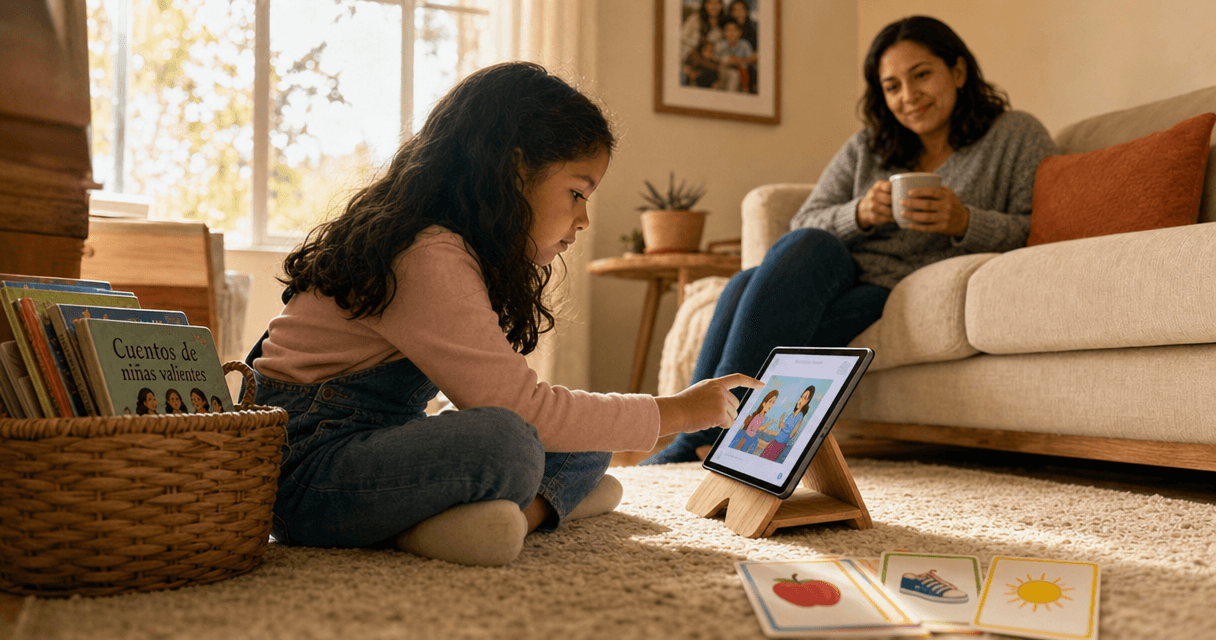
Interactive resources are essential for children learning Spanish. Research shows that interactive and engaging methods are the most effective ways to help children retain a new language, making the right tools critical for long-term success. The best interactive resources combine multiple learning modes—visual, auditory, and kinesthetic—to keep your child engaged while building real conversational skills.
Key takeaways
- Interactive learning accelerates language retention because children participate rather than passively observe.
- The most effective resources combine games, stories, music, and real human conversation.
- Apps work best as supplements to—not replacements for—live interaction with native speakers.
- Quality educational screen time can enhance language acquisition when used appropriately.
- Children stay motivated when learning feels like play and connects to their interests.
Why interactive resources matter for language learning
The brain responds more powerfully when children participate in communication rather than just observe it, and these neural connections form pathways that last a lifetime. Passive exposure—like watching a Spanish cartoon without interaction—can introduce sounds and rhythms, but it rarely builds the confidence your child needs to actually speak.
Interactive resources ask your child to do something: answer a question, repeat a phrase, match a picture to a word, or respond to a teacher. That active participation is what makes vocabulary stick.
What makes a resource truly interactive
Look for resources that require your child to respond, create, or make choices. A truly interactive resource might ask your child to record their voice, drag words into sentences, answer questions about a story, or practice conversation with a real person. The more your child uses the language—not just hears it—the faster they progress.
Best interactive apps for kids learning Spanish
Apps can be powerful tools when chosen carefully. The best apps for children combine clear native-speaker audio, short engaging lessons, and rewards that keep kids coming back.
Story-based apps
Research shows learners pick up a second language faster when they understand messages in context rather than memorizing lists. Story-based apps like FabuLingua teach Spanish through interactive narratives where children listen, read, and play games tied to the story. This approach helps phrases feel natural instead of forced.
Game-based vocabulary apps
Apps like Studycat Spanish and Gus on the Go use games to teach vocabulary through themes like animals, colors, food, and daily routines. These apps work well for building foundational words, especially for children ages 3–8 who respond to bright visuals and immediate rewards.
Look for apps that include:
- Native-speaker pronunciation models
- Short sessions (5–15 minutes) that match your child's attention span
- Progress tracking so you can see what your child is learning
- Offline modes for car rides or waiting rooms
What apps cannot replace
Apps teach vocabulary and listening comprehension, but they cannot replace real conversation. Your child needs a human being who responds to what they say, corrects gently, and adjusts the lesson based on their mood and progress. That is why the most successful families use apps as practice between live classes with a teacher.
Interactive books and reading activities
Books remain one of the most versatile interactive resources, especially when you go beyond passive reading.
Bilingual picture books
Bilingual books with side-by-side English and Spanish text let your child see how the languages connect. Choose books with repetitive language, strong illustrations, and simple sentence structures. After reading, ask your child to retell the story, act out scenes, or draw their favorite moment while describing it in Spanish.
Books with built-in activities
Some Spanish books include songs, QR codes that link to audio recordings, or prompts that ask children to find objects on the page. These turn reading into a multi-sensory experience that holds attention longer.
Simple activities to make any book interactive
You can make any Spanish picture book more interactive by:
- Asking your child to predict what happens next
- Having them point to objects and name them in Spanish
- Acting out the story together with props
- Creating a simple craft or drawing based on the book
- Recording your child retelling the story in their own words
Positive effects of shared reading for children's language development are boosted by including instruction of word meanings and by increasing interactivity. The conversation around the book matters as much as the book itself.
Songs, music, and movement-based learning
Music is one of the most effective interactive tools for young language learners. Songs with repetitive lyrics, clear pronunciation, and actions help children remember words through rhythm and movement.
Choose Spanish songs that include:
- Simple, repetitive choruses your child can sing along with
- Actions or gestures that go with the lyrics (clapping, jumping, pointing)
- Themes tied to daily life (greetings, numbers, animals, family)
You can find Spanish nursery rhymes, children's songs, and educational music on YouTube, Spotify, and apps designed for kids. Singing the same songs regularly builds familiarity and confidence.
Interactive games and hands-on activities
Games turn language practice into play, which is exactly how young children learn best.
Classic games adapted for Spanish
- Simon Says (Simón Dice): Teaches action words and body parts while kids move and listen
- Scavenger hunts: Give clues in Spanish and have your child find objects around the house
- Memory matching: Use flashcards with Spanish words and pictures
- I Spy (Veo Veo): Practice colors, shapes, and objects in real time
Craft and cooking activities
Hands-on projects give your child a reason to use Spanish in context. Try making a simple recipe together while narrating the steps in Spanish, or doing an art project where you name colors, shapes, and materials as you work.
The key is to make Spanish feel useful and fun, not like a separate "lesson" that interrupts playtime.
The most powerful interactive resource: live conversation
All of these resources—apps, books, songs, games—work best when paired with real human interaction. Your child needs someone who listens, responds, encourages, and adjusts to their pace.
For many families, that means working with a dedicated teacher who knows your child by name and builds a relationship over time. A teacher can celebrate progress, gently correct mistakes, and keep your child motivated week after week in ways an app simply cannot.
If you are looking for a way to give your child that real, interactive experience, Spanish For Us pairs your child with a native-speaking teacher for live 1-on-1 online classes. It is the kind of interactive learning that helps children go from knowing a few words to actually speaking with confidence.
Sources
- Debunking 5 Common Myths About Learning Spanish Online — Spanish Academy, February 2025
- The Best Spanish Learning Apps, Books, and Games for Kids — Spanish Academy, February 2025
- The popular children's Spanish language app that makes learning a game — Studycat, November 2025
- Interactive Elaborative Storytelling: Engaging Children as Storytellers to Foster Vocabulary — Frontiers in Psychology, July 2019
- Interactive Learning in Early Childhood: How Engagement Accelerates Language Growth — The Early Childhood Academy, October 2025
Frequently Asked Questions
How much time should my child spend on Spanish apps each day?
Aim for 10–15 minutes of focused app time per day for younger children (ages 5–7) and up to 20–25 minutes for older kids (ages 8–12). Short, consistent sessions work better than long, infrequent ones. Apps are most effective when paired with live conversation practice, not used as the only Spanish exposure your child gets.
Can my child learn Spanish fluently from apps and books alone?
Apps and books build vocabulary and listening skills, but fluency requires real conversation with another person. Your child needs someone who responds to what they say, corrects gently, and helps them practice speaking out loud. The most successful learners use apps and books as supplements to live interaction with a teacher or fluent speaker.
What if my child gets bored with interactive resources quickly?
Rotate resources every few weeks to keep things fresh. Tie Spanish learning to your child's current interests—if they love dinosaurs, find Spanish dinosaur books or apps. Keep sessions short and end before frustration sets in. Most importantly, celebrate small wins so your child associates Spanish with success and fun.
Do I need to speak Spanish myself to use these resources with my child?
You do not need to be fluent. Many interactive resources include native-speaker audio, so your child hears correct pronunciation. Your role is to encourage, celebrate progress, and create a routine. If you want your child to practice conversation, consider pairing these resources with a live teacher who can provide that human interaction.
Ready to get your child speaking Spanish?
Book a free 1-on-1 class with a native-speaking teacher. No commitment, no credit card.
Try a Free Class