How Can Bilingual Storytimes Help Kids Connect with Spanish?
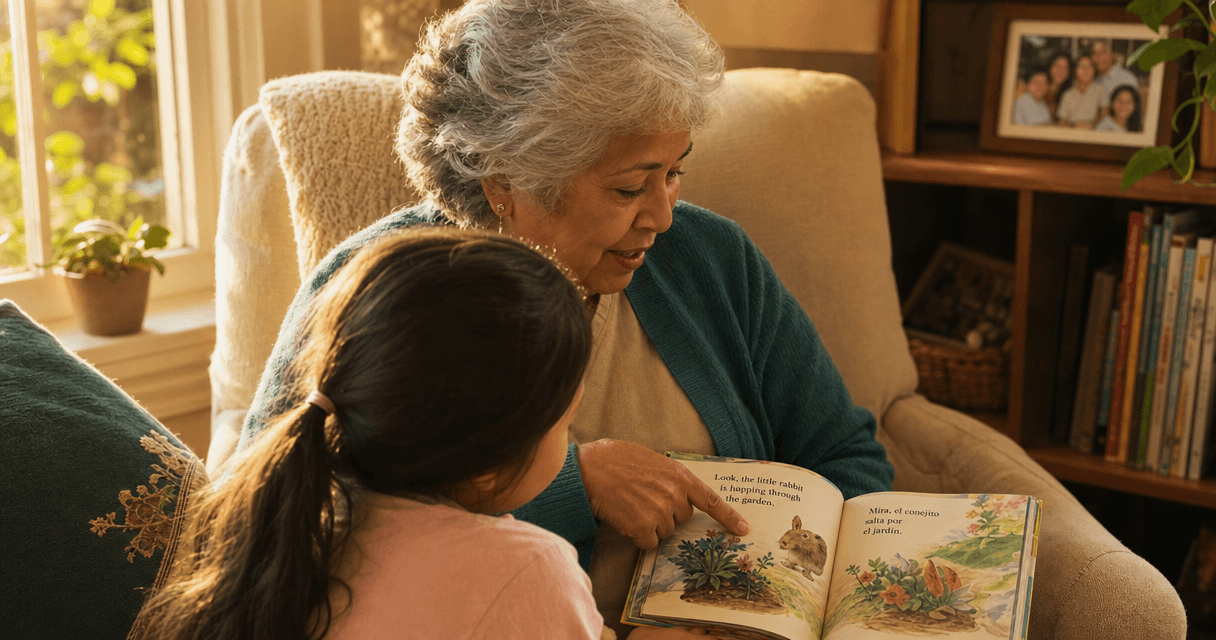
Bilingual storytime creates a natural environment where your child can hear Spanish in a culturally meaningful way while building real language skills. When stories are shared in both English and Spanish, children connect words to family traditions, see their identity reflected in the narrative, and practice listening without pressure. This dual-language approach helps heritage speakers retain Spanish while making the language feel personal and accessible.
Key takeaways
- Bilingual storytimes support both language retention and cultural identity for heritage speakers.
- Hearing stories in two languages builds vocabulary and strengthens listening comprehension naturally.
- Children connect Spanish to family traditions and community when stories reflect their heritage.
- Storytime creates a low-pressure environment where kids absorb language through context and repetition.
- Consistent exposure through bilingual stories helps children feel proud of their heritage language.
Why bilingual storytimes matter for heritage families
For families where Spanish is part of your child's heritage, bilingual storytime offers a unique bridge. According to School Library Journal, bilingual storytime is a natural environment for children to hear stories that are culturally and linguistically relevant, supporting both ethnic identity and language development.
Many heritage families face a common challenge: parents speak Spanish at home, but children respond in English. Research on immigrant families found that children who experienced more consistent use of their heritage language at home reported stronger Spanish skills as adults. The study also showed that parents who felt pride in their heritage language were more likely to use it consistently with their children.
Bilingual storytimes create a space where both languages have equal value. Your child hears Spanish woven naturally into stories, songs, and traditions—and sees that Spanish is not something to avoid, but something to celebrate.
Stories connect language to identity
When your child hears stories in Spanish, they are not just learning vocabulary. They are connecting to where their family comes from.
A Memphis Public Library bilingual storytime program found that families wanted their children to remain connected to their roots, communicate with extended family, and travel in their home countries. One storytime session featured a book about a rebozo—a traditional shawl—and children danced with play scarves while learning the word baile. A family from Mexico attended because they wanted to support their children's connection to Spanish, even though the kids used more English at home.
Stories like these help children see Spanish as part of their story, not just a subject to study.
How bilingual storytimes build language skills
Bilingual storytimes do more than preserve culture. They actively build your child's Spanish vocabulary, listening comprehension, and confidence.
Vocabulary grows through context
When children hear a story in two languages, they naturally connect new Spanish words to familiar English meanings. Research published in the National Institutes of Health notes that shared book reading benefits bilingual language acquisition, and community programs like multilingual storytimes create valuable language exposure and social networks among families.
Your child hears abuela, familia, cocina, and fiesta in the context of a story they understand. The pictures, the rhythm, and the repetition all help the words stick.
Listening comprehension strengthens naturally
Bilingual storytimes give your child a chance to practice listening without the pressure of answering questions or performing. They absorb the sounds, the sentence structure, and the flow of Spanish.
According to the American Academy of Pediatrics, reading aloud to children from infancy is one of the most effective ways to promote brain development and early literacy skills across all languages spoken in the home. When children hear stories in both languages, they build phonological awareness—the ability to recognize and work with sounds—which supports reading in both English and Spanish.
Confidence builds through familiarity
Many children feel shy about speaking Spanish, especially if they are still learning or if they mostly hear English at school. Bilingual storytimes create a welcoming space where Spanish feels normal, not intimidating.
Children see other kids listening to Spanish. They hear adults using both languages with warmth and ease. Over time, Spanish stops feeling like something foreign and starts feeling like something that belongs to them.
What makes a bilingual storytime work
Not all bilingual storytimes are the same. The most effective ones create consistency, celebrate both languages, and make children feel seen.
Both languages are valued equally
The American Library Association emphasizes that successful bilingual storytimes use opening and closing songs in both languages to signal that both have equal value. When your child hears a bilingual welcome song, they understand from the start that Spanish is not an afterthought—it is central to the experience.
Visual aids support understanding
Pictures, puppets, flannel boards, and gestures help children follow the story even when they do not know every word. Visual aids allow children at different language levels to participate and enjoy the same story.
Repetition and rhythm make language stick
Storytimes often include songs, rhymes, and repeated phrases. These patterns help children remember new words and feel confident joining in. A simple song like Los Pollitos Dicen or a repeated phrase like ¿Y tú? becomes something your child can say along with the group.
How to bring bilingual storytime home
You do not need a library program to create meaningful bilingual story moments at home. Here are simple ways to start.
Choose bilingual books your child loves
Look for books that tell the same story in both English and Spanish on facing pages, or books that mix both languages naturally. Choose stories that reflect your family's culture—food, celebrations, everyday moments—so your child sees their life in the pages.
Read the same book in both languages
You can read a favorite book in English one night and Spanish the next. Or read it in English first so your child understands the story, then read it again in Spanish. The familiarity makes the Spanish easier to follow.
Use songs and rhymes
Songs are storytelling in their own way. Sing lullabies, counting songs, or traditional rhymes in Spanish. The rhythm and repetition help your child remember words and phrases without effort.
Let your child lead
If your child wants to flip back to a favorite page, talk about the pictures, or ask what a word means, follow their curiosity. Storytime should feel like connection, not a lesson.
Why the right teacher makes storytime even more powerful
Bilingual storytimes at home are wonderful. But when your child also has a dedicated Spanish teacher who knows them, the progress accelerates.
A teacher can build on the vocabulary your child hears in stories. They can turn a word like rebozo into a conversation about traditions, or a phrase like me gusta into a game. They can celebrate when your child uses a new word and gently encourage them to try more.
Spanish For Us pairs your child with a native-speaking teacher who makes Spanish feel personal, fun, and connected to who they are. Book a free class and see how the right teacher helps your child open up.
Sources
- Beyond Bilingual: Making Storytime Inviting to All English Language Learners — School Library Journal, 2017
- Building Bilingual Skills at Home — North Star SLPC, 2026
- From Outreach to Translanguaging: Developing a Bilingual Storytime — Children and Libraries, 2020
- Bilingual Language Development in Infancy: What Can We Do to Support Bilingual Families? — PMC, 2022
- Teaching Kids to Read in Two Languages — StoryBud, 2026
- Two Languages, One Storytime: A Guide to Bilingual Storytimes — ALSC Blog, 2025
Frequently Asked Questions
What if my child only wants to hear stories in English?
Start by reading familiar favorites in Spanish—books your child already loves in English. The familiarity makes the Spanish less intimidating. You can also read the same book in English first, then again in Spanish, so they understand the story before hearing the new words. Over time, Spanish stories become just as comforting as English ones.
Do I need to be fluent in Spanish to do bilingual storytime at home?
You do not need to be fluent. Many parents read bilingual books even when their own Spanish is limited, and children still benefit from hearing the language. If you are not confident in your pronunciation, you can also play audiobooks or videos of native speakers reading the same stories. The goal is exposure, not perfection.
How often should we do bilingual storytime for it to make a difference?
Consistency matters more than length. Even 10–15 minutes a few times a week helps. The key is making it a regular part of your routine—bedtime, after school, weekend mornings—so your child hears Spanish in a warm, predictable way. Pair storytime at home with weekly live classes for even stronger progress.
What if my child understands Spanish but refuses to speak it?
This is very common, especially for heritage speakers. Bilingual storytime helps because it builds passive vocabulary and listening comprehension without forcing your child to perform. Over time, as their confidence grows and they hear more Spanish in context, speaking often follows naturally. A patient teacher who makes Spanish feel fun can also help your child open up.
Ready to get your child speaking Spanish?
Book a free 1-on-1 class with a native-speaking teacher. No commitment, no credit card.
Try a Free Class