How Can You Help Your Child Build a Spanish Vocabulary at Home?
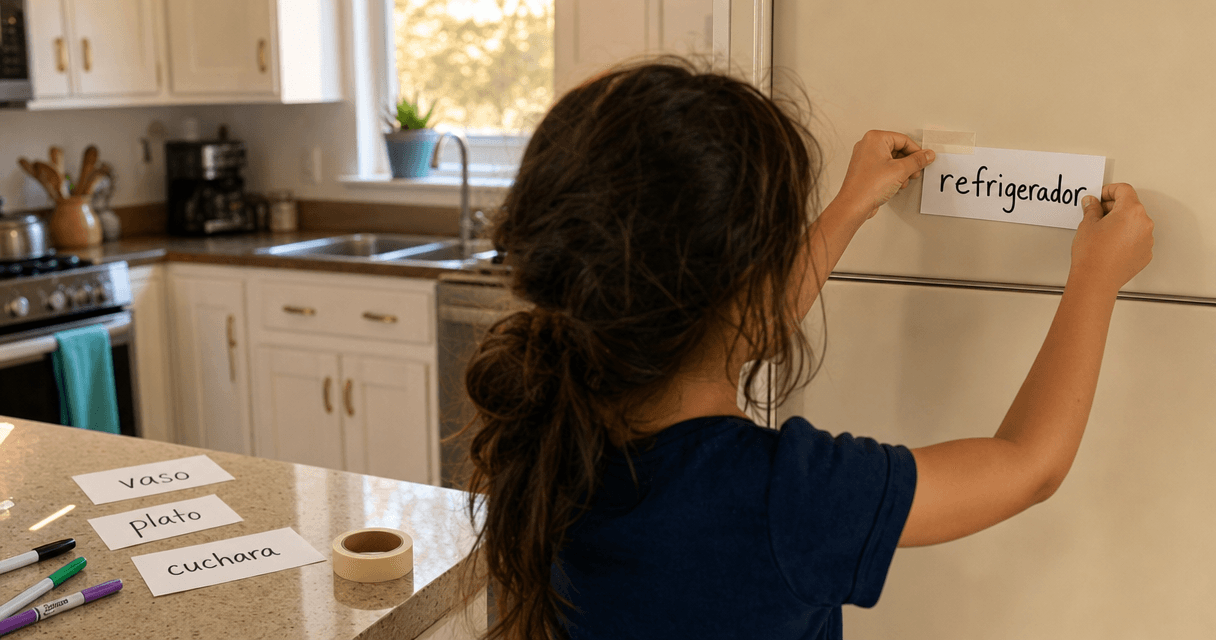
Your child can build a strong Spanish vocabulary at home through everyday conversations, labeling objects, and reading together. Research shows that children expand vocabulary most effectively through exposure in their surroundings, gleaning meaning from context. The key is creating consistent, meaningful opportunities for your child to hear and use Spanish words in natural ways.
Key takeaways
- Children learn vocabulary best through repeated exposure in meaningful contexts, not memorization.
- Labeling household objects helps children associate Spanish words with tangible items they see daily.
- Reading aloud exposes children to richer vocabulary than everyday conversation provides.
- Following your child's interest when naming objects makes word learning more effective.
- Heritage language vocabulary strengthens family communication and cultural connection across generations.
Why vocabulary matters for heritage connection
When your child learns Spanish vocabulary, something bigger happens than just adding words to their repertoire. Heritage language ability is important for children's social-emotional wellbeing, particularly their capacity to communicate with family members who speak Spanish at home.
Every new word your child learns in Spanish is a bridge to abuela, to tíos, to cousins who might otherwise feel out of reach. Research on immigrant families found that adolescents' heritage language fluency was positively related to respect for parents, with quality of communication serving as the connection. The vocabulary your child builds now shapes the relationships they'll have for years to come.
Building vocabulary from a young age is great preparation for reading fluency and comprehension later on. When your child knows more Spanish words, they can understand what they hear from family members and eventually read in Spanish with confidence.
Start with what your child already sees
The most effective spanish-vocabulary-tips begin right in your home. You don't need flashcards or formal lessons. Start by naming the objects your child encounters every single day.
Label household objects
Labeling everyday objects in your home is a simple and constructive way to encourage language growth. Put small labels on items like the sofa (sofá), table (mesa), or lamp (lámpara). Your child will see and read the object's name each day as they move through the house.
You can create labels in Spanish and place them where your child will notice:
- Bathroom items: espejo (mirror), cepillo de dientes (toothbrush), jabón (soap)
- Kitchen objects: refrigerador (refrigerator), plato (plate), vaso (glass)
- Living room furniture: silla (chair), ventana (window), puerta (door)
Research confirms that children visually process objects differently when they are labeled, using longer fixations to examine labeled objects and showing robust retention of these labels afterward. The simple act of labeling creates a print-rich environment that turns your home into a vocabulary classroom.
Follow your child's lead
Object labeling is most effective when the parent describes an object the child is already focused on—gazing at, pointing to, or vocalizing about. When your daughter picks up her doll, that's the moment to say muñeca. When your son points at the dog, say perro.
This approach works because your child's attention is already engaged. You're not interrupting their focus or redirecting them. You're simply giving them the Spanish word for what they're already curious about.
Use conversations as vocabulary practice
You don't need to be fluent to build your child's Spanish vocabulary. What matters is creating frequent opportunities for them to hear Spanish words in context.
Describe what you're doing
Talk through your daily routine in Spanish, even if you mix in English. When you're cooking dinner, name the ingredients: tomate, cebolla, arroz. When you're getting dressed, point out zapatos, camisa, pantalones.
Stimulating parent-child conversations are one of the main influencing factors on vocabulary development. You don't have to talk about anything exciting. Describe what happened earlier in your day, your routine at home, or what you see on a walk together.
Repeat new words in meaningful contexts
Repeating new words in meaningful contexts makes them more memorable for children. When you introduce a new word, use it again within the next few minutes, then again the next day.
If you teach your child enorme (enormous) while looking at a big watermelon at the grocery store, bring it up again at home: "Remember that enorme watermelon we bought? Let's cut it now." Over the next week, point out other enormous things—a tall building, a full moon, a giant teddy bear.
Read aloud in Spanish
Reading aloud to your child is the best way to increase their vocabulary. Books provide words your child won't encounter in everyday conversation, and a great story gives context and illustrations for learning new words.
Even if your child can read independently, reading aloud to them helps them access harder texts than they could read alone. This exposes them to more challenging Spanish vocabulary and creates opportunities for conversation between you.
Choose books that match your child's interests. If they love animals, find Spanish picture books about the zoo or the rainforest. If they're obsessed with trucks, look for construction vehicle books in Spanish. When children are interested in a topic, they're more curious about new words they encounter.
Pause when you come across an unfamiliar word. Offer a brief, straightforward definition right when the word comes up. Point to the illustration if it helps. Then keep reading. You're not testing your child—you're simply opening the door to a new word.
Make it part of everyday life
The goal is not perfection. The goal is exposure, repetition, and connection. Your child doesn't need to memorize lists of Spanish words. They need to hear those words used naturally, in contexts that matter to them, by people they love.
When you build your child's Spanish vocabulary at home, you're doing more than teaching language. You're preserving a connection to family, to culture, to the parts of your child's identity that Spanish carries. Every word they learn is a conversation they'll be able to have with the people who matter most.
If you want your child to move beyond vocabulary and into real conversation, they need more than labels and books. They need a teacher who knows how to make Spanish come alive. That's where Spanish For Us comes in—1-on-1 classes with a dedicated native-speaking teacher who meets your child exactly where they are.
Sources
- Vocabulary Development — ParentPowered, 2024
- Create a Print-Rich Home with Object Labels — Bilingual Balance, 2022
- Harmonious bilingual experience and child wellbeing: a conceptual framework — Frontiers in Psychology, 2026
- Vocabulary: Activities for Your Pre-K Child — Reading Rockets
- Longer looks for language: Novel labels lengthen fixation duration for 2-year-old children — ScienceDirect, 2023
- Talking Toddlers: Seven Tips to Help Develop Language Skills — ABC News, 2010
- 21 Fun Ways to Improve Your Child's Vocabulary — Bedrock Learning, 2023
- 4 Easy Ways to Build Your Child's Vocabulary at Home — Brightly, 2021
Frequently Asked Questions
What if I'm not fluent in Spanish myself?
You don't need to be fluent to help your child build vocabulary. Start with the words you do know and label objects around your home. Use picture books, videos, or apps to hear correct pronunciation, then repeat those words with your child. Many parents successfully support their child's Spanish learning by learning alongside them, and your effort shows your child that the language matters.
How many new Spanish words should I introduce each week?
Focus on quality over quantity. Introducing 3-5 new words per week and using them repeatedly in different contexts is more effective than overwhelming your child with long lists. Children need multiple exposures to a word before it sticks, so prioritize repetition and meaningful use over adding more words.
Should I correct my child's Spanish pronunciation mistakes?
Gentle correction is fine, but avoid making it feel like a test. If your child says a word incorrectly, simply repeat it back correctly in your response without stopping the conversation. For example, if they say "el gata," you can reply, "Sí, la gata es bonita." This models the correct form without discouraging them from trying.
Can labeling objects really make a difference?
Yes. Research shows that children process and remember labeled objects differently than unlabeled ones, and the simple act of seeing a word paired with an object daily reinforces learning. Labels turn your home into a constant, passive learning environment where vocabulary practice happens naturally as your child moves through their day.
Ready to get your child speaking Spanish?
Book a free 1-on-1 class with a native-speaking teacher. No commitment, no credit card.
Try a Free Class