What Are the Most Common Mistakes Kids Make When Learning Spanish?
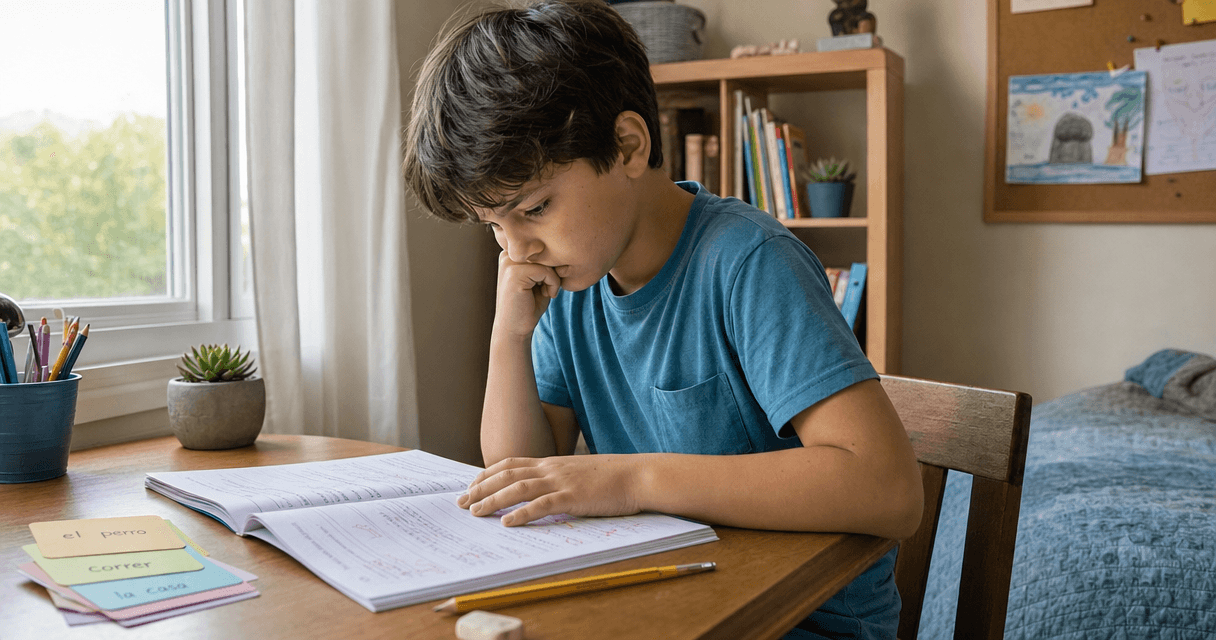
The most common Spanish learning mistakes kids make include mispronouncing the rolled R, confusing ser and estar, translating word-for-word from English, mixing up noun genders, and struggling with verb conjugations. These mistakes are predictable patterns, not signs your child can't learn Spanish.
Key takeaways
- Pronunciation errors like the rolled R and silent H are normal and fixable with consistent listening practice.
- Confusing ser and estar is one of the most frequent mistakes because English only has one verb for "to be."
- Word-for-word translation from English creates awkward Spanish sentences that don't follow natural patterns.
- Verb conjugation challenges stem from Spanish verbs changing based on subject and tense, unlike simpler English patterns.
- Catching these mistakes early prevents them from becoming ingrained habits that are harder to fix later.
Pronunciation mistakes that trip up young learners
Your child isn't struggling with Spanish pronunciation because they lack talent. Spanish has sounds that don't exist in English, like the rolled R in perro versus pero. When kids can't produce these sounds right away, they often feel defeated.
The rolled R is the biggest pronunciation hurdle. Your child might say "puh-doe" instead of perro, or avoid words with double R entirely. The silent H trips up kids too—they pronounce hola like "hotel" instead of "oh-la." The ñ sound causes confusion as well. Saying ano instead of año changes "year" to a word you definitely don't want your child using.
English speakers also over-emphasize consonants and drag out vowels in ways that sound unnatural to native Spanish speakers. Your child might say "hablow" instead of hablo, adding that telltale English "w" sound at the end.
The fix? Listening practice with native speakers. Apps and videos can't correct pronunciation in real time. A teacher who hears your child say pollo as "poyo" can gently model the correct sound and celebrate when your child gets closer.
The ser vs. estar confusion
This is the mistake that frustrates parents and kids alike. Both ser and estar mean "to be," but they're used in completely different situations. English doesn't make this distinction, so your child's brain keeps defaulting to one verb for everything.
Ser describes permanent traits: "Ella es inteligente" (She is smart). Estar describes temporary states or locations: "Ella está cansada" (She is tired). Kids mix them up constantly, saying "Soy cansado" when they mean "Estoy cansado."
School programs often teach the rule but don't give kids enough practice using it in real sentences. Your child memorizes "DOCTOR" and "PLACE" mnemonics but freezes when they need to speak. The concept clicks when they use the verbs in real conversations, not worksheets.
Word-for-word translation traps
One of the biggest mistakes is translating English directly into Spanish. Your child thinks in English, translates each word, and ends up with sentences that sound bizarre to native speakers.
For example, English says "I am 10 years old." Your child translates it as "Yo soy 10 años viejo," which is grammatically wrong. The correct Spanish is "Tengo 10 años"—literally "I have 10 years." English uses "to be" for age, but Spanish uses "to have."
Word order is another trap. English says "the red car," but Spanish says "el auto rojo"—literally "the car red." Adjectives usually come after nouns in Spanish. Kids who memorize vocabulary but not sentence patterns end up stringing words together in English order.
False cognates add another layer of confusion. Words that look similar in English and Spanish often mean completely different things. Embarazada looks like "embarrassed" but means "pregnant." Constipado looks like "constipated" but means "having a cold." These mix-ups can be funny or mortifying depending on the context.
Noun gender mistakes
Spanish assigns a gender to every noun—el for masculine, la for feminine. This is completely foreign to English speakers, and kids make gender mistakes constantly.
Your child might say "la problema" instead of "el problema," or "el mano" instead of "la mano." There's no intuitive pattern—some words that seem masculine are feminine and vice versa. Kids feel like they're guessing, and often they are.
The mistake compounds when adjectives have to match the noun's gender. "The red house" becomes "la casa roja," but "the red car" is "el auto rojo." Your child has to remember the noun's gender and then change the adjective ending to match. When they're already struggling to find the right words, this extra cognitive load is overwhelming.
The solution isn't drilling gender rules. It's learning words with their articles from the start—la mesa, not just mesa. Hearing and using the words together helps the pattern stick naturally.
Verb conjugation overload
Verb conjugation is a major hurdle because Spanish verbs change form based on who's doing the action and when. English verbs are simpler—"I speak, you speak, he speaks." Spanish has six different forms just for the present tense of hablar: hablo, hablas, habla, hablamos, habláis, hablan.
Kids who are already behind in school Spanish often shut down when faced with conjugation charts. They understand the concept in class but can't apply it when speaking. They default to the infinitive—"Yo hablar español"—which sounds like broken Spanish.
Irregular verbs make it worse. Just when your child gets comfortable with regular patterns, they hit verbs like ir (to go) and ser (to be) that don't follow any rules. "Yo voy, tú vas, él va" bears no resemblance to the infinitive ir.
Research shows that children who engage in conversational practice improve fluency 30% faster than those who rely on drills and isolated vocabulary lists. Your child needs to use conjugations in real sentences, with a teacher who corrects gently and models the right form.
The fear-of-speaking mistake
This isn't a grammar or pronunciation error, but it's one of the most damaging. Many kids hesitate to speak Spanish because they fear making mistakes. They've been corrected so many times in class that they'd rather stay silent than risk getting it wrong again.
When your child is already struggling at school, this fear becomes a self-fulfilling cycle. They don't speak, so they don't practice, so they fall further behind, so they feel even more anxious about speaking. Meanwhile, the confident kids in class are making just as many mistakes—but they're talking through them and improving faster.
A patient teacher who celebrates effort over perfection can break this cycle. When your child knows they won't be embarrassed for trying, they start to take risks. That's when real progress happens.
Why these mistakes happen—and why they're fixable
These common Spanish learning mistakes aren't random. They happen because Spanish and English have fundamentally different structures, and your child's brain is trying to apply familiar English patterns to a new language.
The good news? Every single one of these mistakes is fixable with the right support. Your child doesn't need to be naturally gifted at languages. They need consistent practice, a teacher who knows how to correct without discouraging, and a learning environment where mistakes are treated as part of the process.
When your child works with a dedicated teacher who sees the same patterns week after week, those mistakes get caught and corrected before they become habits. The teacher knows your child said "soy cansado" last week, and gently reminds them it's "estoy cansado" this week. That repetition, in a safe relationship, is what makes the correction stick.
Identifying these common mistakes gives you a roadmap. Now you know what to listen for, what to celebrate when your child gets it right, and what to expect as normal bumps in the road. Your child isn't failing Spanish. They're learning it the way every child learns it—one mistake, one correction, one small victory at a time.
If your child is struggling at school and needs help catching up, Spanish For Us pairs them with a patient, experienced teacher who knows exactly how to turn these mistakes into progress. Book a free class and see the difference a real teacher makes.
Sources
- The Top 10 Most Common Spanish Learning Mistakes — Spanish Academy, 2025
- The #1 Mistake Parents Make When Teaching Kids Spanish — Spanish Academy, 2025
- Common Pronunciation Mistakes Spanish Language Learners Make — beepboop.us, 2023
- 5 Common Mistakes In Spanish For Learners To Watch For — Duolingo Blog, 2026
- VERY Common Grammar Mistakes in Spanish: Complete Guide — Vamos Spanish, 2024
- Common mistakes in Spanish: how to avoid them — Enforex, 2025
- 150 funny and common false cognates in Spanish and English — Berlitz, 2024
Frequently Asked Questions
How long does it take for kids to stop making these common mistakes?
It varies by child, but with consistent practice and a dedicated teacher, most kids start correcting pronunciation and grammar mistakes within 8-12 weeks. The key is regular exposure—short, frequent sessions work better than long, sporadic ones. Mistakes that get caught and corrected early don't become ingrained habits.
Should I correct my child's Spanish mistakes at home if I'm not fluent?
Only if you're confident in the correction. If you're not sure, it's better to celebrate their effort and let their teacher handle corrections. Inconsistent or incorrect corrections at home can confuse your child more. Instead, encourage them to speak Spanish without fear of being wrong.
My child keeps mixing up ser and estar. Is this normal?
Completely normal. This is one of the most persistent mistakes even for intermediate learners because English doesn't distinguish between the two. Your child needs lots of practice using both verbs in real sentences, not just memorizing rules. A teacher who corrects gently in conversation helps the distinction stick naturally over time.
Can apps help fix pronunciation mistakes like the rolled R?
Apps can't replace a live teacher for pronunciation. They don't hear the specific sound your child is making or provide real-time correction. A teacher can model the sound, watch your child's mouth position, and celebrate incremental progress. Pronunciation improves fastest with human feedback.
What if my child is too embarrassed to speak Spanish after making mistakes at school?
This is common for kids who are struggling. The solution is a safe, one-on-one environment where mistakes are expected and celebrated as learning. A patient teacher who builds your child's confidence can reverse this fear. Once your child experiences being praised for trying, they start taking risks again.
Ready to get your child speaking Spanish?
Book a free 1-on-1 class with a native-speaking teacher. No commitment, no credit card.
Try a Free Class