How Can We Create a Spanish Immersion Environment at Home?
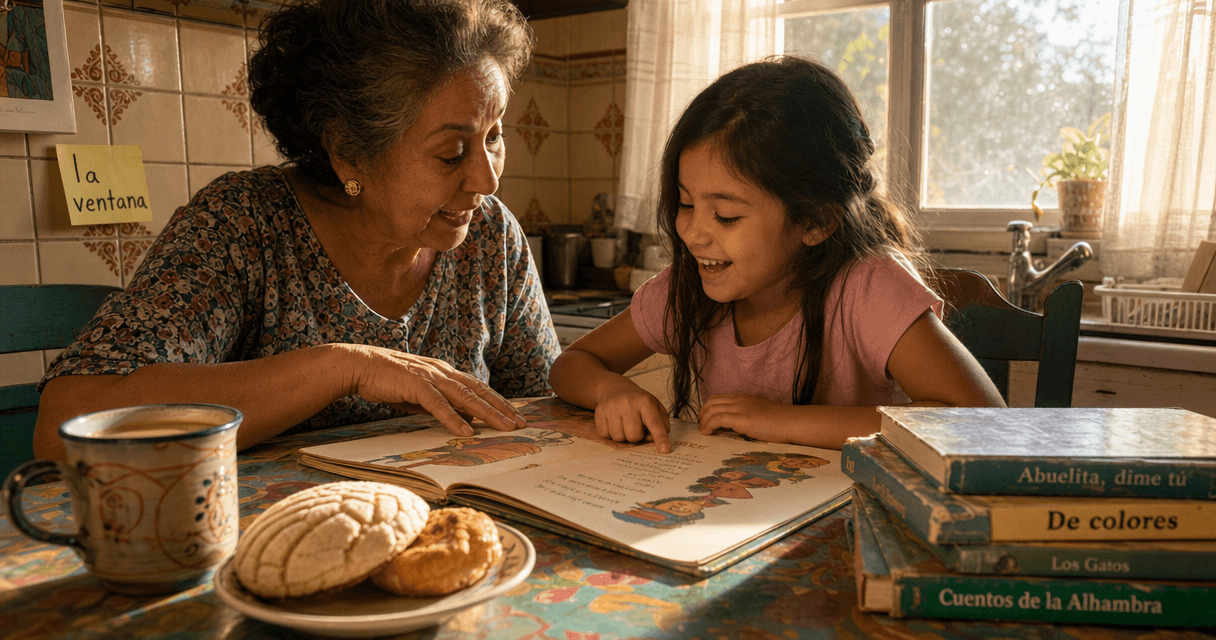
Creating a Spanish immersion environment at home gives your child daily opportunities to connect with their heritage and develop real fluency. When Spanish becomes part of everyday routines, conversations, and family traditions, your child starts speaking naturally instead of treating the language as something separate from their life.
Key takeaways
- Parental language practices and attitudes are critical factors in bilingual development and shape children's heritage language outcomes.
- Daily routines like morning greetings and mealtimes offer consistent opportunities to reinforce Spanish vocabulary and structure.
- Children who maintain fluency in their family's heritage language develop stronger cultural identity and deeper connection to their ethnic background.
- Labeling household items, celebrating cultural traditions, and connecting with Spanish-speaking family members create meaningful language practice.
- A Spanish-rich home environment makes the language feel natural, familiar, and part of your family's identity.
Why a Spanish immersion environment matters for heritage families
Your child's connection to Spanish carries family history, traditions, and the ability to speak with relatives who shaped your own life. Language is paramount for children to become socialized and develop a sense of belonging within cultural settings, which means Spanish becomes more than vocabulary — it becomes part of who they are.
Research shows that children who maintain fluency in their heritage language are more likely to develop a strong cultural identity and a deeper connection to their ethnic background. When your child can participate fully in family traditions, communicate with grandparents, and appreciate the cultural nuances embedded in Spanish, they build confidence and a positive sense of identity.
The home is where this connection either thrives or fades. Parental language practices and attitudes are critical factors in bilingual development and shape children's heritage language outcomes. The good news? You can create an environment where Spanish feels as natural as breathing.
Weave Spanish into daily routines
Daily routines offer some of the most effective opportunities for at-home Spanish learning, and your child already knows what to expect during these moments. Using familiar activities to introduce or reinforce Spanish helps the language stick.
Morning and evening rituals
Start the day with "¡Buenos días! ¿Cómo dormiste?" instead of "Good morning." Name clothing items as your child gets dressed: "Ponte la camisa. ¿Dónde están tus zapatos?"
End the day the same way. Say "Buenas noches" during bedtime, talk about the day in simple Spanish phrases, or read a Spanish bedtime story together.
Mealtime vocabulary
Meals happen every day, which makes them perfect for repetition. Use words like "agua," "leche," "tenedor," "cuchara," and "servilleta" during breakfast, lunch, and dinner. Ask your child to pass items in Spanish or describe what they are eating.
Over time, your child will associate Spanish words with actions and objects, leading to more confident and spontaneous use of the language.
Label your home in Spanish
One of the simplest ways to surround your child with Spanish is to label common household items. Stick labels on "la puerta," "la mesa," "la silla," "el refrigerador," and "la ventana."
This strategy works because your child sees the words multiple times a day in context. They start recognizing written Spanish while reinforcing spoken vocabulary. You can expand the labels as your child grows — add phrases like "Apaga la luz" near light switches or "Lávate las manos" near the bathroom sink.
Build a Spanish home library
Books create opportunities to read together, hear new vocabulary, and explore stories that reflect your family's culture. Start a designated shelf or basket for Spanish books only. Keep them somewhere your child can see and choose books on their own.
Your local library likely has a Spanish section. If the collection is small, ask about interlibrary loan to access books from other branches. You can also explore Spanish audiobooks, which help with listening comprehension and expose your child to native pronunciation.
Look for books that connect to your family's specific heritage — stories set in the country your family is from, folktales you heard growing up, or books about traditions you celebrate.
Use Spanish music, songs, and media
Music makes language memorable. Play Spanish songs during car rides, while cooking, or during playtime. Sing along together. Traditional children's songs and nursery rhymes are repetitive and help with pronunciation and vocabulary.
You can also switch screen time to Spanish. Change the language setting on your child's favorite shows or find age-appropriate Spanish cartoons and movies. Watching familiar stories in Spanish helps your child follow along while hearing native speakers.
Celebrate cultural traditions in Spanish
Cultural holidays and family traditions give Spanish meaning beyond the classroom. Celebrate holidays from your family's country of origin and talk about their significance in Spanish. Cook traditional meals together and name ingredients, tools, and steps in Spanish.
These moments teach your child that Spanish carries memories, values, and connection. Families who teach their kids a heritage language pass down a cultural identity that feels like home, turning everyday activities into cultural experiences.
Connect with Spanish-speaking family and community
Your child needs to hear and use Spanish with real people, not just through books and screens. Bilingualism helps bridge language gaps between generations, enabling deeper connections — your child can share stories and traditions with grandparents that might otherwise be lost in translation.
Schedule regular video calls with Spanish-speaking relatives. Encourage your child to speak Spanish during the call, even if they mix in English. The relationship matters more than perfection.
Look for local Spanish playgroups, cultural events, or community gatherings where your child can interact with other Spanish-speaking families. Social interaction builds real-world language practice and shows your child that Spanish is something other kids speak too.
Make Spanish the language of specific times or places
Some families choose to speak only Spanish at home, but that can feel overwhelming. A gentler approach is to designate certain times or activities as "Spanish time."
Pick one day a week — "Spanish Sunday" — where the family speaks as much Spanish as possible. Or make certain activities Spanish-only: cooking together, playing board games, or weekend breakfast.
This structure gives your child predictable practice without the pressure of switching completely.
Play games and activities in Spanish
Children learn best when they are having fun. Play classic games like "Simón dice" (Simon Says), hide-and-seek ("escondite"), or memory card games in Spanish. Use Spanish instructions, count in Spanish, and celebrate wins in Spanish.
You can also create scavenger hunts with Spanish clues, cook recipes while reading instructions in Spanish, or do arts and crafts projects inspired by Spanish-speaking cultures.
These activities make Spanish feel playful and natural instead of like homework.
Speak Spanish even if you are not fluent
You do not need to be perfectly fluent to create a Spanish-rich home. Use the Spanish you know. Practice alongside your child. Make mistakes together and laugh about them.
Your effort shows your child that Spanish matters to the family. Parents' investment is critical to children's attitudes and identity construction, and when you prioritize Spanish at home, your child sees that the language is worth learning.
If you are worried about your own Spanish skills, consider enrolling your child in live 1-on-1 classes with a native-speaking teacher. A dedicated teacher who knows your child by name can provide the fluency modeling and personalized practice that complements what you build at home.
Creating a Spanish immersion environment at home takes intention, but it does not require perfection. When you weave Spanish into daily routines, surround your child with books and music, celebrate your family's traditions, and connect with Spanish-speaking relatives, you give your child something priceless: the ability to speak the language of their roots. If you are ready to add personalized support to your home efforts, Spanish For Us pairs your child with a dedicated native-speaking teacher for live 1-on-1 classes that make Spanish feel personal, fun, and confidence-building.
Sources
- Resilient heritage language maintenance: the interplay of family, culture, and pragmatic choices — Frontiers in Psychology, 2025
- Language and culture – integral parts of a bilingual child's identity — Multilingual Parenting, 2021
- The Benefits and Challenges of Bilingualism in Multicultural Families — Daniel Dashnaw, 2024
- How to Support Spanish Immersion at Home: 10 Easy Activities for Preschoolers — Inic Preschool, 2026
- How Bilingualism Builds Stronger Family Connections — Jump Immersion School, 2026
- Language and Cultural Identity Construction in Children Attending a Bilingual Programme in France: A Longitudinal Case Study — Journal of Language, Identity & Education, 2024
Frequently Asked Questions
What if I'm not fluent in Spanish myself?
You don't need to be fluent to create a Spanish-rich home. Use the Spanish you know, practice alongside your child, and make mistakes together. Your effort shows your child that Spanish matters. You can also bring in native-speaking support through live classes, video calls with relatives, or Spanish-speaking community connections to complement what you build at home.
How much Spanish exposure does my child need each day?
Consistency matters more than duration. Even 15-30 minutes of meaningful Spanish practice daily — through conversation, reading, songs, or play — builds fluency over time. The key is making Spanish a predictable part of your routine so your child hears and uses it regularly, not just once in a while.
Will mixing Spanish and English at home confuse my child?
No. Children have the ability to learn multiple languages and do so in many parts of the world. Code-switching between languages is normal in bilingual families and does not harm language development. What matters most is that your child hears and practices both languages consistently.
What if my child resists speaking Spanish at home?
Resistance often happens when Spanish feels like pressure instead of connection. Make it playful — use games, music, cooking, and activities your child already enjoys. Connect Spanish to people they love, like grandparents or cousins. When Spanish feels fun and meaningful, kids are more likely to participate willingly.
Can I create immersion if no one else in my household speaks Spanish?
Yes, though it requires more intentional effort. Surround your child with Spanish through books, music, shows, and online classes with native speakers. Connect with Spanish-speaking community members, schedule regular video calls with relatives, or find local playgroups. A dedicated teacher who sees your child weekly can provide the consistent native-speaker interaction that builds fluency.
Ready to get your child speaking Spanish?
Book a free 1-on-1 class with a native-speaking teacher. No commitment, no credit card.
Try a Free Class