What Are the Best Strategies for Encouraging Spanish Conversations at Home?
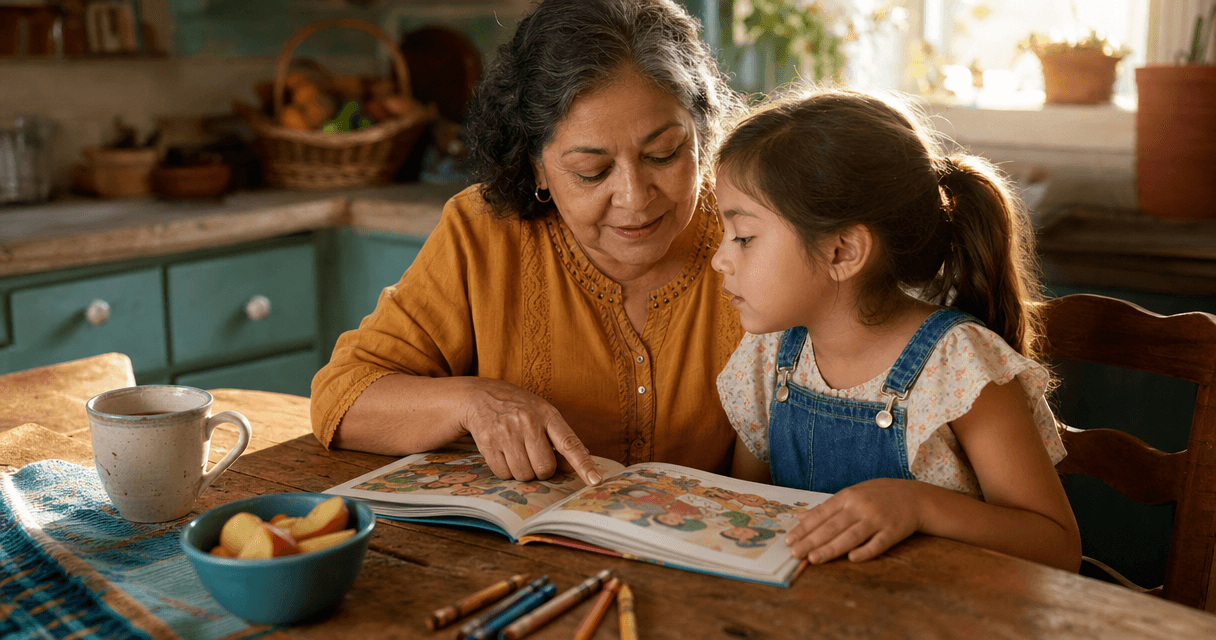
Create a home where Spanish flows naturally. Research shows that children's language use patterns mirror their parents' level of commitment, making your daily efforts the foundation of your child's bilingual journey.
Key takeaways
- Speaking only Spanish at home gives children significantly more exposure than one-parent approaches, with a 97% success rate for bilingualism.
- Code-switching between languages is a normal part of bilingual development and should never be corrected or discouraged.
- Quality language interactions matter more than quantity—rich conversations during daily routines build stronger skills than formal study time.
- Children naturally respond to Spanish when it becomes part of games, stories, and everyday moments rather than feeling like a lesson.
- Consistency across family members creates a supportive environment where Spanish feels like home, not homework.
Why your home language strategy matters
Your child hears English everywhere—at school, on the playground, in stores. Spanish needs a protected space to grow. The home is that space.
Linguist Annick De Houwer found that 96% of children in families using the minority language at home become bilingual, compared to lower success rates with other approaches. When both parents speak Spanish at home consistently, your child receives the rich, sustained input their brain needs to build fluency.
This approach works because it creates clear boundaries. Spanish is the language of family, of belonging, of abuela's stories and Sunday meals. English is the language of the outside world. Your child learns to move between both with confidence.
Make Spanish the language of connection
Start with daily routines
Your child cycles through the same conversations every single day. Use them.
Morning greetings in Spanish set the tone before your child's feet hit the floor. "Buenos días, mi amor. ¿Cómo dormiste?" becomes muscle memory. Mealtime offers natural openings: "¿Qué quieres comer?" "Pásame el agua, por favor." Bedtime routines close the day in Spanish—stories, songs, and whispered goodnight wishes.
Quality language interactions during everyday moments help children develop stronger skills in both languages, according to research from the National Association for the Education of Young Children. You don't need worksheets. You need conversation.
Turn play into practice
Children learn best when they're having fun. A puppet who "only speaks Spanish" suddenly makes the language essential. Role-playing a restaurant, a store, or a doctor's visit gives your child real reasons to use Spanish vocabulary.
Conversation prompts work beautifully. Ask "Si fueras un animal, ¿cuál serías?" or "¿Qué prefieres: el sol o la luna?" These open-ended questions spark longer responses than yes-or-no questions ever will.
Board games, scavenger hunts, and cooking together all become Spanish practice when you narrate what you're doing. "Vamos a buscar tres cosas rojas" turns cleanup into a game. "Cuenta los huevos" makes your child the chef's assistant.
What to do when your child answers in English
This is the moment every heritage parent knows. You ask a question in Spanish. Your child answers in English.
Don't correct. Don't scold. Just respond naturally in Spanish and keep the conversation going.
Code-switching is a normal part of bilingual development, especially in young children. When your child mixes languages, they're not confused—they're using every tool they have to communicate. Parents strategically code-switch to enhance understanding and teach new words, and children do the same.
Model the language you want to hear. If your child says "I want water," hand them the glass and say "Aquí está tu agua." You've acknowledged their request and given them the Spanish phrase. Over time, with enough exposure, they'll reach for the Spanish first.
Build a language-rich environment
Surround them with Spanish
Label household items with sticky notes: "la puerta," "la mesa," "el espejo." Your child absorbs vocabulary through constant visual exposure.
Create a Spanish corner with books, puzzles, and games. Make it the coziest spot in the house—the place where Spanish stories come alive.
Play Spanish music during breakfast, car rides, and playtime. Songs teach pronunciation and vocabulary in ways that stick. Your child will sing "Los Pollitos Dicen" long after they've forgotten a vocabulary list.
Connect Spanish to identity
Talk about why Spanish matters. Share stories about your childhood, your parents, the places where your family comes from. When your child understands that Spanish is the language of their roots, it becomes more than words—it becomes belonging.
Celebrate Spanish-language holidays with music, food, and traditions. Video calls with Spanish-speaking relatives give your child real audiences and real reasons to speak.
Research on heritage language maintenance shows that cultural connection and family ties serve as key motivations for children to maintain their home language. Your child speaks Spanish to talk to abuela, to understand tía's jokes, to be part of the family in a way English can't provide.
Involve the whole family
Consistency across family members reinforces Spanish as the home language. When siblings speak Spanish to each other, when grandparents visit and fill the house with stories, when everyone at the dinner table uses the same language—your child sees Spanish as normal, not special.
If one parent doesn't speak Spanish fluently, they can still support the effort. Learning alongside your child, celebrating their progress, and creating space for Spanish to flourish all matter.
When you need more support
Sometimes home isn't enough. Your child needs practice with someone outside the family—someone who expects Spanish, who won't let them slide into English, who makes conversation feel like play.
That's where a dedicated teacher changes everything. A native-speaking teacher who knows your child's name, remembers what they talked about last week, and designs every class around their interests gives your child something you can't: structured, consistent practice with an adult who speaks Spanish naturally.
Weekly classes create accountability and momentum. Your child practices at home because they want to tell their teacher about it. They learn new phrases in class and bring them to the dinner table. The two environments feed each other.
If you're ready to give your child that kind of support, Spanish For Us matches your child with a native-speaking teacher for 1-on-1 classes they'll actually look forward to. It's the missing piece that turns home efforts into real fluency.
Sources
- Resilient heritage language maintenance: the interplay of family, culture, and pragmatic choices — Frontiers in Psychology, 2025
- Which Family Language Strategy Works for You? — Spanish Academy, 2025
- Benefits When Families Speak Their Home Languages — NAEYC, 2024
- What Parents Have to Teach Us About Their Dual Language Children — NAEYC, 2015
- How Bilingual Infants Cope with Code-Switching — University of Delaware Learning Sciences Blog, 2020
- Resilient heritage language maintenance: the interplay of family, culture, and pragmatic choices — PMC, 2025
Frequently Asked Questions
What if I'm not fluent in Spanish myself?
You don't need perfect Spanish to create a Spanish-speaking home. Focus on using the Spanish you do know during daily routines—greetings, mealtimes, bedtime. Learn alongside your child using books, songs, and apps. Your effort and consistency matter more than fluency. Many families also bring in a native-speaking teacher for structured practice while parents provide the everyday exposure.
How much Spanish exposure does my child actually need?
Children need consistent, daily exposure to develop fluency. Aim for Spanish to be the primary language at home—during meals, play, routines, and conversations. Even 30 minutes of focused, quality interaction daily builds skills, but the more Spanish your child hears and uses, the stronger their foundation becomes. Consistency across days and family members matters more than long study sessions.
Should I correct my child when they make mistakes in Spanish?
No. Correcting mistakes can make children self-conscious and discourage them from speaking altogether. Instead, model the correct form naturally in your response. If your child says something incorrectly, repeat it back the right way as part of continuing the conversation. This gentle modeling helps them learn without feeling criticized or shut down.
My child understands Spanish but won't speak it—what do I do?
This is very common and completely normal. Keep speaking Spanish to them consistently, even when they respond in English. Create low-pressure opportunities to use Spanish through games, songs, and playful prompts. Celebrate any Spanish word they produce, no matter how small. Over time, as their confidence and vocabulary grow, they'll begin speaking more. Patience and persistence win here.
Can screen time help with Spanish learning at home?
Yes, when used intentionally. Spanish-language shows, movies, and educational apps provide additional exposure and model natural pronunciation. Choose age-appropriate content your child enjoys, and watch together when possible so you can talk about what you're seeing. Screen time works best as a supplement to real conversations, not a replacement for them.
Ready to get your child speaking Spanish?
Book a free 1-on-1 class with a native-speaking teacher. No commitment, no credit card.
Try a Free Class