How Does One-on-One Tutoring Benefit Children Learning Spanish?
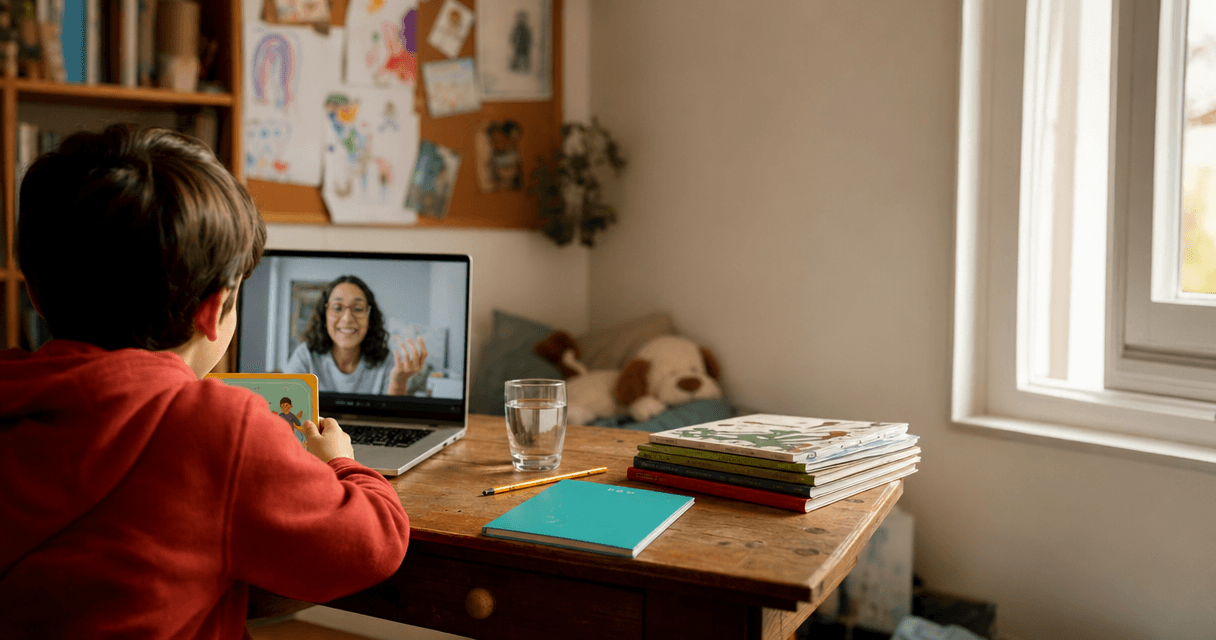
One-on-one tutoring gives your child personalized attention that group classes simply can't match. Research shows that one-on-one tutoring may be the most effective afterschool activity for improving academic achievement, and in language learning specifically, individualized instruction allows teachers to respond directly to each learner's needs. When your child has a dedicated teacher focused entirely on them, every minute of class becomes a chance to practice, ask questions, and build real fluency.
Key takeaways
- One-on-one tutoring delivers faster language progress through immediate feedback and personalized pacing.
- Children receive 100% of the teacher's attention, eliminating the distractions and wait time of group settings.
- Personalized instruction builds confidence by creating a safe space to practice without peer judgment.
- Individual lessons adapt to your child's learning style, interests, and specific challenges in real time.
- Bilingualism enhances executive function skills that support academic success across all subjects.
Your child gets 100% of the teacher's attention
In a traditional classroom, teachers divide their focus among 15 to 26 students, leaving limited time for individual attention. One-on-one tutoring changes that equation completely. Your child becomes the sole focus of every lesson.
This means immediate answers to questions, instant pronunciation correction, and real-time adjustments when a concept isn't clicking. There's no waiting for other students to finish, no competing for the teacher's eye, and no falling behind because the class moved on too quickly. Educational psychologist Benjamin Bloom discovered that students who receive tutoring can perform better than 98% of students in the traditional classroom, a finding that has held up across decades of research.
Faster progress through personalized pacing
Every child learns at their own speed. In a group class, the pace is set by the average—too slow for some, too fast for others. One-on-one tutoring removes that constraint.
Your child's teacher can spend extra time on tricky verb conjugations or breeze through vocabulary they've already mastered. They can circle back to pronunciation until it's perfect or introduce more advanced conversation when your child is ready. This flexibility means your child isn't held back by the group or left behind when they need more time.
Confidence grows in a judgment-free space
Many children hesitate to speak in group settings. They worry about making mistakes in front of peers, being corrected publicly, or not keeping up with more confident classmates. That anxiety can shut down participation—and without practice speaking, language learning stalls.
One-on-one lessons eliminate that social pressure. Individual language classes provide a supportive and non-intimidating environment where the student can practice their language skills without fear of judgment, leading to increased confidence in speaking and communicating. Your child can make mistakes, ask for help, and try new phrases without worrying what anyone else thinks. That freedom to experiment is where real fluency begins.
Mistakes become learning moments
In a one-on-one setting, errors aren't embarrassing—they're opportunities. The teacher can address each mistake immediately, explain why it happened, and guide your child to the correct form. This kind of targeted correction is far more effective than generic feedback delivered to a group.
Over time, your child internalizes these corrections and begins to self-correct. That's the hallmark of true language proficiency, and it happens faster when every error gets immediate, personalized attention.
Lessons adapt to your child's learning style
Some children learn best through visual aids. Others need hands-on activities or repetition through songs and games. In a group class, the teacher uses a one-size-fits-all approach. In a one-on-one lesson, the teacher tailors every activity to how your child learns best.
If your child loves stories, the teacher can build vocabulary through picture books. If they're kinesthetic learners, the lesson might include movement games. If they're struggling with a specific grammar concept, the teacher can create custom exercises until it clicks. This level of customization simply isn't possible when one teacher is managing multiple students.
Real-time adjustments keep your child engaged
A good one-on-one teacher reads your child's cues. If energy is flagging, they switch to a game. If your child is confused, they slow down and reteach. If your child is bored, they introduce a challenge.
This responsiveness keeps lessons engaging and prevents the frustration that can make children resist language learning altogether. Your child stays motivated because the lesson always meets them where they are.
Bilingualism builds cognitive advantages that last
The benefits of one-on-one Spanish tutoring extend far beyond language. Bilingual children have been shown to outperform monolingual children on tasks measuring executive functioning skills, including attention, working memory, problem-solving, and task switching. These are the same skills that support academic achievement across every subject.
A 2023 review of 147 studies found that bilingual children perform better in executive functions, the mental processes that help kids plan, focus, remember instructions, and juggle multiple tasks. These advantages appear early—some research shows benefits in children as young as two years old—and they compound over time.
When your child learns Spanish through personalized one-on-one instruction, they're not just gaining a second language. They're strengthening the cognitive skills that will help them excel in math, reading, science, and beyond.
The teacher-student relationship drives results
One-on-one tutoring creates a relationship, not just a transaction. Your child sees the same teacher every week. That teacher learns your child's name, interests, strengths, and challenges. They celebrate progress together and work through frustrations as a team.
This continuity matters. Children are more motivated to practice for a teacher who knows them. They're more willing to take risks and try new things with someone they trust. And they're more likely to stick with Spanish long-term when it's connected to a positive, supportive relationship.
Accountability and consistency
When your child has a dedicated teacher, they show up. There's no hiding in the back of a group class or letting someone else answer all the questions. Your child is accountable for their own learning, and that accountability builds responsibility and work ethic.
The consistency of seeing the same teacher weekly also creates a rhythm. Your child knows what to expect, the teacher knows exactly where to pick up each lesson, and progress builds week after week without gaps or repetition.
Why Spanish For Us makes one-on-one tutoring work
At Spanish For Us, every child gets a dedicated native-speaking teacher matched to their age, level, and personality. These aren't random tutors from a marketplace—they're experienced educators who specialize in teaching children and know how to make language learning fun.
Your child's teacher will get to know them, adapt every lesson to their needs, and guide them from single words to full conversations. Classes are 30 minutes of focused, engaging instruction where your child is the star. And if the fit isn't perfect, we'll rematch at no cost.
Ready to see what personalized Spanish instruction can do for your child? Book a free trial class and watch them start speaking with confidence.
Sources
- One-on-One and Small-Group Tutoring — Southwest Educational Development Laboratory
- Why One-on-One Language Lessons Accelerate Learning According to Science — Language Trainers USA, 2026
- 6 Benefits of One-to-One Tutoring — Hoot Reading, 2022
- Should You Take Individual or Group Language Classes? — Polyglottist Language Academy, 2025
- The effects of bilingualism on toddlers' executive functioning — PMC (NIH)
- From childhood to aging: the powerful cognitive benefits of bilingualism — Ynetnews, 2025
Frequently Asked Questions
What if my child is shy and won't speak in front of a teacher?
One-on-one lessons are actually ideal for shy children. Without peers watching, most kids relax and open up quickly. The teacher can start with low-pressure activities like games or songs, building confidence gradually. Many parents tell us their shy child became the most talkative one in the family after a few weeks of personalized classes.
How much does one-on-one tutoring cost compared to group classes?
One-on-one classes typically cost more per session than group classes, but the return on investment is higher. Your child gets 100% of the teacher's time, progresses faster, and builds fluency in weeks instead of months. At Spanish For Us, classes start at $23 per session, and you can try the first class free to see the difference for yourself.
Will my child miss out on peer interaction without a group class?
While group classes offer social interaction, they often sacrifice speaking time and personalized attention. In a one-on-one setting, your child practices conversation with a fluent native speaker every single class—far more valuable than chatting with other beginners. Many families supplement with Spanish playdates or cultural activities for the social piece.
How do I know if the teacher is a good fit for my child?
At Spanish For Us, we use AI-powered matching to pair your child with a teacher based on age, level, and personality. You'll meet the teacher during your free trial class. If the fit isn't right for any reason, we'll rematch you at no cost. The goal is a teacher your child genuinely connects with and looks forward to seeing every week.
How quickly will I see progress with one-on-one lessons?
Most parents notice a difference within the first few weeks—new words used at home, more confidence trying Spanish phrases, excitement about class. Measurable progress depends on frequency (we recommend at least twice weekly) and practice between sessions, but personalized instruction consistently delivers faster results than group settings or apps.
Ready to get your child speaking Spanish?
Book a free 1-on-1 class with a native-speaking teacher. No commitment, no credit card.
Try a Free Class