Creative Ways to Practice Spanish Outside of Class (That Kids Actually Love)
The most effective way to practice Spanish outside of class is to weave the language into everyday moments your child already enjoys — games, music, cooking, and screen time. Research shows that children who receive consistent daily exposure to a second language retain vocabulary and build fluency far more effectively than those who rely on weekly lessons alone. The key is making practice feel like play, not homework.
Key takeaways
- Daily exposure to Spanish, even in short bursts, reinforces what your child learns in class and accelerates fluency.
- Music, games, and cooking are high-engagement activities that build vocabulary without feeling like formal study.
- Labeling household objects in Spanish creates passive exposure that strengthens word recognition over time.
- Watching familiar movies in Spanish helps children connect meaning to sound and pick up natural pronunciation.
- Outdoor scavenger hunts and movement-based games combine physical activity with language practice in memorable ways.
Why practice outside of class matters
Your child's weekly Spanish class is building the foundation. But language fluency requires repetition and context that a single hour can't provide. Studies on bilingual children show that home language activities — such as shared reading, singing, and conversation — directly predict vocabulary growth in both languages.
The good news? You don't need to be fluent in Spanish to create a language-rich environment at home. You just need consistency, creativity, and a willingness to make Spanish part of your family's routine.
Turn screen time into Spanish time
Your child already watches shows and movies. Make that time work double duty.
Switch the audio to Spanish on their favorite movies — especially ones they've already seen in English. When children know the storyline, they can follow along even when they don't catch every word. Disney films, Encanto, Coco, and animated series on Netflix all offer Spanish audio tracks.
If your child is reading age, turn on Spanish subtitles alongside the Spanish audio. Seeing and hearing the words at the same time reinforces spelling and pronunciation.
For younger kids, YouTube channels like 123 Andrés and Rockalingua offer original Spanish songs designed for language learners. The repetition, visuals, and catchy melodies make vocabulary stick.
Set a weekly movie night rule
Pick one night a week where the family watches something in Spanish. Make popcorn, settle in, and let your child hear native speakers in action. Over time, this becomes a tradition they look forward to — not a chore.
Sing, dance, and repeat
Music improves pronunciation, memory retention, and overall language skills in children learning a second language. Songs with repetitive lyrics and simple melodies are especially effective because kids can sing along after just a few listens.
Create a Spanish playlist for car rides, morning routines, or dance parties in the living room. Include classics like "Las Ruedas del Autobús" (The Wheels on the Bus) and "Cabeza, Hombros, Rodillas y Pies" (Head, Shoulders, Knees and Toes).
Younger children love action songs where they can move their bodies while singing. Older kids might enjoy current Spanish pop songs — artists like Shakira, Juanes, or Bad Bunny make language practice feel cool, not educational.
Cook together in Spanish
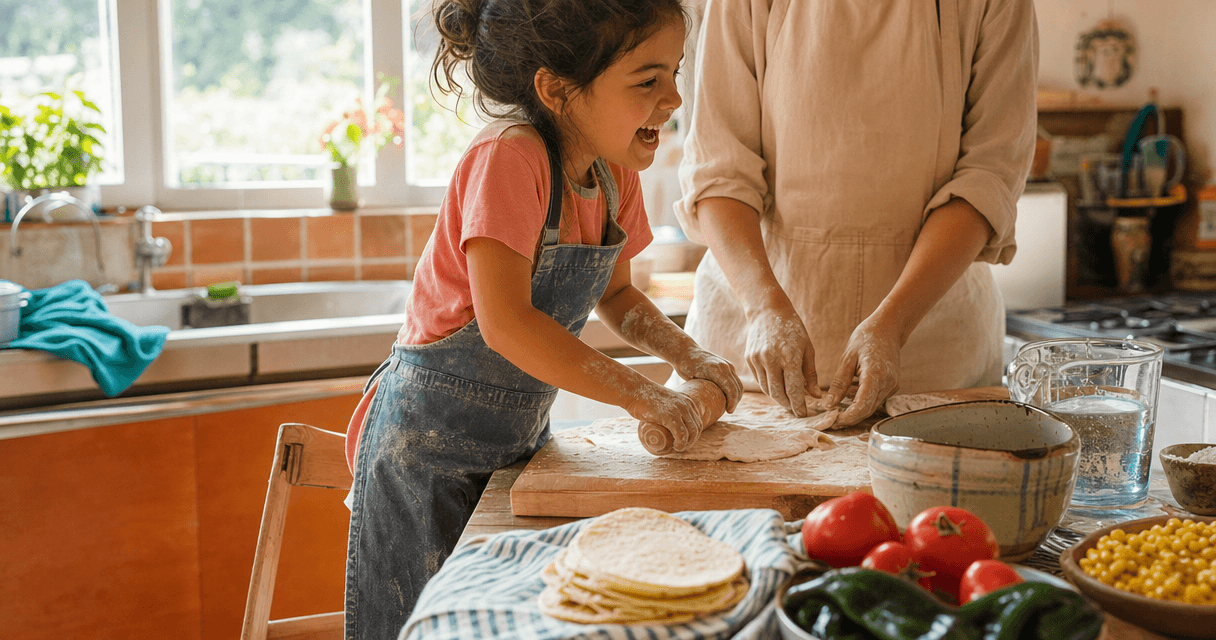
Cooking is a natural language laboratory. You're naming ingredients, following steps, using action verbs (cortar, mezclar, hornear), and describing textures and tastes.
Find a simple recipe in Spanish — empanadas, quesadillas, arroz con leche — and walk through it together. Even if you're reading the recipe in English and translating key words, your child is hearing Spanish vocabulary in a meaningful context.
Make a shopping list in Spanish before you go to the store. Have your child help you find los tomates, la leche, and el queso. The physical act of locating and holding the item cements the word in their memory.
Label your home
This is one of the simplest, lowest-effort strategies — and it works.
Print or write Spanish labels for common objects around the house: la puerta (door), la ventana (window), la mesa (table), el refrigerador (refrigerator). Stick them where your child will see them daily.
You're not asking your child to study the labels. You're creating passive exposure. Over time, the repetition sinks in. When your child walks past la puerta fifty times a week, the word becomes automatic.
Rotate the labels every few weeks to keep things fresh. Focus on different rooms or themes — kitchen vocabulary one month, bedroom vocabulary the next.
Play games that require Spanish
Games are the secret weapon of language learning. They're competitive, social, and fun — which means kids stay engaged longer and retain more.
Spanish Bingo (Lotería)
Create bingo cards with Spanish vocabulary words or images. Call out the words in Spanish, and players mark their cards. The first to complete a row shouts "¡Lotería!" or "¡Bingo!"
You can theme the cards around animals, colors, food, or whatever your child is learning in class.
Simón Dice (Simon Says)
This classic game is perfect for practicing verbs and body parts. "Simón dice… toca tu nariz." (Simon says… touch your nose.) If your child is just starting out, stick to simple commands. As they progress, add more complex instructions.
Scavenger hunts
Hide objects around the house or yard and give clues in Spanish. "Encuentra algo azul." (Find something blue.) "Busca el libro rojo." (Look for the red book.)
Outdoor scavenger hunts are especially effective because they combine movement, discovery, and language practice. Kids are so focused on the hunt that they forget they're learning.
Memory matching games
Use flashcards or printed images to play memory. Lay pairs of cards face down, flip two at a time, and try to find matches. Every time your child flips a card, they name the object in Spanish.
This game builds vocabulary and strengthens recall under pressure — both critical for conversational fluency.
Read together — even if you're not fluent
Reading in Spanish doesn't require perfect pronunciation. It requires consistency.
Find bilingual picture books at your library or order a few online. Classics like Buenas Noches, Luna (Goodnight Moon) and La Oruga Muy Hambrienta (The Very Hungry Caterpillar) are available in Spanish and easy to follow.
If your child is a beginning reader, let them read aloud to you. If they're younger, you read to them — even if you stumble over words. Your child is hearing the rhythm and structure of Spanish, and that's what matters.
For families who want native pronunciation, audiobooks are a game-changer. Pair the physical book with the audio version so your child can see and hear the words at the same time.
Dedicate 10 minutes a day to "Spanish-only" time
Set a timer for ten minutes and challenge your family to speak only Spanish. It doesn't have to be perfect. You can point, gesture, use English words when you're stuck, and laugh at mistakes.
The goal isn't fluency — it's creating a low-pressure space where your child practices thinking in Spanish. Even ten minutes a day adds up to over an hour of practice each week.
You can theme these sessions: Spanish breakfast where you name everything on the table, Spanish playtime where you describe what you're building, or Spanish bedtime where you talk about the day.
Use apps strategically (but don't rely on them alone)
Apps like Duolingo, Gus on the Go, and Endless Spanish can supplement your child's learning. They're colorful, gamified, and give instant feedback — which kids love.
But apps should never replace human interaction. Language is social. Your child needs to hear Spanish spoken by real people, respond in real time, and make mistakes in a safe environment.
Use apps for vocabulary reinforcement and pronunciation practice. Use conversation — with you, with their teacher, with Spanish-speaking family or friends — for everything else.
Make it a family effort
Your child is more likely to practice Spanish outside of class if the whole family is on board. When everyone participates — even badly — it normalizes the learning process and removes the pressure to be perfect.
You don't need to become fluent alongside your child. You just need to show them that trying is worth it, that mistakes are part of learning, and that Spanish is something the whole family values.
The families who see the most progress are the ones who treat Spanish as a lifestyle, not a subject. It's the language of movie night, the soundtrack to Saturday morning pancakes, the game you play in the car. It's woven into the fabric of daily life — which is exactly how children become fluent.
If you're looking for a teacher who can build on what you're practicing at home, Spanish For Us pairs your child with a dedicated native-speaking teacher for 1-on-1 classes designed around their interests and learning style. Your first class is free.
Sources
- Home Language Activities and Expressive Vocabulary of Toddlers from Low-SES Monolingual Families and Bilingual Immigrant Families — PMC, 2020
- Home Environment, Bilingual Preschooler's Receptive Mother Tongue Language Outcomes, and Social-Emotional and Behavioral Skills — PMC, 2019
- Everyday Easy Spanish Activities for Kids — TruFluency Kids, 2023
Frequently Asked Questions
How much time should my child spend practicing Spanish outside of class?
Even 10-15 minutes of daily exposure makes a significant difference. Consistency matters more than duration. Short, frequent practice sessions throughout the week — through songs, games, or conversation — are more effective than a single long study session.
What if I don't speak Spanish myself?
You don't need to be fluent to support your child's learning. Use audiobooks, Spanish-language shows, and music to provide native pronunciation. Focus on creating opportunities for exposure and celebrating your child's progress, even if you're learning alongside them.
My child resists practicing at home. How do I motivate them?
Make practice feel like play, not work. Let your child choose the activity — whether it's a game, a song, or cooking together. Avoid turning practice into a chore or a test. When kids associate Spanish with fun, they're far more likely to engage willingly.
Should I correct my child's mistakes during informal practice?
Focus on encouragement over correction during casual practice. If your child says something incorrectly, model the correct version naturally in your response rather than stopping to correct them. Building confidence and willingness to speak is more important than perfect grammar at this stage.
Can screen time really help my child learn Spanish?
Yes, when used strategically. Watching familiar movies in Spanish or educational content designed for language learners provides valuable exposure to native pronunciation and sentence structure. The key is pairing screen time with interactive activities like conversation and games, not relying on it exclusively.
Ready to get your child speaking Spanish?
Book a free 1-on-1 class with a native-speaking teacher. No commitment, no credit card.
Try a Free Class