How Can Watching Spanish Cartoons Aid Language Development?
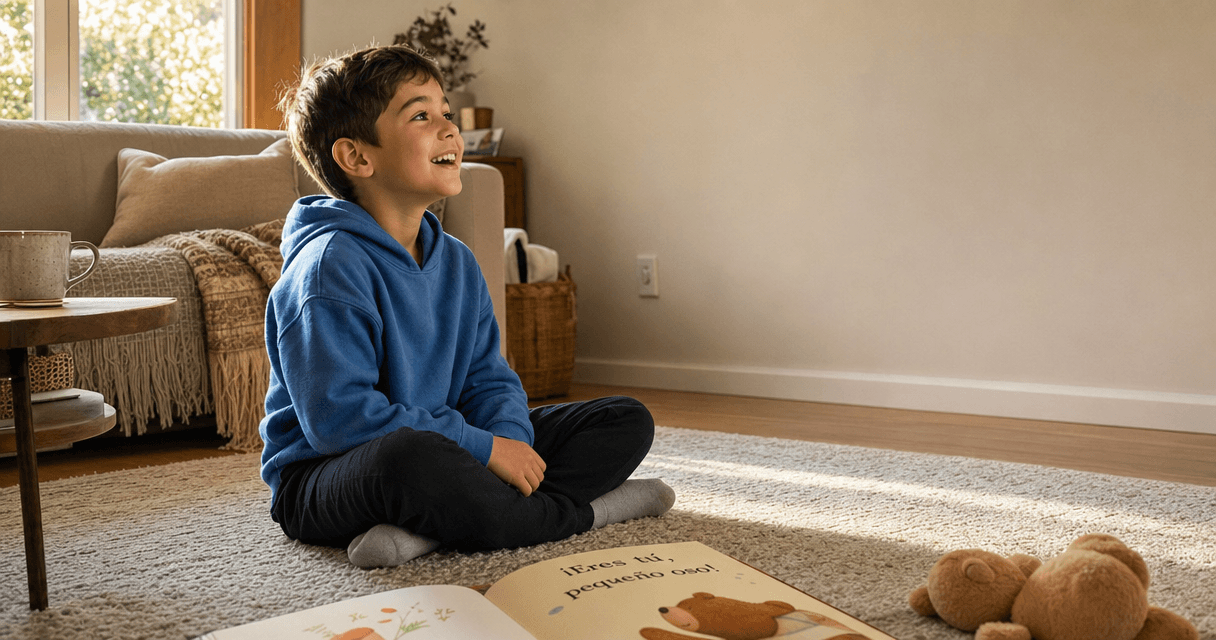
Spanish cartoons offer children a powerful way to build vocabulary and listening skills. Research shows that cartoons positively affect children's language acquisition and cognitive development, making them a valuable tool when used purposefully. As children engage with animated characters, they absorb vocabulary and phrases effortlessly through the combination of visual context, repetition, and engaging storylines.
Key takeaways
- Visual context in cartoons helps children understand new Spanish words without translation.
- Repetition of phrases and vocabulary in cartoons reinforces learning through natural exposure.
- Comprehensible input — language slightly above a child's current level — drives acquisition when paired with visual support.
- Cartoons work best as one part of a broader Spanish learning approach that includes real conversation.
- The right balance matters: cartoons can supplement but not replace interaction with a live teacher.
Why visual context makes vocabulary stick
When your child watches a Spanish cartoon, they are not just hearing words. They are seeing actions, facial expressions, and story context that make meaning clear without translation.
Verbal explanation accompanied by nonlinguistic support like visual aids is one of the most effective instructional strategies for children learning a second language. A child watching a character say "¡Tengo hambre!" while holding their stomach and looking at food immediately understands hunger without needing an English explanation.
This process mirrors how children learn their first language. They connect sounds to meaning through context, building mental associations that feel natural rather than memorized.
For children ages 5–12, this visual scaffolding helps bridge the gap between what they currently understand and what they are ready to learn next. The pictures do not just illustrate the words — they make the Spanish comprehensible.
Repetition builds phonological memory
Cartoons excel at repetition. Characters use the same phrases episode after episode. Theme songs repeat vocabulary. Story patterns become predictable.
This repetition is not boring for children — it is exactly what their brains need to lock in new language.
Studies show strong correlations between phonological memory and vocabulary knowledge in children, with the ability to hold and rehearse sound patterns playing a critical role in language development. When your child hears "¡Vamos!" dozens of times across different episodes, that phrase moves from unfamiliar to automatic.
Cartoons also use simple sentence structures and everyday language, making it easier for children to pick up patterns. A character might say "¿Dónde está?" in multiple contexts — looking for a toy, searching for a friend, hunting for a snack. Your child starts recognizing the question structure without explicit grammar instruction.
How much repetition is helpful?
Rewatching favorite episodes is actually beneficial. Your child catches new words and phrases they missed the first time, and familiar storylines reduce cognitive load so they can focus on the language itself.
Think of it like reading the same bedtime book over and over. Children find comfort in repetition, and that comfort creates the low-pressure environment where language learning thrives.
Comprehensible input: the sweet spot for learning
Not all Spanish cartoons work equally well for language development. The key is finding content at the right level.
Comprehensible input refers to language that is slightly above a learner's current level but still understandable through context. Linguist Stephen Krashen calls this the "i+1" level — where "i" is what your child already knows, and "+1" is the next step.
For a beginner, a cartoon with clear visuals, slow speech, and simple vocabulary hits that sweet spot. For a child with some Spanish exposure, a show with slightly faster dialogue and more complex plots keeps them challenged without overwhelming them.
Visual context combined with subtitles helps learners grasp both plot and language simultaneously, making media consumption a rich source of comprehensible input in an engaging format.
The magic happens when your child understands most of what is happening but encounters a few new words or phrases per episode. That is when acquisition takes hold.
What cartoons cannot do alone
Cartoons are powerful, but they have limits.
Research indicates that using cartoons as classroom material stimulates motivation, learning, and social development, but the real breakthrough comes when children have opportunities to use the language themselves.
Your child might recognize "¡Hola!" and "¡Adiós!" from their favorite show, but speaking those words to a real person feels different. Cartoons provide input — the language going into your child's brain. But language development also requires output — the chance to practice, make mistakes, and receive encouragement from someone who responds.
A child who only watches Spanish cartoons may develop strong listening comprehension and passive vocabulary. But without conversation practice, they may hesitate to speak or struggle to form their own sentences.
That is where a live teacher changes everything.
Cartoons work best as part of a bigger plan
The families who see the strongest results use cartoons as one piece of a broader Spanish learning strategy.
Here is what that might look like:
- Your child watches 15–20 minutes of a Spanish cartoon a few times per week
- They attend a weekly 1-on-1 Spanish class where a teacher builds on that exposure with conversation, games, and personalized instruction
- You sprinkle in Spanish phrases during everyday moments — at meals, in the car, before bed
- Your child hears the same vocabulary from multiple sources, reinforcing what they are learning
Cartoons create familiarity and comfort with Spanish sounds. A dedicated teacher turns that passive exposure into active speaking confidence.
When your child hears a phrase in a cartoon and then uses it successfully in class with their teacher, that is when Spanish starts feeling real. Not like something that only happens on a screen, but something they can actually do.
Choosing the right cartoons for your child
Not every Spanish cartoon will work for every child. Consider your child's age, interests, and current Spanish level.
For younger beginners (ages 5–7), look for:
- Slow, clear speech
- Lots of visual action that matches the dialogue
- Repetitive phrases and simple vocabulary
- Short episodes (under 15 minutes)
For older learners (ages 8–12), consider:
- Age-appropriate storylines that hold their attention
- Slightly faster, more natural speech patterns
- Characters they can relate to
- Content that introduces new topics and vocabulary
Your child is more likely to stick with Spanish cartoons if they genuinely enjoy the show. A cartoon that bores them will not hold their attention long enough to support learning, no matter how educationally perfect it is.
The cartoons-plus-teacher advantage
Cartoons give your child ears for Spanish. A teacher gives them a voice.
When your child watches Spanish cartoons and then brings that exposure into a 1-on-1 class, their teacher can build on what they have already heard. The teacher might reference a character your child loves, use vocabulary from a favorite episode, or create games around familiar themes.
That connection between screen time and real conversation makes Spanish feel cohesive rather than fragmented.
Over time, your child stops thinking of Spanish as something that only happens in cartoons. It becomes something they speak, something they use, something that belongs to them.
If you are looking for a Spanish learning path that combines the best of both worlds — the engagement of great content and the transformation that comes from the right teacher — Spanish For Us can help. Our native-speaking teachers know how to turn your child's passive exposure into active speaking confidence, one 1-on-1 class at a time.
Sources
- Impact of Cartoon Programs on Children's Language and Behavior — ResearchGate, 2017
- Designing Vocabulary Instruction for Preschool Emergent Bilingual Children — Multicultural Education, 2018
- The phonological loop as a language learning device — Psychological Review, 1998
- Comprehensible Input and Second Language Acquisition — Studies in Second Language Acquisition, 1994
- Comprehensible Input & Spanish: The Secret to Second Language Acquisition — FabuLingua, 2025
- Impact Of Cartoons On Children's Language Learning Abilities And Emotional Intelligence Development — European Proceedings, 2019
Frequently Asked Questions
How much Spanish cartoon time is enough for my child?
Fifteen to twenty minutes a few times per week is a good starting point. The goal is regular exposure without overwhelming your child or replacing other activities. Cartoons work best when paired with real conversation practice, like weekly classes with a teacher who can turn that passive listening into active speaking.
Should I use English subtitles when my child watches Spanish cartoons?
For beginners, Spanish subtitles or no subtitles work better than English ones. English subtitles can pull your child's attention away from listening and make them rely on reading instead of absorbing the spoken language. If your child is frustrated, try Spanish subtitles so they can connect the sounds to the written words.
What if my child watches cartoons but still won't speak Spanish?
Cartoons build listening comprehension and passive vocabulary, but speaking requires a different kind of practice. Your child needs a safe, encouraging environment to try out words and receive feedback. A patient teacher who makes speaking feel like play rather than pressure can help your child move from understanding Spanish to actually using it.
Are Spanish-dubbed cartoons as effective as original Spanish shows?
Both can work, but original Spanish-language cartoons often feel more natural because the dialogue matches the character animations and cultural context. Dubbed versions sometimes have awkward phrasing or timing. Choose whichever holds your child's attention best — engagement matters more than perfect authenticity at this stage.
Can cartoons help my child if they are already taking Spanish classes?
Yes. Cartoons reinforce what your child learns in class by giving them extra exposure to vocabulary and sentence patterns in a fun, low-pressure format. When your child hears familiar words from their teacher show up in a favorite cartoon, it strengthens the connection and makes the language feel more real and useful.
Ready to get your child speaking Spanish?
Book a free 1-on-1 class with a native-speaking teacher. No commitment, no credit card.
Try a Free Class