What Are Effective Ways to Reinforce Spanish Learning During Family Gatherings?
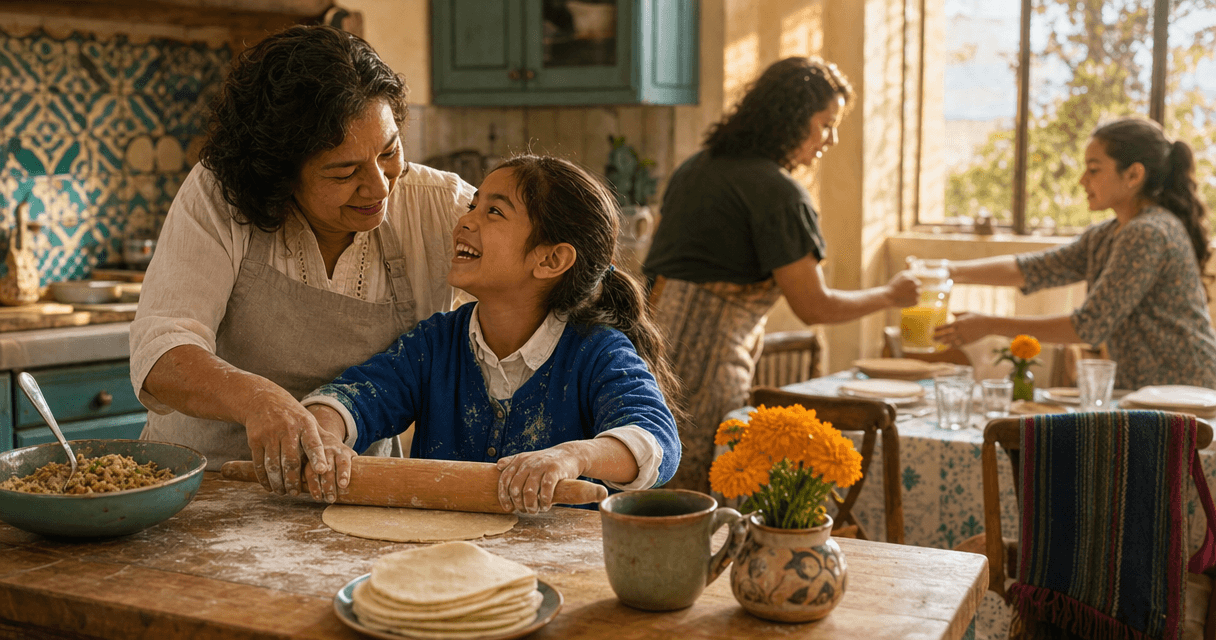
Family gatherings are one of the most powerful opportunities to reinforce Spanish learning during family gatherings. Research shows heritage languages are more notably used during family events, gatherings, cultural ceremonies and rituals, making these moments ideal for your child to practice Spanish in a context that feels natural, meaningful, and connected to family identity. When your child hears Spanish spoken by grandparents, aunts, uncles, and cousins, the language stops feeling like a school subject and starts becoming part of who they are.
Key takeaways
- Family gatherings provide natural, meaningful contexts where Spanish feels connected to identity and belonging, not just schoolwork.
- Grandparents play a central role in encouraging heritage language transmission and maintenance, making their presence at gatherings especially valuable.
- Simple strategies like cooking together, sharing family stories, and creating Spanish-only moments can reinforce language skills without pressure.
- Efforts to transmit cultural heritage positively predict successful heritage language maintenance, so pairing Spanish with traditions strengthens both language and connection.
- Consistency matters more than perfection — even small, repeated Spanish interactions at family events build confidence over time.
Why family gatherings matter for Spanish learning
Your child may practice Spanish in class or at home, but family gatherings offer something structured learning cannot replicate: real conversation with people they love.
Linguistic connection opens doors to family relationships, cultural celebrations, and intergenerational conversations, creating lasting memories and a deep sense of belonging. When your child asks abuela for a second helping in Spanish, or laughs at a cousin's joke told in Spanish, the language becomes tied to warmth, joy, and family — not just vocabulary drills.
These gatherings also give your child a chance to hear Spanish spoken in different accents, registers, and contexts. One aunt may speak quickly, another may use regional expressions, and grandparents may tell stories using words your child has never heard in class. That variety builds listening skills and cultural fluency in ways a single teacher or app never could.
Create Spanish-only moments within the gathering
You do not need to enforce Spanish for the entire event. Instead, carve out specific moments where Spanish is the language of choice.
Cooking together
Invite your child to help prepare a family recipe with a Spanish-speaking relative. Cooking is hands-on, conversational, and full of opportunities to practice vocabulary. Your child can ask for ingredients, follow instructions, and talk about what they are making — all in Spanish.
Cooking traditional recipes together and discussing them in the native tongue pairs language practice with cultural learning. The kitchen becomes a classroom where your child learns both how to make empanadas and how to ask for la masa or el relleno.
Storytelling time
Ask grandparents or older relatives to share family stories in Spanish. These do not need to be formal or long. Even a five-minute story about growing up in another country, a funny childhood memory, or how a family tradition started can captivate your child and give them rich listening practice.
If your child does not understand every word, that is okay. The goal is exposure, connection, and context. You can gently translate or clarify afterward, but let the story unfold in Spanish first.
Games and activities in Spanish
Bring a simple Spanish-language game to the gathering — a card game like Lotería, a board game with Spanish instructions, or even a scavenger hunt where clues are written in Spanish. Games lower the pressure and make Spanish feel playful.
Your child will practice listening, reading, and speaking without realizing they are working. And when cousins or siblings join in, the language becomes a shared experience, not a solitary task.
Lean on grandparents and extended family
Grandparents played a central role in encouraging heritage language transmission and maintenance, with strong correlations observed between parental efforts and children's ability to communicate with extended family. If your child has Spanish-speaking grandparents, aunts, uncles, or older cousins, they are your greatest allies.
Before the gathering, let these relatives know you are working on Spanish with your child. Ask them to speak Spanish directly to your child, even if your child answers in English at first. Encourage them to be patient and warm, not corrective.
Many children respond to Spanish more willingly when it comes from someone other than their parents. A grandparent's request feels less like a lesson and more like a conversation. That shift in dynamic can make all the difference.
Pair Spanish with cultural traditions
Efforts to transmit cultural heritage positively predict successful heritage language maintenance. When Spanish is tied to something your child already loves — a holiday, a meal, a song, a dance — the language becomes inseparable from the experience.
Celebrate in Spanish
If your family celebrates Día de los Reyes, Navidad, Quinceañeras, or other cultural events, make Spanish part of the celebration. Sing songs in Spanish, say toasts in Spanish, or explain the meaning of the tradition in Spanish.
Your child will associate Spanish with joy, pride, and belonging. Those emotional connections make the language stick.
Share family history
Talk about where your family is from, why you speak Spanish, and what the language means to your family's identity. Let your child hear stories about their great-grandparents, the town where you grew up, or the reasons your family came to the United States.
These conversations give Spanish a sense of purpose. Your child is not just learning a language. They are learning their family's story.
Make space for imperfect Spanish
Your child may mix English and Spanish, make grammar mistakes, or hesitate before answering. That is normal and expected.
Correction should always be subtle so that a child doesn't feel inhibited. If your child says something incorrectly, gently model the correct phrase in your response without calling out the error. The goal is to keep them talking, not to make them self-conscious.
Family gatherings should feel safe and encouraging. If your child senses judgment or frustration, they will stop trying. If they feel celebrated for every attempt, they will keep practicing.
Build consistency across gatherings
One family gathering will not make your child fluent, but many gatherings over time will build confidence and familiarity.
Make Spanish a regular part of family events. If your family gathers monthly, weekly, or even a few times a year, commit to incorporating Spanish into each one. Over time, your child will start to expect it, anticipate it, and even look forward to it.
Consistency also helps your extended family understand that Spanish is a priority for your household. When relatives see you making the effort gathering after gathering, they are more likely to support it and participate.
What to do if your family speaks mostly English
Not every family has native Spanish speakers at every gathering. If your extended family speaks mostly English, you can still create Spanish moments.
Bring a Spanish-speaking friend, invite a teacher, or connect with other Spanish-learning families in your community. You can also use technology — play Spanish music during the gathering, show a short Spanish video, or have your child share something they learned in Spanish class.
Even small exposures add up. Your child will see that Spanish is not confined to the classroom. It can exist anywhere you make space for it.
Why this matters for heritage families
For heritage families, Spanish is not just a skill. It is a bridge.
When your child can speak Spanish with abuela, they are not just practicing vocabulary. They are building a relationship. When they can understand a family story told in Spanish, they are not just listening. They are claiming their identity.
Family gatherings are where language, culture, and love come together. When you make Spanish part of those moments, you are giving your child something no app or worksheet ever could: a reason to speak.
If you want your child to build confidence and fluency with a dedicated teacher who understands how to make Spanish feel personal and exciting, Spanish For Us offers live 1-on-1 classes with native-speaking teachers. Every class is tailored to your child's level, interests, and goals — so Spanish becomes something they actually want to speak.
Sources
- Family language policy and heritage language transmission in Pakistan — Frontiers in Psychology, 2025
- The impact of heritage language on children's sense of belonging and connection to cultural heritage — Bianca Mister, PhD, 2023
- Resilient heritage language maintenance: the interplay of family, culture, and pragmatic choices — Frontiers in Psychology, 2025
- Bilingual Families — Children's Minnesota, 2024
- How Bilingualism Builds Stronger Family Connections — Jump Immersion School, 2026
Frequently Asked Questions
What if my child only answers in English even when relatives speak Spanish to them?
This is very common and does not mean your child is not learning. Keep the Spanish input consistent and patient. Over time, as your child's comprehension grows and they feel more confident, they will start responding in Spanish. Celebrate any Spanish words they do use, even if the rest of the sentence is in English.
How do I ask extended family to help without making it feel forced?
Frame it as a favor and explain why Spanish matters to your family. Let them know you are working on Spanish at home and their support would mean a lot. Ask them to speak Spanish naturally and warmly, not as a test. Most relatives feel honored to be part of their grandchild's or niece's language journey.
What if my family gatherings are loud and chaotic — is it still helpful for language learning?
Yes. Real-world Spanish is often loud, fast, and full of overlapping voices. Your child benefits from hearing Spanish in authentic contexts, even if they cannot catch every word. The exposure builds listening skills and helps Spanish feel like a living, social language.
Should I correct my child's Spanish mistakes during family gatherings?
Avoid direct correction in the moment. Instead, gently model the correct phrase in your response. For example, if your child says something incorrectly, repeat it back correctly as part of your reply. This keeps the conversation flowing and prevents your child from feeling self-conscious.
What if I am not fluent in Spanish myself?
You do not need to be fluent to support your child. Lean on Spanish-speaking relatives, use simple phrases you do know, and create opportunities for your child to interact with fluent speakers. Your role is to encourage and celebrate their efforts, not to be their teacher.
Ready to get your child speaking Spanish?
Book a free 1-on-1 class with a native-speaking teacher. No commitment, no credit card.
Try a Free Class