How Can Parents Use Games to Teach Spanish at Home?
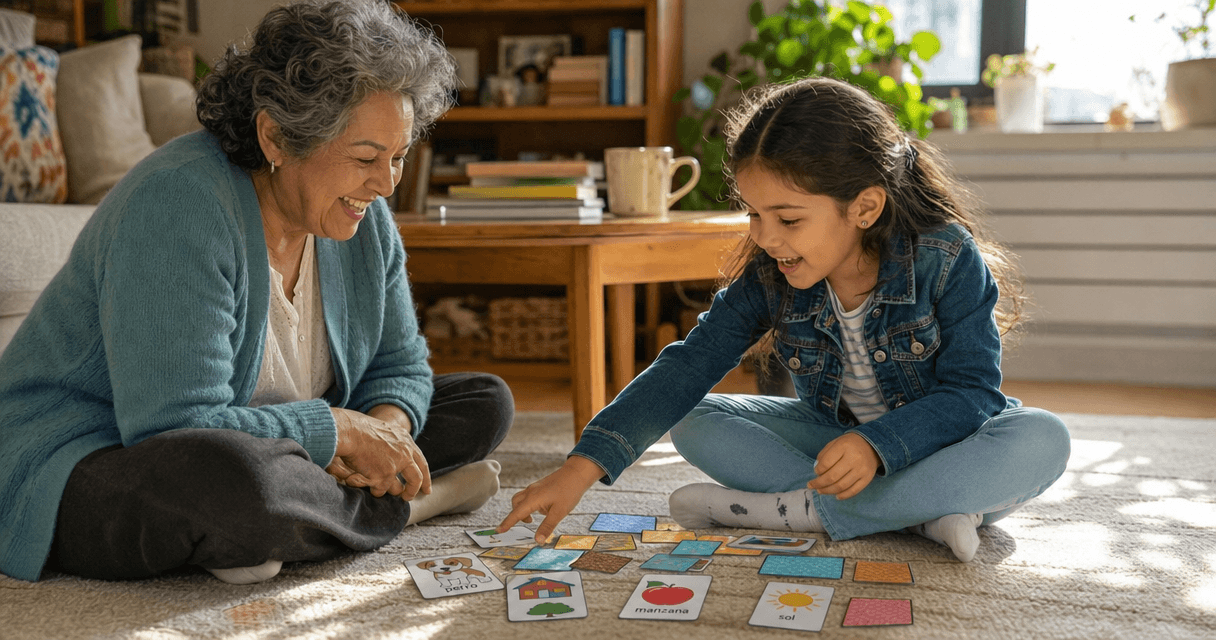
Spanish-learning games turn language practice into something your child looks forward to. When you use games to teach Spanish at home, your child builds vocabulary, practices speaking, and connects with their heritage—all while having fun. Games create a low-pressure environment where Spanish feels natural instead of forced.
Key takeaways
- Game-based learning has a moderate to large effect on cognitive, social, and engagement outcomes, making it ideal for language practice.
- Simple games like memory, charades, and Simon Says require minimal setup and teach vocabulary through play.
- Play establishes a favorable context for language learning by promoting peer-mediated interactions and imaginative repetition.
- Consistency matters more than long sessions—short daily games build fluency faster than occasional intensive study.
- Games help children practice Spanish without the pressure of formal lessons, reducing resistance and building confidence.
Why games work for Spanish learning
Your child learns best when they're engaged, curious, and having fun. Online games that involve reading, writing, and communication can help children develop their language skills and build their vocabulary. Games tap into that natural curiosity and make Spanish feel like play instead of work.
When your child is focused on winning a round of memory or acting out a verb in charades, they stop worrying about making mistakes. They start using Spanish because the game requires it, not because you told them to practice.
Children show eagerness and enthusiasm to learn a new language through play-based activities, experiencing no uncertainty or anxiety during participation in creative games. That confidence is what helps Spanish stick.
Simple Spanish-learning games you can start today
You don't need special materials or perfect Spanish to make games work. Here are five games that require almost no setup and teach real language skills.
Memory (Memoria)
Create pairs of cards with Spanish words and matching pictures, or Spanish words and their English translations. Lay them face down and take turns finding matches. Each time your child flips a card, they say the word out loud.
This game builds vocabulary recognition and recall. Your child hears the word, sees it written, and connects it to meaning—all in a single turn.
Spanish Simon Says (Simón Dice)
One person gives commands in Spanish starting with "Simón dice." Players follow the command only if it begins with "Simón dice." Use simple action verbs your child already knows: "Simón dice salta" (jump), "Simón dice toca tu cabeza" (touch your head), "Simón dice corre en círculos" (run in circles).
This game sharpens listening comprehension and helps your child connect Spanish words with physical actions. The movement makes the language memorable.
Charades (Adivina la Palabra)
Write Spanish verbs on slips of paper. One person draws a verb and acts it out silently while others guess in Spanish. Start with action verbs like "bailar" (dance), "nadar" (swim), "cocinar" (cook), "dormir" (sleep).
Charades encourages creativity and gets your child thinking in Spanish. They're not translating—they're connecting meaning directly to the word.
I Spy (Veo Veo)
One person says, "Veo, veo" (I spy). Others ask, "¿Qué ves?" (What do you see?). The first person gives a clue in Spanish: "Veo algo azul" (I see something blue) or "Veo algo en la cocina" (I see something in the kitchen).
This game practices colors, shapes, and everyday vocabulary using objects your child already knows. It makes Spanish part of your home environment.
Scavenger Hunt (Búsqueda del Tesoro)
Create a list of household items in Spanish. Your child searches the house and checks off each item as they find it, saying the word out loud. For younger children, use pictures alongside the words.
Scavenger hunts get your child moving, reading, and speaking Spanish. The physical activity keeps them engaged longer than sitting at a table.
How to make games a consistent habit
Consistency builds fluency. Ten minutes of Spanish games every day will do more for your child's language development than an hour-long session once a week.
Pick a time that already exists in your routine:
- After dinner while you're cleaning up
- During the car ride home from school
- Before bedtime as a wind-down activity
- On weekend mornings while breakfast is cooking
Keep game materials ready. A deck of homemade flashcards in a kitchen drawer or a jar of verb slips on the counter makes it easier to start without hunting for supplies.
Rotate games so your child doesn't get bored. Play memory on Mondays, charades on Wednesdays, and I Spy on Fridays. Variety keeps the practice fresh.
What to do when your child resists
Some children push back against Spanish practice, especially if they've had frustrating experiences before. Games can help repair that relationship.
Start with the games your child already loves. If they like drawing, try Pictionary in Spanish. If they love being silly, lean into charades. If they're competitive, make it a timed challenge.
Let your child win sometimes. The goal is building confidence and positive associations with Spanish, not perfect accuracy. Celebrate effort, not just correct answers.
If your child answers in English during a Spanish game, gently repeat their answer in Spanish and keep playing. Pressure kills curiosity. Patience builds it.
When games aren't enough
Games are powerful, but they work best alongside other Spanish experiences. Your child also needs to hear fluent Spanish speakers, practice real conversation, and see Spanish used in meaningful contexts.
If your child enjoys games at home but you want them to build conversational fluency, they need a teacher who can respond, correct gently, and keep them engaged week after week. That's where Spanish For Us comes in—live 1-on-1 classes with native-speaking teachers who know how to make Spanish feel personal, fun, and confidence-building.
Sources
- Game-based learning in early childhood education: a systematic review and meta-analysis — Frontiers in Psychology, 2024
- Game-based learning in early childhood education: a systematic review and meta-analysis — National Institutes of Health, 2024
- Second Language Acquisition through play in Early Childhood Education settings — Research about ECEC, 2024
Frequently Asked Questions
What if I don't speak Spanish fluently myself?
You don't need to be fluent to play Spanish games with your child. Start with simple vocabulary games using flashcards, online resources, or apps that provide pronunciation. Your child will benefit from your effort and enthusiasm, even if your accent isn't perfect. Many families successfully support Spanish learning at home while learning alongside their kids.
How long should each game session last?
Keep game sessions short—10 to 15 minutes is ideal for younger children, and 20 to 25 minutes works for older kids. Frequent short sessions build fluency faster than occasional long ones. Stop before your child gets bored or frustrated so they look forward to the next round.
What if my child only wants to answer in English?
This is completely normal and doesn't mean the games aren't working. Gently repeat their English answer in Spanish and keep playing. Over time, as their confidence builds, they'll start using more Spanish. Avoid pressuring them to respond in Spanish—let the game create natural opportunities for them to try.
Can games replace formal Spanish lessons?
Games are a powerful supplement but work best alongside other Spanish experiences like conversation with fluent speakers, reading, and listening. Games build vocabulary and confidence, but your child also needs real dialogue and feedback from someone who can respond naturally and correct gently.
How do I know which games are right for my child's level?
Start with games that use vocabulary your child already recognizes, then gradually introduce new words. If a game feels too hard, simplify it—use fewer cards, give visual clues, or let your child peek at a word list. If it's too easy, add a timer, increase the vocabulary set, or require full sentences instead of single words.
Ready to get your child speaking Spanish?
Book a free 1-on-1 class with a native-speaking teacher. No commitment, no credit card.
Try a Free Class