Stay or Step Away During Your Child's Online Spanish Class?
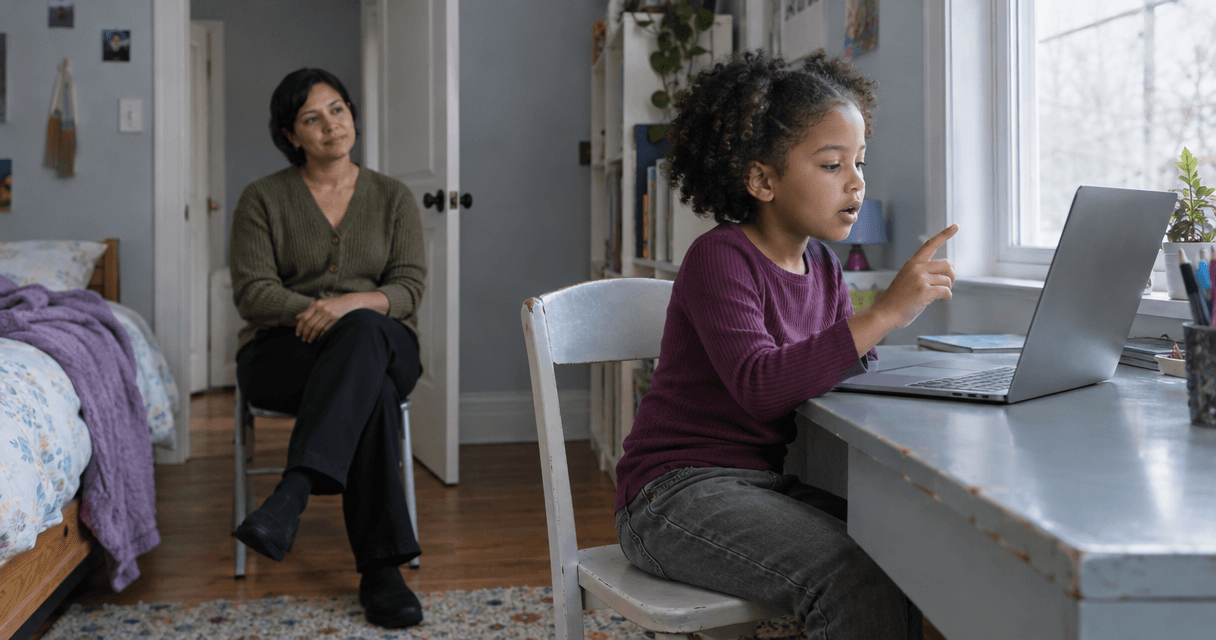
Stay beside your child when they need help joining the activity, step back when they respond directly to the teacher, and return briefly when a specific problem interrupts participation. For the question “should parents sit in on online classes,” use this practical starting point: offer the smallest amount of help your child needs while letting the teacher lead. Agree on that approach together before class.
Key takeaways
- Start nearby and agree with the teacher on when you should help.
- Watch for direct responses to the teacher before trying a little more distance.
- Leave Spanish answers and corrections to the teacher unless they request your help.
- Return for a specific problem, then reassess whether your child still needs you beside them.
- Compare participation across classes before changing your arrangement permanently.
Agree on your role before class begins
Tell the teacher what you plan to do: “I’ll sit nearby at first and stay quiet. Please let me know when you’d like me to help or move back.” Tell your child where you will be and how to call you over.
For younger children, NAEYC’s guidance on adjusting adult support recommends providing enough assistance for the task, then reducing it as competence grows. Applying that principle to your seat during online Spanish is a practical adaptation, rather than a tested seating rule.
Choose a manageable starting position
Try a chair beside your child but slightly behind the screen. Keep the mouse within your child’s reach, and agree that you will handle technical trouble if needed.
Avoid setting a deadline such as “By the third class, you must do this alone.” Instead, ask the teacher what participation to watch for before changing your position.
Watch what happens before you prompt
During an activity, quietly observe who your child responds to and what happens during a pause. Use these questions as an informal checklist, without turning class into a scorecard:
- Does your child respond to the teacher with words, pointing, or a gesture?
- Does your child wait for you to whisper an answer before trying?
- When the teacher offers a picture or example, does your child rejoin?
- Can your child signal confusion directly to the teacher?
Record concrete observations afterward, such as “Pointed to the picture without my help.” Avoid broad labels such as “unfocused” or “bad at listening.” Ask the teacher how those moments fit the activity’s goal.
Give the teacher room to respond
If your child pauses, hold back your own answer and watch what the teacher does next. In its classroom guidance on children’s agency, NAEYC encourages adults to pause before jumping in to help; that guidance concerns classroom participation, rather than online Spanish specifically.
For your class, agree that the teacher gets the next turn after a hesitation. Avoid treating every silence as your cue to intervene.
Stay nearby when your help has a clear purpose
Consider staying beside your child if they ask for reassurance, need help operating the device, or repeatedly leave the activity and cannot rejoin with the teacher’s support. Name the job you are doing: “I’m here to help with the sound.” Keep checking whether that job still requires you beside them.
Separate practical help from supplying answers
Imagine the teacher displays two animal pictures and asks your child to choose. If your child looks toward you, resist pointing to the correct picture or mouthing its name. Let the teacher repeat, demonstrate, or simplify the choice.
If the teacher requests your help, give the agreed cue once: “You can show your teacher.” Then stop speaking and let your child take the next turn. Save translation and pronunciation coaching for situations where the teacher specifically asks you to contribute.
A Stanford study of parent involvement found an association between frequent adult intervention during already-engaged activity and greater self-regulation difficulties in young children. It did not establish that sitting nearby causes problems or test online Spanish classes; use it as a reason to examine unnecessary prompting, without feeling guilty about offering needed help.
Step back when the exchange continues without you
Try more distance when your child responds directly to the teacher, accepts the teacher’s help, and continues without checking your face before every answer. Choose a familiar activity for your first attempt. Tell your child what you are doing rather than slipping away.
Change one thing at a time
First, try staying in the same chair while dropping your verbal reminders. If the exchange continues, move to another chair in the room during a later activity. Only consider moving outside the room when your child and teacher are comfortable with that arrangement.
Use a simple explanation: “I’ll be by the doorway. You can call me if you need help.” Remain available and maintain appropriate supervision; stepping back from teaching does not mean leaving your child without support.
If your child turns toward you after you move, pause before returning. Let the teacher invite them back into the activity, while staying responsive if they ask for you.
Return briefly when participation breaks down
Return for an identifiable problem: lost audio, an inaccessible control, a request from the teacher, or visible distress. Describe the issue calmly: “The sound stopped,” or “You’re upset; let’s pause.” Avoid adding a Spanish quiz while you troubleshoot.
Once the problem is resolved, ask whether your child wants you nearby for the next activity. If distress continues, discuss a break or ending early with the teacher. Keep comfort and participation ahead of completing a planned step away.
Afterward, write one short note: “Moved to the doorway during the picture activity; returned when the microphone stopped working.” Ask the teacher whether your child participated differently with you farther away. Choose the next arrangement together, allowing for days when more support is useful.
At Spanish For Us, use your first class to discuss what helpful parent involvement could look like for your child. You can book a free class and bring one clear question: “What should I watch for before I move back?”
Sources
- DAP: Teaching to Enhance Each Child’s Development and Learning — National Association for the Education of Young Children.
- Can I Help You? Supporting Equity, Learning, and Development by Allowing Children to Help Out — National Association for the Education of Young Children, 2023.
- Stanford-led study highlights the importance of letting kids take the lead — Stanford Report, 2021.
Frequently Asked Questions
What if I don't speak enough Spanish to understand the class?
Focus your observations on who your child responds to and whether they can ask the teacher for help. After class, ask the teacher to explain the activity’s goal and describe one thing your child did independently. Leave judgments about Spanish accuracy to the teacher.
What if I need to work while my child is in class?
Tell the teacher beforehand how available you will be, and arrange for a responsible adult to respond if needed. Try your nearby-work arrangement while you can still interrupt your task. If your child needs frequent hands-on help, reconsider the timing or available support before relying on that setup.
Should a sibling sit beside my child instead of me?
Ask the teacher before including a sibling, and avoid assigning the sibling responsibility for supervision or supplying answers. If your child wants company, consider having the sibling join the greeting and then leave the activity. Keep an adult available for practical help.
What if my child uses accommodations or assistive technology?
Plan your role around those supports with the teacher before changing where you sit. Specify which tasks require adult assistance and which your child wants to handle independently. Keep needed accommodations in place while experimenting with less verbal prompting.
Ready to get your child speaking Spanish?
Book a free 1-on-1 class with a native-speaking teacher. No commitment, no credit card.
Try a Free Class